



Quarterly earnings grabbed much of the attention for gaming investors last week amid a flurry of reports. It was an overall disappointing week, though, and the Roundhill Sports Betting & iGaming ETF, which invests in a basket of gaming companies, closed in the red, even as the S&P 500 Index rose 3.6% and had its best week since April.
Corsair Gaming and Genius Sports were among the major gainers last week, while Playtika Holdings and Flutter Entertainment were among the major losers.

Biggest Gainers
Corsair Gaming (NYSE: CRSR) +35.25%
With a gain of over 35%, Corsair Gaming was by far the biggest gainer in our coverage of gaming stocks last week. These gains were predominantly seen on Friday as markets gave a thumbs-up to the company’s Q2 earnings. The company’s revenue dipped 2% year-over-year (YoY) to $314.3 million, but the metric came in ahead of Street estimates.
Meanwhile, the company’s profitability blew past Wall Street expectations, with adjusted EPS of $0.23, more than double the consensus estimate. Moreover, the company posted a GAAP profit of $9.1 million in the quarter, compared with a loss of $20.3 million in the corresponding quarter last year.
The company also raised its annual guidance for both the top line and the bottom line. For revenues, it raised the low end of its guidance to $1.40 billion from $1.33 billion, while keeping the top end unchanged at $ 1.47 billion. It also raised its adjusted EPS guidance to between 85 cents and 94 cents, while the previous forecast called for that metric to land between 58 cents and 74 cents.
Notably, CRSR stock is up over 141% for the year, in part due to optimism about its artificial intelligence (AI) endeavors.
Genius Sports (NYSE: GENI) +9.52%
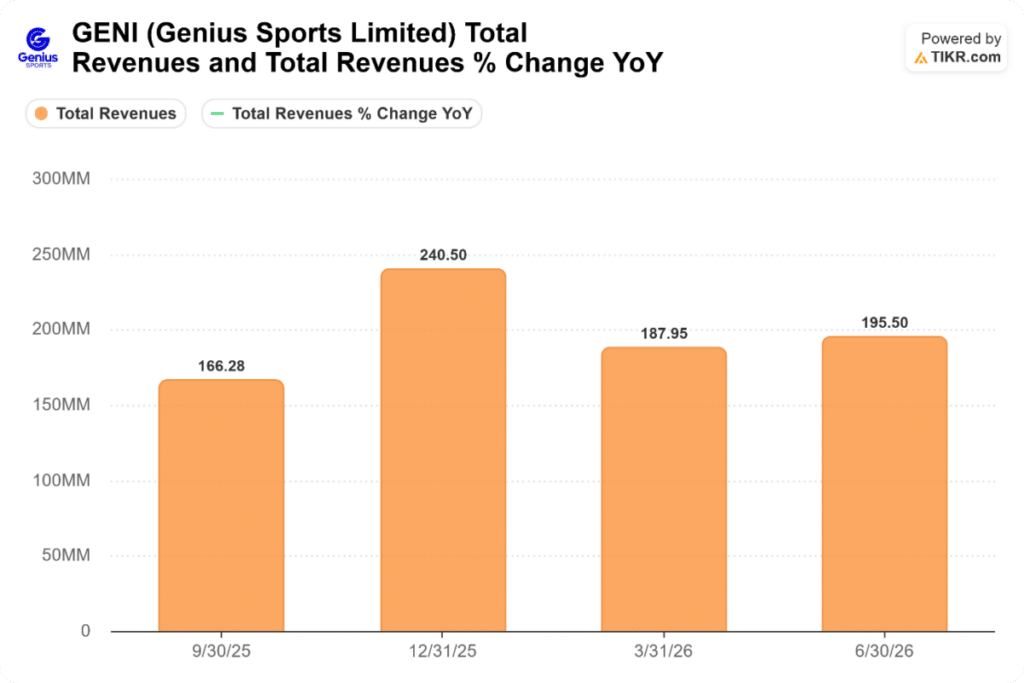
Genius Sports reported its Q2 earnings last week and generated revenues of $196 million in the quarter, up 65% YoY and ahead of its guidance of $185 million. Its adjusted EBITDA came in at $53 million versus its guidance of $45 million. After the strong Q2 performance, Genius raised its annual guidance and now expects to post revenues between $1.005 billion and $1.025 billion, up from the previous range of $990 million to $1.010 billion. It also increased its annual adjusted EBITDA guidance to $285 million – $ 295 million, up from the $270 million – $280 million it previously guided for.
In his prepared remarks, Mark Locke, Genius Sports Founder and CEO, said, “We continue to realize the benefits of the infrastructure we’ve spent years building. Advertisers are placing greater value on our combination of official data and audience, prediction markets are opening an entirely new avenue for growth, and our core Betting business continues to outperform.”
Light & Wonder (ASX: LNW) +8.77%
Light & Wonder‘s stock rose nearly 9% last week, helping it trim its YTD loss to about 21%. Like with CRSR and GENI, LNW’s rally last week was driven by the market’s reaction to its Q2 earnings.
The company’s consolidated revenue rose 2% YoY to $828 million, while adjusted EBITDA expanded 9% to $383 million. Its adjusted free cash flow surged 50% YoY to $156 million.
Moreover, LNW’s recurring revenue grew to $580 million, representing 71% of total revenue in the quarter. Investors rewarded this shift toward a more predictable, high-quality earnings base over cyclical hardware sales.
Biggest Losers
Playtika Holdings (NYSE: PLTK) -26.32%
Playtika Holdings lost over a quarter of its market cap last week and was by far the biggest loser in our coverage. Notably, the stock was among the major gainers in the preceding two weeks amid rumors that the company is in talks with Chinese tech giant Tencent to sell the Israeli gaming studio SuperPlay for up to $1.5 billion.
Talking of Q2 earnings, Playtika’s numbers were largely in line with estimates, but its guidance spooked investors. The management said that full-year 2026 revenue and adjusted EBITDA are now expected to track toward the lower end of their previously guided ranges. The company blamed softening consumer sentiment driven by inflationary pressures on discretionary spending.
Playtika also announced plans to cut second-half marketing spend for SuperPlay titles (such as Disney Solitaire) by up to 70% relative to the first half of the year. Markets are concerned over whether recent revenue growth, especially from newer titles, can be sustained once marketing support is drastically pulled back.

Flutter Entertainment (NYSE: FLUT) -9.31%
Flutter Entertainment continued its dismal run and fell over 9% last week to extend its YTD loss to 56%. While its Q2 revenues were slightly ahead of Street estimates, its EPS came in at 49 cents, which fell well short of estimates.
It also lowered full-year U.S. revenue and EBITDA forecasts. The lower guidance reflects softer U.S. sports betting growth, higher promotional spending to defend FanDuel’s market share, and heavy investments in new offerings like prediction markets.
Notably, FanDuel is Flutter’s most important business, but it has lost market share in the U.S. Commenting on that business, CEO Peter Jackson admitted that, “We didn’t execute very well last year.”
The company said that it would shift FanDuel Predicts sports and novelty contracts to Crypto.com from CME. “This new exchange arrangement will ensure we can deliver new products at pace ahead of the NFL season start,” said Jackson during the earnings call.
Incidentally, Flutter also announced a leadership transition, stating that Jackson would depart at the end of this quarter. He will be succeeded by Dan Taylor, who is currently heading the company’s international business.
Rush Street Interactive (NYSE: RSI) -7.54%
Rush Street Interactive fell over 7% last week despite an otherwise stellar Q2 earnings. Its revenues rose 46% YoY to a record $393.8 million, beating consensus estimates. The EPS was in line with estimates, but the company raised its annual revenue guidance to between $1.56 billion and $1.60 billion.
The management, however, cautioned that profit margins are expected to hit their annual low in Q3 while revenue growth is expected to be similar to Q2. The company is ramping up user acquisition and marketing spend by up to $10 million in Q3 to support new regional rollouts, such as its launch in Alberta, Canada.
Meanwhile, while these investments would be a drag on Q3 numbers, it expects revenues and EBITDA to rise significantly in the final quarter of the year.
Major Gaming Industry Developments
Reports suggest that Polymarket is in early talks to raise approximately $1 billion in a new funding round, which would value the prediction markets platform at over $20 billion. The company’s most recent funding round was reportedly in April, which valued it at $15 billion. In comparison, rival Kalshi was valued at $22 billion in its May funding round, and the company is reportedly looking to raise funds at a $40 billion valuation in the current quarter.
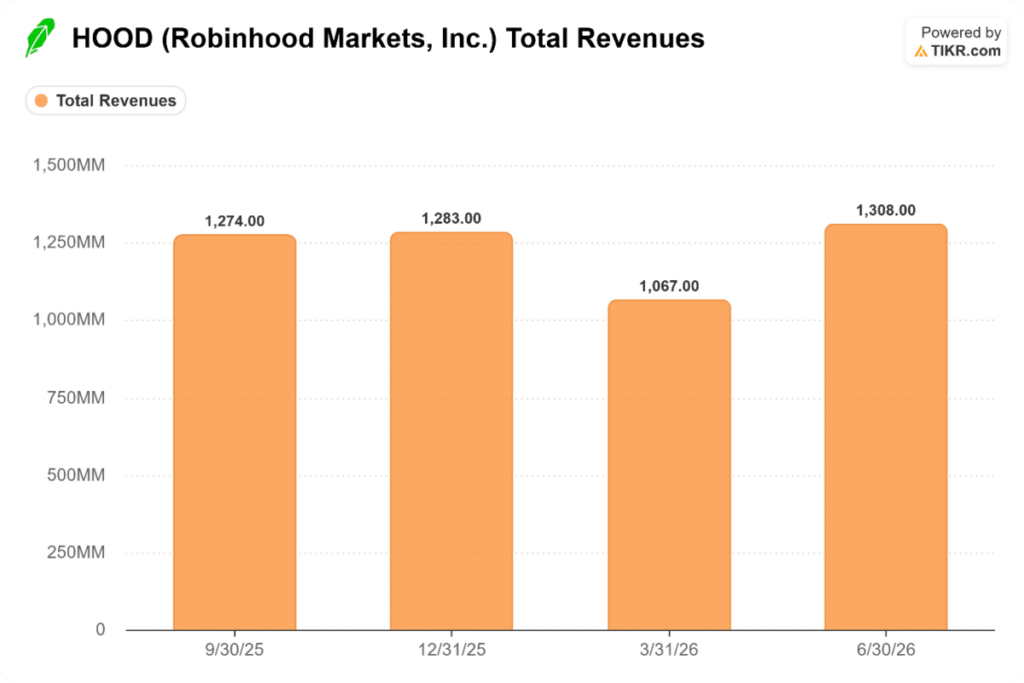
Notably, the Q2 earnings season is a testament to the explosive growth the prediction market industry is experiencing. For instance, Robinhood and Coinbase were able to somewhat offset the “crypto winter” through their event-contract business. For instance, Robinhood’s event contract revenues came in at $156 million in Q2, well ahead of the $100 million its cryptocurrency business generated. Coinbase’s Q2 prediction markets revenue grew in triple digits on a quarter-over-quarter basis and is now running at an annualized rate of over $100 million.
DraftKings said that the annualized volume for its predictions business has risen to $11 billion, up from $2.3 billion in April. Over 600,000 customers have used DraftKings’ prediction offering so far, and the company expects that number to get into the millions this NFL season.
Looking at other developments, Polymarket officially partnered with the ATP Tour last week to become the official prediction market provider for the men’s professional tennis circuit. The agreement, struck via Tennis Data Innovations (TDI), grants Polymarket exclusive streaming rights in the prediction-market category. Registered U.S. users can stream live matches directly on the platform while participating in real-time markets.
Novig officially launched its sports prediction market nationwide following its designation from the Commodity Futures Trading Commission (CFTC) as a Designated Contract Market (DCM). Meanwhile, a day before the rollout, it sued New York in an apparent bid to preempt any state regulatory crackdown, given the state’s history of targeting prediction market platforms.
Macau released comprehensive H1 non-gaming visitor spending metrics. The data showed that total revenues rose 17.1% to $5.51 billion and is an indication that business is stabilizing following the slump during the FIFA World Cup.