


The Fibonacci betting system is a popular progressive strategy used in casino games and betting to manage stakes during losing and winning streaks. Based on a simple numerical sequence, it increases bets in a controlled way rather than relying on aggressive doubling methods.
In this guide, you’ll learn how the Fibonacci sequence in gambling works step by step, see practical betting examples, explore its advantages and disadvantages, and explain the risks players should understand before using it in real-money play.
Key Beats
- The Fibonacci betting system raises your bet after each loss following the famous numerical sequence (1, 1, 2, 3, 5, 8…), then moves one step back after a win to recover losses gradually.
- It works best on even-money bets in games like roulette, baccarat, or craps, where outcomes are close to 50/50.
- The Fibonacci system may be safer than Martingale, but losing streaks and table limits can still crush your bankroll.
What Is the Fibonacci Betting System?
The Fibonacci betting system is a negative progression betting strategy that adjusts your stake based on previous results. Instead of doubling bets after a loss, the system follows the Fibonacci sequence (1, 1, 2, 3, 5, 8…) to increase wagers gradually, helping players manage risk in a more controlled way.
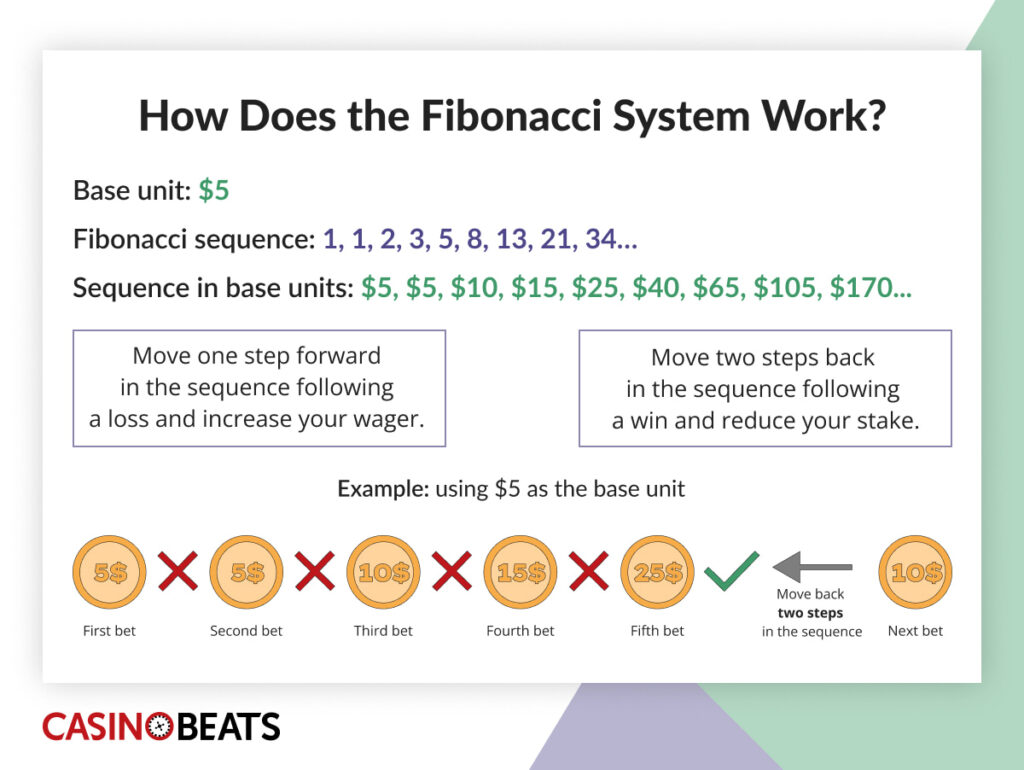
The core idea is simple: after each losing bet, you move one step forward in the sequence, increasing your stake slightly. After a win, you move two steps back, reducing the bet size while aiming to recover earlier losses over time.
This structure is why many players in real-money casinos see the Fibonacci betting system as a more balanced alternative to aggressive strategies like Martingale.
The Fibonacci betting strategy is most commonly used on even-money or near-even-money bets, such as roulette (red/black, odd/even), or baccarat (banker/player). While it does not eliminate the house edge, the Fibonacci betting system provides a clear staking framework that helps players stay disciplined and avoid emotional betting decisions.
How Does the Fibonacci System Work
The Fibonacci betting strategy is structured, easy to track, and often appeals to beginners who want a more controlled betting rhythm. Here’s a simple, practical breakdown of how does fibonacci work in betting.
- Choose a unit size
Decide on a fixed betting unit before you start, such as $5 or $10. Every wager is placed in multiples of this unit, which helps you stay consistent and avoid impulsive bet sizes.
- Start at the beginning of the Fibonacci sequence
Use the sequence 1, 1, 2, 3, 5, 8… Each number represents how many units you bet. For example, with a $5 unit, a “3” means a $15 bet.
- Increase after a loss
When a bet loses, move one step forward in the sequence and place the next bet using the new number of units. This gradual increase aims to recover losses without huge jumps.
- Step back after a win
After a winning bet, move two steps back in the sequence. This reduces your stake and helps lock in gains, rather than risking them immediately.
- Repeat the process
Continue following the sequence until you return to the starting point or reach a preset stop point, such as a profit goal or loss limit.
And that’s it! Simple, easy to use, and structured. Do note that the Fibonacci system doesn’t change the odds, but it helps structure your betting and keep emotions in check.
Examples of the Fibonacci Sequence in Gambling
In this example, one unit equals $1, and all bets are placed on an even-money outcome. After each loss, the bet moves one step forward in the Fibonacci sequence. After a win, it moves two steps back.
| Bet Number | Fibonacci Number | Bet Amount ($) | Result | Profit/Loss ($) |
|---|---|---|---|---|
| 1 | 1 | $1 | Loss | -$1 |
| 2 | 1 | $1 | Loss | -$2 |
| 3 | 2 | $2 | Loss | -$4 |
| 4 | 3 | $3 | Loss | -$7 |
| 5 | 5 | $5 | Win | -$2 |
| 6 | 2 | $2 | Win | $0 |
In this example, two consecutive wins are enough to recover the previous losses and return to break-even, which shows how the Fibonacci betting strategy aims to gradually recoup losses rather than recover them in a single bet.
Where to Use the Fibonacci Betting System
The Fibonacci betting system is designed for bets with simple win-or-lose outcomes and stable odds. For that reason, it works best in games where payouts remain consistent and results are close to even, allowing the sequence to progress in a predictable way.
Below are the most common games where players apply the Fibonacci system, along with important considerations for each.
Roulette
The Fibonacci roulette strategy is one of the roulette strategies that works best on outside bets, such as Red/Black, Odd/Even, or 1–18/19–36. These bets offer close-to-even payouts, which makes the Fibonacci sequence easier to follow. Roulette’s predictable outcomes and simple layout make it the most practical game for beginners in online casinos testing Fibonacci betting, though long losing streaks can still increase wager sizes rapidly.
Blackjack
Applying Fibonacci betting system to blackjack is possible but more challenging. While single hands have near-even odds, options like splits, doubles, and surrenders complicate the sequence. For beginners, it is best to stick to simple hands without additional actions to keep progression consistent.
Baccarat
Baccarat is well-suited for Fibonacci strategy, especially on Banker or Player bets, which offer low house edges and predictable outcomes. Avoid Tie bets, as their high house edge can disrupt the system’s progression. This makes baccarat a popular alternative to roulette for even-money betting strategies.
Craps
In craps, the Fibonacci sequence betting can be applied to bets such as Pass Line / Don’t Pass Line or Come / Don’t Come. These bets provide simple win/lose outcomes suitable for progression. However, the pace of the game and multiple betting options require careful tracking and discipline to maintain the sequence correctly.
Sports Betting
The Fibonacci betting strategy can be used in sports betting for even-money wagers, such as coin-toss style bets or point spreads with roughly 50/50 odds. Keep in mind that changing odds, bookmaker margins, and market volatility can affect progression, making it less reliable than in fixed-payout casino games.
Other Table Games
Any table game with clear win-or-lose bets can theoretically accommodate the Fibonacci system. Games like Casino War are simple examples. Regardless of the game, the house edge remains, and long losing streaks can still escalate bet sizes quickly, so careful bankroll management is essential.
Fibonacci Betting System Variations: How to Adapt the Sequence for Different Strategies
The classic Fibonacci system follows a fixed pattern, but many players tweak it to better suit their style or the game they’re playing. These fibonacci strategy variations work to help manage risk and pace the bets. They do not guarantee wins nor eliminate the house edge, regardless of the version.
Reverse Fibonacci
This variant flips the traditional approach. You increase your bet after a win and reduce it after a loss.
Pros: Can build profits during winning streaks.
Cons: A sudden loss can wipe out recent gains.
Best for: Short sessions and momentum-style play.
Modified Fibonacci
Instead of starting at 1, 1, like the usual Fibonacci, you begin higher (for example: 2, 3, 5).
Pros: Helps you recover faster after small losing streaks.
Cons: You take higher risk sooner.
Best for: Players with larger bankrolls.
Partial Progression
You limit how far the Fibonacci sequence in gambling can grow or skip steps after several losses.
Pros: Reduces pressure on your bankroll during bad runs.
Cons: Slower recovery of losses.
Best for: Conservative players.
Hybrid Systems
Hybrids are a mix of the Fibonacci betting system with Martingale or D’Alembert.
Pros: Flexible and customizable.
Cons: More complex and risky if misunderstood.
Practical tip: These variations work best in even-money games like roulette or baccarat. Always set strict bankroll limits as adaptations don’t remove losing streaks or the house edge.
Advantages of Using the Fibonacci Betting Strategy
The Fibonacci system offers multiple advantages in addition to making gameplay feel more controlled.
- Easy to understand and follow: The Fibonacci sequence is straightforward, so you don’t need math skills or experience to use it correctly.
- Slower stake increases: Your bets rise gradually after losses, which helps avoid the huge bankroll spikes in riskier systems like Martingale.
- Built-in recovery approach: Moving two steps back after a win allows you to recover losses steadily instead of chasing them.
- Promotes disciplined betting: Following a set sequence reduces the likelihood of emotional decisions and impulsive wagers.
- Suitable for simple games: It works best in even-money games like roulette, baccarat, or blackjack side bets, where outcomes are clear.
Pitfalls of the Fibonacci System in Gaming
The Fibonacci betting system is arguably more forgiving than some alternate progressive strategies. However, it comes with its own set of risks:
- Losing streaks add up: Even a modest losing run can quickly push the cost of your bets up. If you are on the edge of your ‘spending limit’ and ‘just one more bet’ will recover your losses, it’s tempting to make that bet. However, you could lose again.
- Table limits: Every casino has maximum bet limits, which may prevent you from completing the sequence.
- Slower recovery: Since the bet increases are more gradual, it can take multiple wins to get back to where you started, especially after longer losing streaks.
- False sense of control: Because the Fibonacci betting system feels ‘calculated,’ some players may chase losses longer than they should.
- You need more than one win: After a long losing streak, you will need more than one win to return to where you started.
Look at this scenario. The player loses six bets and wins on bet 7. Even so, the player is still down:
| Bet Number | Bet Amount ($) | Result | Cumulative Loss/Profit ($) |
|---|---|---|---|
| 1 | $5 | Loss | -$5 |
| 2 | $5 | Loss | -$10 |
| 3 | $10 | Loss | -$20 |
| 4 | $15 | Loss | -$35 |
| 5 | $25 | Loss | -$60 |
| 6 | $40 | Loss | -$100 |
| 7 | $65 | Win | -$35 |
At bet six, the player is down $100. That’s a sizable deficit if you are playing a $5 bet.
The Fibonacci betting system can be enjoyable for short sessions, but it does not overcome the house edge. Long losing streaks still carry risk, and players often end up playing catch-up. Use the Fibonacci betting sequence responsibly and with a controlled bankroll.
Fibonacci Betting Strategy vs. Other Similar Betting Systems
Fibonacci is one of several negative progression betting systems, meaning your bets increase after losses. While there are numerous systems available, how do they compare? Here’s a simple comparison of Fibonacci and other popular systems, focusing on risk and overall value.
| System | Method | Risk Level | Value |
|---|---|---|---|
| Fibonacci | Bets increase gradually after losses by following the Fibonacci sequence (1, 1, 2, 3, 5…). | Moderate | Slower recovery with less pressure on your bankroll, but smaller short-term gains. |
| Martingale | You double your bet after every loss until you win. | High | It can produce quick wins, but a short losing streak can wipe out your bankroll fast. |
| Labouchère | Bets are based on a preset number sequence that changes after wins and losses. | Moderate | More flexible than Martingale, but can still get risky during long losing runs. |
5 Tips for Best Use of the Fibonacci Betting System
The Fibonacci betting system is easy to learn, but a little discipline works even better. Below, we’ve highlighted tips to help you use the system more efficiently, responsibly, and avoid common mistakes.
- Start small: Choose a unit size that feels comfortable and won’t stress your bankroll. Starting small gives you room to follow the sequence properly, even during a losing streak.
- Stick to even-money bets: The Fibonacci system works best on even-money bets, such as red/black, odd/even, or banker/player. These bets keep the progression simple and more predictable.
- Track your sequence carefully: Always keep track of your position in the Fibonacci sequence. Losing track can lead to betting too much or jumping ahead when you shouldn’t.
- Set clear win and loss limits: Decide in advance how much you’re willing to win or lose in a session. Once you hit that limit, stop playing and lock in your result.
- Stay disciplined and patient: Don’t rush, chase losses, or change the system mid-game. Staying calm and consistent is the best way to enjoy the Fibonacci betting system responsibly.
Conclusion
No system can beat the house edge. In the long run, the casino always wins. The Fibonacci betting sequence may offer structure, but it does not change the house edge.
Don’t gamble what you can’t afford to lose, whether using the Fibonacci betting strategy or any other system. You might get lucky, but statistically, your luck will eventually run out. Treat the casino as paid entertainment and enjoy it.
FAQs
-
What is the Fibonacci betting system?
It’s a popular betting method where you increase your bet after a loss using the Fibonacci number sequence to try to recover losses gradually.
-
What is the 61.8% Fibonacci level?
It’s a part of Fibonacci retracements, a popular concept from trading, not gambling. It has no real impact on casino gaming.
-
Is the Fibonacci strategy profitable?
No strategy guarantees profit. It can manage your bets, but the house edge still applies.
-
Can the Fibonacci system be used in roulette?
Yes, it’s often used for even-money bets like red/black or odd/even, with stakes increasing based on the sequence after losses.
-
What is the Fibonacci sequence?
A number series where each value equals the sum of the two before it: 0, 1, 1, 2, 3, 5, 8, 13, and so on.