


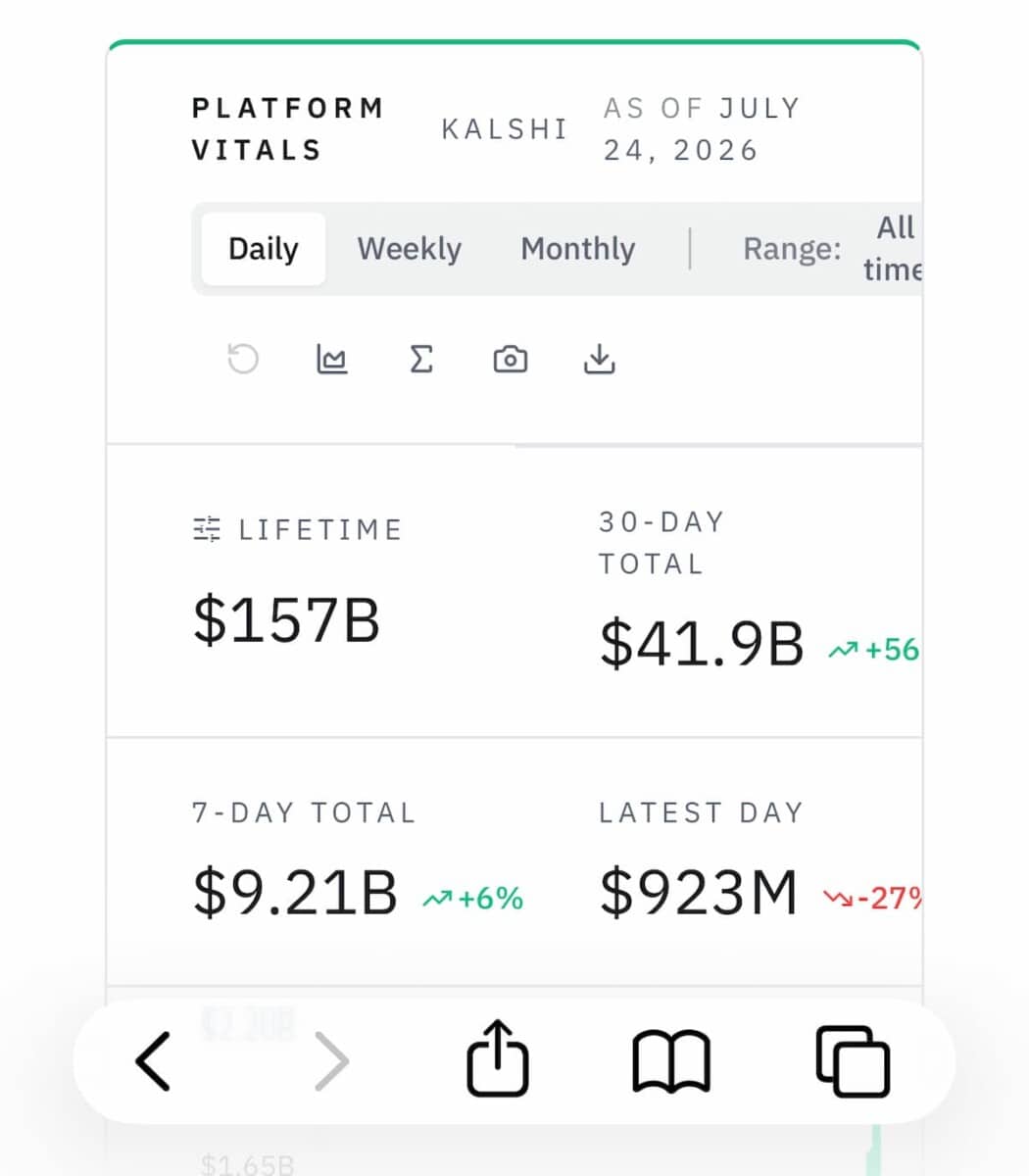
Prediction markets have grown exponentially since they began offering sports-event contracts last year. A new tool, Ticker Tracker, allows users to chart the rise, and the expectation is that the numbers will continue to grow.
“Like all good inventions, it was sort of born out of necessity,” Ticker Tracker founder Eric Ramsey told CasinoBeats during a call this week.
Ramsey covered the sports betting industry for Legal Sports Report before prediction markets burst on the scene and started dominating discussions.
“I needed a way to aggregate all this data that was coming from prediction markets, and there just wasn’t really a good tool that existed,” he added.
Prediction markets, as federally regulated exchanges, are required to publish daily trade volume data. Operators display the volume on their platforms across individual markets and also make APIs available with more detailed breakdowns of the trades.
For everyday users, it can be difficult to digest, but Ticker Tracker provides an easy-to-navigate platform that shows which markets are attracting users and how fast the industry is growing. The tool is free to use and aims to share as accurate a picture as possible of the prediction market industry.
Kalshi Exploded During World Cup
Looking at the data, we can clearly see just how much prediction markets are growing. Kalshi launched in July 2021, but it was not until it started offering markets on the 2024 presidential election that it made headlines. The platform really took off when it entered sports last year, and its volume exploded during the World Cup.
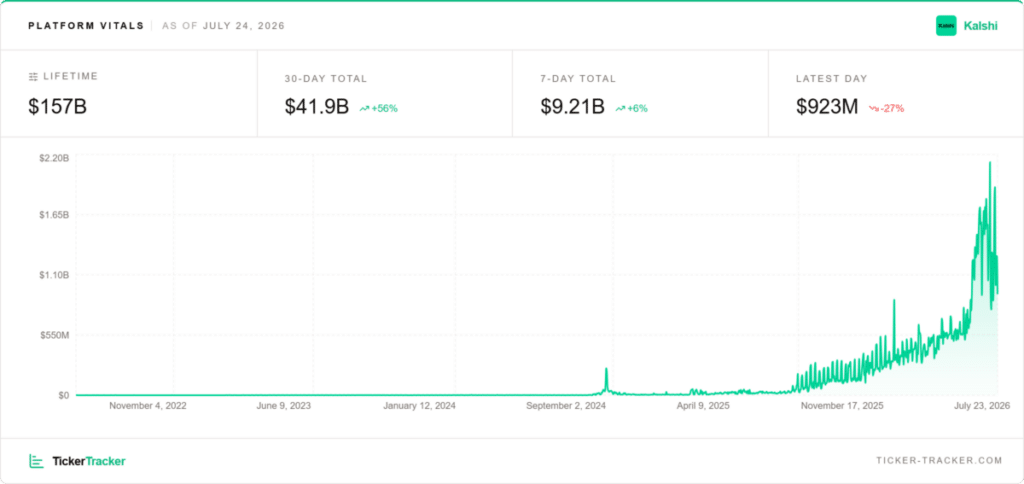
As Ticker Tracker’s chart shows, Kalshi reached a daily trading volume of over $2 billion in July. Over the course of the tournament, volume exceeded $33 billion.
Sports Continue to Dominate Trading
You can delve deeper into the data on Ticker Tracker’s explorer page, which shows the categories that attract traders. Even after the World Cup, volume remains high with sports dominating.
“Kalshi just went absolutely parabolic during the World Cup—numbers that we just didn’t expect to see,” said Ramsey. “And so I’ve been watching the last few days, now that the World Cup is over, kind of seeing how the comedown is, how far we fall off, and we’re still well over $1 billion a day on Kalshi.”
As the chart below shows, single-sport markets accounted for over $531 million of the $1.3 billion in volume on July 23. Exotics are parlays, with the majority of those also sports. Essentially, that means that around 75% of all trading was on sports. Crypto accounted for around 16%, with all other markets accounting for the remaining 9%.

Kalshi had over 3 million app downloads during the World Cup, and the numbers suggest many of these customers are sticking around.
Misconceptions Around Prediction Market Volume
Ticker Tracker displays the notional volume traded on prediction markets. This is the total face value of contracts traded, rather than the amount of money that actually changed hands. Each contract is valued at $1, but a user buys the contract at a much lower price.
“When we see a number like $40 billion traded on Kalshi this month, that doesn’t really mean there was $40 billion changing hands over the course of the month,” Ramsey explains. “It’s great for them that people think that, but that’s a misconception, essentially.”
For example, you can currently predict LeBron James‘ next team at Kalshi. A contract on Cleveland is available at 27c. If you buy that, you pay 27c, and if he moves there, you get $1. So, the notional volume of that contract is $1, but if he actually moves to Miami, then only 27c has changed hands.
In that way, volume is not equatable to betting handle at a sportsbook, unfortunately for Ramsey and others working in the industry.
“My ultimate goal with this is to allow us to compare prediction market volume to traditional sports betting volume and find a way to make these numbers align or be on the same level,” Ramsey says. “But I think that’s misguided. To the best of my ability, I’ve tried to keep these as two separate things. So, prediction market volume is just a different thing than sports betting volume.”
“We can try to find ways to bring them as analogs of each other, try to talk on the same terms, but really, from what I’ve seen and experienced building this, it is really prudent of us to just think of them as two completely separate numbers.”
Report Predicts Volume Will Reach Trillions of Dollars
“I feel like there is far more chatter and intrigue and coverage of prediction markets in the States here these days than traditional sportsbooks,” said Ramsey. “The conversation has completely turned toward prediction markets. So, as that continues, the volume momentum should continue, too, I would think, pending, of course, all the litigation and legal concerns hanging in the air, obviously.”
Those concerns are also growing. Nevada and Michigan have already banned Kalshi, and Washington state could soon follow after a judge ruled it is operating an illegal betting platform this week.
Despite the potential for more and more states to block access, analysts predict volume will continue to grow. A new report from Macquarie Equity Research said taker volume could grow from the current $22 billion to $1.5 trillion.
Taker volume is basically the amount of money users risk, such as the 27c in the LeBron example. Kalshi generates revenue based on the fees from this figure, so Macquarie says it is a better measure of the industry’s size.
Surprisingly, Macquarie claims that non-sports markets will account for the majority of the market by 2030.
“We expect the business to become increasingly diversified, with sports declining from roughly 88% of volume in 2025 to 47% by 2030, as adoption broadens across economics, politics, finance, weather, and other event categories,” the report stated.
It added, “We expect Kalshi’s non-sports taker volume could increase from $1.3bn in 2025 to $274bn by 2030, while sports taker volume could grow from $9bn to $247bn over the same period.”
You can watch Ticker Tracker to see if those predictions are accurate. Ramsey plans to add data from Polymarket and Crypto.com in the near future, having just integrated Underdog‘s stats as the company launched its standalone platform.