



Pat McAfee wanted a winning bet so much that he ended up losing $5,000 for the chance of winning a fraction of that. The sports analyst thought Team USA could not fail to beat Italy in the World Baseball Classic. He was wrong.
McAfee posted on X, “WOW I NEED A WIN BAD.. Just any sort of positive bet would be sweet at this stage of continued losses.. What’s a guaranteed win regardless of the odds?”
He ended up betting on the US to beat Italy in the World Baseball Classic at odds of -1100. If successful, he would have won $454.54.
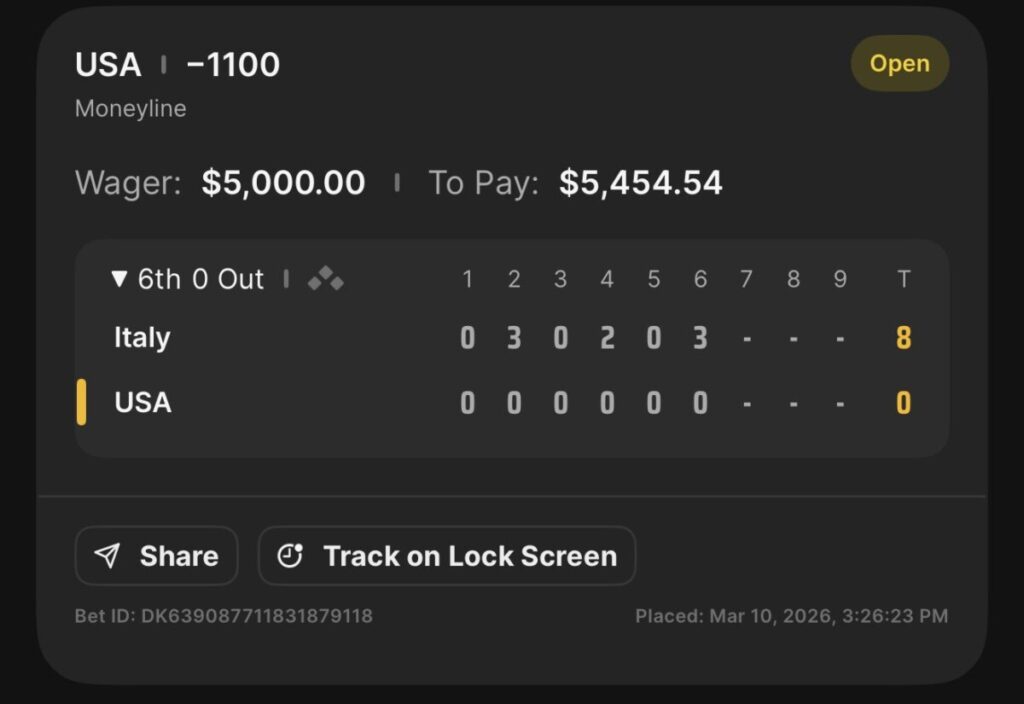
Italy took a commanding 8-0 lead after six innings. Despite a late rally, the USA lost 8-6. McAfee bemoaned his wager on his show the next day.
Hall of Fame Gambler Warns Against McAfee Betting Style
McAfee had become desperate and was willing to stake more than usual on the wager, just in the hope that the consensus was correct.
That is a recipe for losing, according to professional sports bettor Jeff Whitelaw. Whitelaw was inducted into the Sports Gambling Hall of Fame at Circa in Las Vegas last year. He has turned a profit in 33 of the last 35 years from betting with a shrewder strategy than jumping on favorites.
Whitelaw’s tips: “Never chase,” he said. “There are always going to be games tomorrow, so if you miss a number, just pass and be patient and wait for a good opportunity. There always seem to be good spots.
“Use good money management and bet one unit or two units or three units, whatever your unit is, and always do some due diligence. Don’t just blindly bet a game because it’s on TV.”
On the opposite side are celebrities such as McAfee and Drake, placing big bets on a whim. The Canadian rapper has a string of losing wagers, leading to the “Drake Curse” being coined. He says he has now given up sports betting following a $1 million loss on the Super Bowl.
Bet Against the Public
Whitelaw developed his gambling style while working as a ticket writer for three years at a Barbary Coast sportsbook.
“Whenever I would write tickets on the same team over and over and over, they would always seem to lose,” he told the Las Vegas Review-Journal. “Then, when I became a bettor, I noticed I was always betting against the public.”
Like in McAfee’s case, he noted, “Still, to this day, the public typically bets favorites and (the) over, and I’m more of an underdog and under bettor.”
The rise of prediction markets has given US gamblers more opportunities to wager against popular opinion. Users may be able to find better lines and odds than they would at sportsbooks.
Easier in the Past
Whitelaw, however, says that gambling was easier in the past, when information was scarce, and markets responded more slowly.
“It was way easier in the 90s and early 2000s because when you would get information on something, you might not even hear about it for a day,” he said. “Now that you have (the social media platform X) and various things, it’s a matter of seconds or a minute. You have to do things instantaneously. The days of getting information before anybody else have gone by the wayside.”
Online gambling rarely has discrepancies for long, either. Whitelaw added, “Now the lines and totals are almost identical … and the lines are sharper. But back in the 90s, a game might be anywhere from 3½ to 5½, so you have a middle, and you have a play, and the totals would be three or four points off.”
While prediction markets and online sportsbooks make betting more accessible, they also encourage gamblers to wager with less discipline in the hope of landing a win. As McAfee has shown, that strategy will often leave you out of pocket.