


After more than three decades of working in the sports betting industry, author Robert Walker spent two years “writing the book that my career made me uniquely qualified to write.”
Originally, it was going to be a “love letter” to DraftKings, praising the company’s founders for building a gaming empire after previous jobs at VistaPrint. However, as he delved into the company’s practice, it became a story equally about exploitation as innovation.
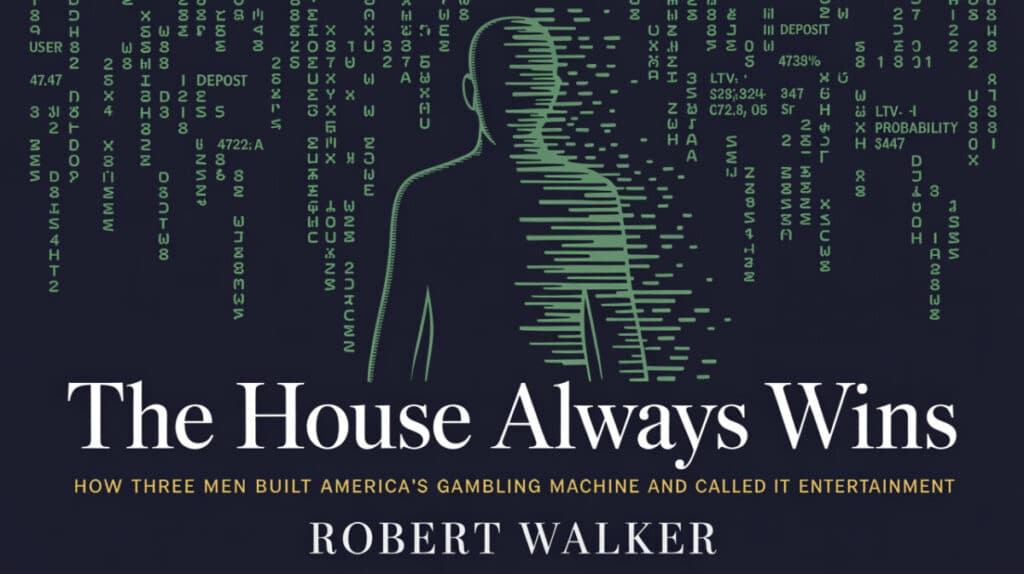
Walker released The House Always Wins: How Three Men Built America’s Gambling Machine and Called It Entertainment this week. The book charts the rise of DraftKings from its founding as a fantasy sports app in 2012 through to its recent entry into prediction markets in 2026.
“It’s not an anti-gambling book,” Walker told CasinoBeats in an exclusive interview this week. “It was going to be a love letter to DraftKings. I think what the company has done is amazing. Going from working at VistaPrint to running a multi-billion-dollar business is remarkable.”
He added, “The founders aren’t villains. The technology is genuinely impressive. I actually almost worked for them. I met them around the time of the PASPA appeal, and I really liked them. But I didn’t think it would be a good fit. I’m too much of a control freak; I’d want to do everything.”
At that time, Walker was working as a bookie in Las Vegas, where he still lives. He also met with FanDuel and shared similar praise for how the platform has grown into one of the leading apps in the US.
Innovation Leads to Exploitation
As both companies have grown, their practices have come under scrutiny. On the day we spoke to Walker, a new lawsuit was filed against DraftKings, FanDuel, the NFL, Genius Sports, and several VIP hosts who worked at the sportbooks.
The lawsuit alleges that the companies “use sophisticated digital technology and software—including artificial intelligence and machine learning—to create addicted gamblers.”
Another lawsuit has since been filed against the two betting operators, which also alleges that they are purposefully designing their products to be addictive.
In his book, Walker explains how algorithms have taken over. AI now controls 70% of DraftKings’ promotional spending decisions.
“The AI determined who received offers, when they received them, what dollar amounts were offered, and what behavioral triggers initiated the deployment cycle,” Walker wrote.
Algorithms Don’t Know Their Customers
This is a big part of the problem, Walker says.
“The algorithm doesn’t know that the deposit was supposed to be for a mortgage payment, or pay for a child’s daycare,” says Walker. “The Know Your Customer (KYC) requirements are a good step. Like if someone is earning $100,000 a year, but they’re depositing $200,000, we have to ask ‘how?'”
Instead, the algorithm designs ways to get players to deposit more often. Walker notes that the bonuses dished out to users are carefully calibrated by the system to maximize use.
He gives the example that if the first bonus is $50, then the next one is usually less. By offering a $25 bonus, it creates a sense of urgency, leading more users to use it and engage with the platform because they worry it will disappear.
The system also learns when the best time is to send push notifications to players, which is often late at night or after a big loss. The latest lawsuit alleges that by doing this, DraftKings and FanDuel should be held responsible for creating gambling addicts.
Players Also Bear Responsibility
“It’s important to point out that the majority of bettors see it as a form of entertainment and can casually place bets without it becoming a problem,” Walker says. “I always say that betting can be a good way to spend money. If you pay $20 to see a movie, you might like it or you might not. But if you bet $20 on a game, then you know you’re going to be invested for those few hours. Win or lose, it creates excitement.”
The problem is when users lose control of their wagering and gamble beyond their limits. Are betting companies responsible for that?
“I think the customers also have to take a lot of responsibility. I hope the book helps with that. Like if I’m getting these offers or if I’m assigned a VIP host, then people should be questioning it,” he adds. “The host isn’t your friend; they only want you to lose money. If you stop gambling, then they won’t be interested anymore.”
His book also highlights that a large portion of revenue comes from a small percentage of users. For DraftKings, data extracted from internal analytics showed that 42% of revenue came from 3.8% of its user base.
“The companies need these players. Their biggest fear is that they lose them to competitors, so that’s why they fight so hard to keep them.”
What’s the Answer?
“I don’t have the answer,” Walker says. “But I think regulators don’t know either. The problem is they’re coming from an uninformed position. I think the best example is Nevada; I’m biased in that. But it’s because it’s got the longest history with gambling.”
Nevada sets a tax rate of 6.75%, one of the lowest in the country. States with exorbitant rates, like New York at 51%, leave little room for companies to profit, says Walker.
Other states simply do not have the experience to know the best way to regulate an industry that is still in its formative years.
“In some states, it’s governed by the parimutuel or the lotteries, and they make a lot of mistakes,” Walker added. “I always give the example of Kentucky as a state that doesn’t know what it’s doing. They place a tax on the betting handle of around 1.75%. They don’t know what they’re doing.”
Prediction Markets: The New Frontier
Nevada has also dealt with the threat of prediction markets, driving out Polymarket, Crypto.com, and, most recently, Kalshi.
“Predictive markets are just sports betting,” says Walker. “Kalshi actually tried to argue that a T-shirt salesman could offset risks by trading on the Super Bowl. That’s not how people are using them. It’s ridiculous.”
DraftKings has gone all-in on the new opportunity presented by prediction markets, which could lead to “legal” sports betting across the US.
“DFS, sports betting, now prediction markets, they’re all the same product. The regulatory arbitrage is brilliantly executed,” said Walker. “I actually shelved the book for a long time, but when they entered into prediction markets, I went back to it. It’s another sign of the company’s innovation and evolution.”
DraftKings CEO Jason Robins stated, “We will pursue this opportunity, we will compete, and we will win.”
And Walker thinks they are in a strong position. The user base from DFS gave them a competitive advantage when sports betting became legal, and the same can happen with prediction markets.
“They possess the largest database of American sports bettors, the most advanced behavioral prediction models in the consumer gambling industry, and a dominant share of a market that generates tens of billions of dollars in annual handle,” says Walker.
Sports prediction markets are facing increasing legal challenges, but even if they are eventually prohibited, DraftKings will still retain its user base, advanced algorithms, and sports betting market share. As Walker’s book title says, “The House Always Wins.”