


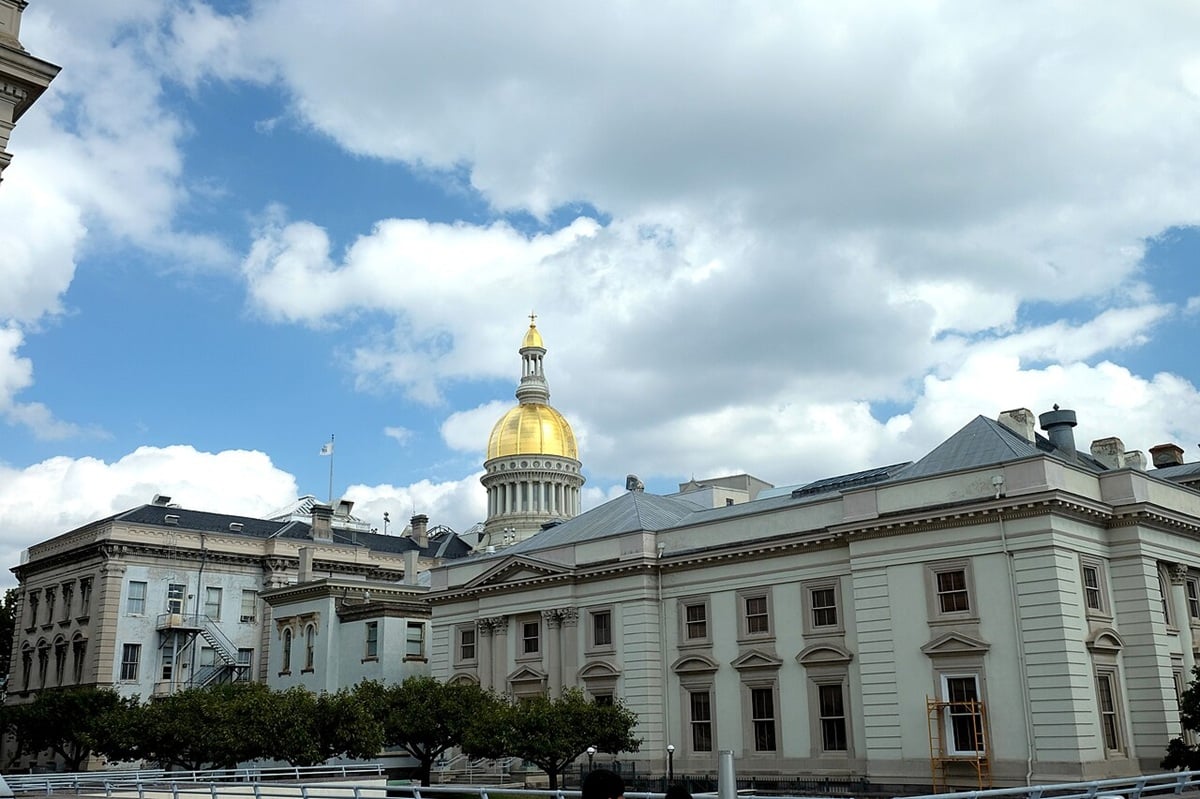
New Jersey intends to take its battle against Kalshi to the Supreme Court. The state was decisive in paving the way for sports betting to be legalized nationwide and may again be the catalyst for a major ruling on sports prediction markets.
A joint status report filed by Kalshi and New Jersey attorneys requested that the court refrain from issuing any further judgments pending the Supreme Court’s decision.
“Defendants have indicated that they intend to seek further review of the Third Circuit’s decision in the U.S. Supreme Court,” stated the filing. “The parties therefore respectfully request that this Court continue to stay proceedings pending any decision by the U.S. Supreme Court”.
The Third Circuit Court of Appeals ruled 2-1 that Kalshi was likely to succeed in the case, arguing that federal laws preempt state gambling regulations and make its sports markets fair and legal. The dissenting judge concluded that “[b]ecause Kalshi is facilitating gambling, it can be subjected to state regulation.”
How Will Supreme Court Rule?
Legal experts have long predicted that the Supreme Court will eventually rule on whether sports prediction markets are allowed to continue.
Daniel Wallach, who has been one of the leading voices in the numerous legal battles between prediction market operators and state gambling regulators, said he gives it a 70-80% chance that the Supreme Court will rule against prediction markets.
Kayvan Sadeghi, a partner at the legal firm Jenner & Block in New York, supported that view. He noted that while the Trump administration and some Republicans support prediction markets, conservative judges are frequently sympathetic to states’ rights arguments. As the Supreme Court judges are overwhelmingly conservative, this would favor the gambling regulators.
Law professor Melinda Roth told us she believes it is more of a 50-50 shot.
The Supreme Court’s 2018 ruling, which allowed states to legalize sports betting, could be decisive. In that decision, the court ruled that the federal prohibition of sports betting was unconstitutional and that states have the right to decide on whether to allow the activity.
When Will Supreme Court Hear The Case?
It took years of persistence for the sports betting case to eventually reach the Supreme Court. Judges initially rejected the state’s arguments that the federal ban on sports betting was unconstitutional.
The Third Circuit Court of Appeals upheld the initial rulings in a 2-1 split decision, as it did in the case involving Kalshi in New Jersey. Judges believed federal law preempts state regulations.
The Supreme Court refused to hear the case in 2014, but Governor Chris Christie persisted and petitioned for the court to hear the case in 2016. It eventually agreed in 2017 before issuing its decisive ruling in 2018.
Kalshi first filed its lawsuit against New Jersey authorities in April last year after the state sent it a cease-and-desist letter. As the PASPA case demonstrates, these complex cases can take many years to resolve.
Roth said she believes it will be at least another year before the Supreme Court hears the case, and she added that the ruling in the sports betting case “doesn’t necessarily indicate how they will rule here.”
At a hearing before the Ninth Circuit, judges appeared to favor the arguments of the state of Nevada over those of Kalshi. A ruling is expected in the next few weeks. If Nevada favors the state, then this would create a Circuit split, which could accelerate the case to the Supreme Court.
Polymarket Offers Wagering On Timeline
Polymarket, like most things, has a market on when the Supreme Court will hear a sports event contract case. It currently gives it just an 18% chance of accepting a case by the end of the year.
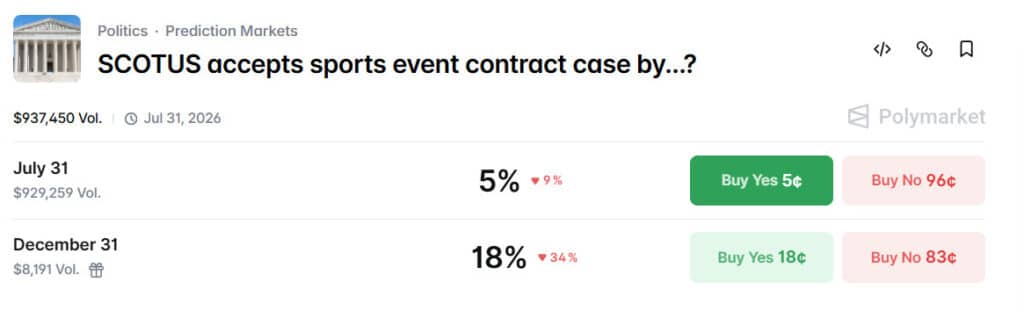
There is no market on which way the court will rule, but that could follow if it does accept the case. Whether it can continue offering markets on everything and anything will likely depend on the outcome.