


A bingo pattern is the specific shape or arrangement of numbers a player must cover on their card to win a round. These bingo card layouts can include straight lines, letters, frames, or full-card coveralls.
In this guide, we will cover the most common bingo patterns you’ll encounter in halls and online, how to distinguish between basic patterns and complex shapes, and the logic behind how these patterns affect your chances of winning.
Key Beats
- Simple patterns (like a single line) are easier to hit and finish quickly, while complex patterns (like the Full House) offer the lowest odds but the highest jackpot payouts.
- Many winning patterns, such as the “Letter X” or “Plus Sign,” utilize the center Free Space, making them mathematically faster to complete than patterns that only use the edges.
- Depending on the bingo pattern required to win the game, the difficulty level may be heightened.
What Are the Different Bingo Patterns?
In a typical bingo game, you will see many different bingo game patterns. Some are “speed” games that end very quickly, while others are more complex and require you to cover almost the entire card. Usually, these are put into four groups based on their shape and how hard they are to finish:
- Basic and simple patterns: These are the fastest games and usually involve straight lines or the four corners.
- Letter and shape patterns: These are middle-difficulty designs like the letter “X” or a “Diamond.”
- Complex and hardest patterns: These are longer games, like filling the outer “Frame” or the whole card (Blackouts).
- Themed and unique patterns: These are creative shapes used for special events, like a heart for Valentine’s Day or a tree for Christmas.
Basic and Simple Bingo Patterns
These are the most common bingo patterns to win because they require the fewest numbers. They are ideal for beginners and are often used to start a bingo session.
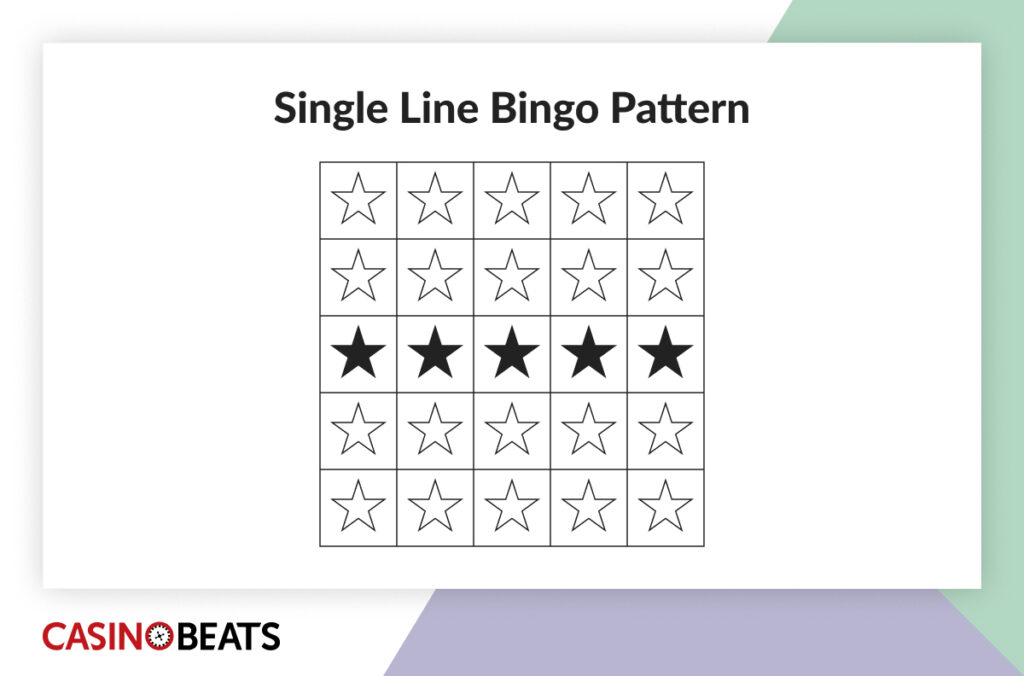
Single Line
The most basic bingo pattern. You win by completing a straight line of five numbers in any direction: horizontal, vertical, or diagonal. It is the best way for new players to learn how to track numbers across the B-I-N-G-O columns.
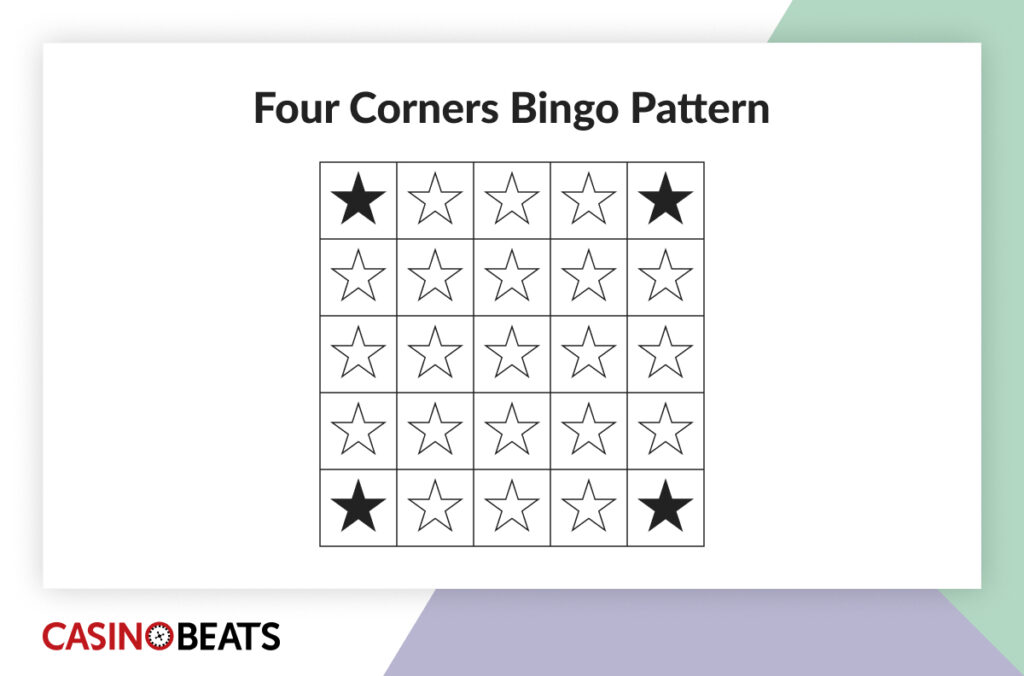
Four Corners
This pattern is exactly what it sounds like. You must dab the very first and last numbers on the top row, and the very first and last numbers on the bottom row. It is a favorite for fast-paced games because you only need to watch four specific spots.
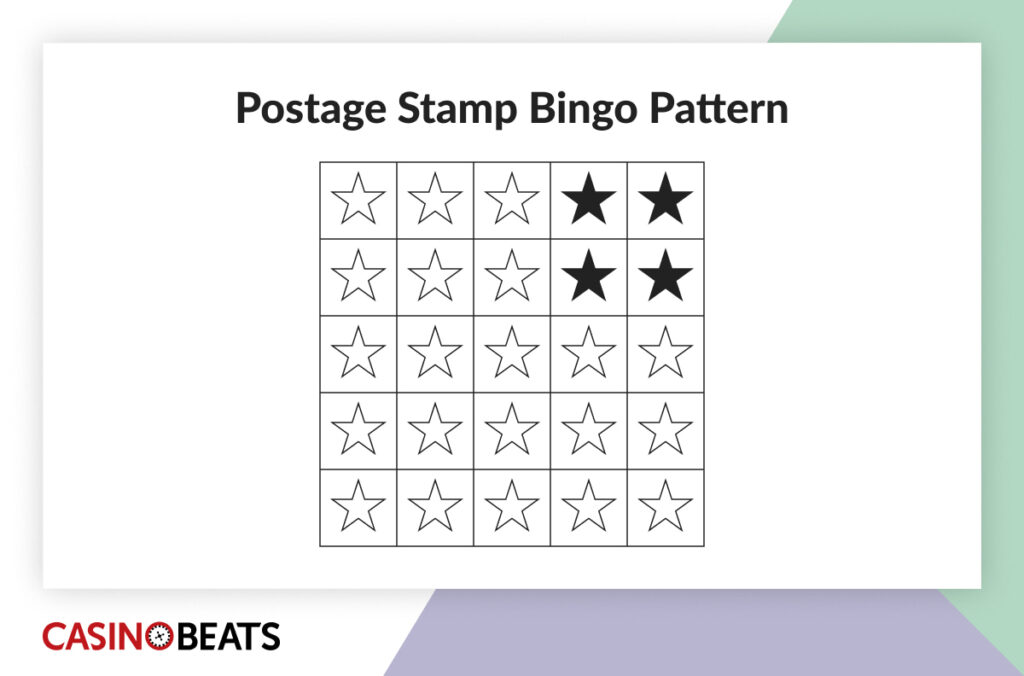
Postage Stamp
A Postage Stamp is a small 2 x 2 square of four numbers. It is usually tucked away in one of the four corners of the card. It’s a very popular “mini” pattern used in early rounds.
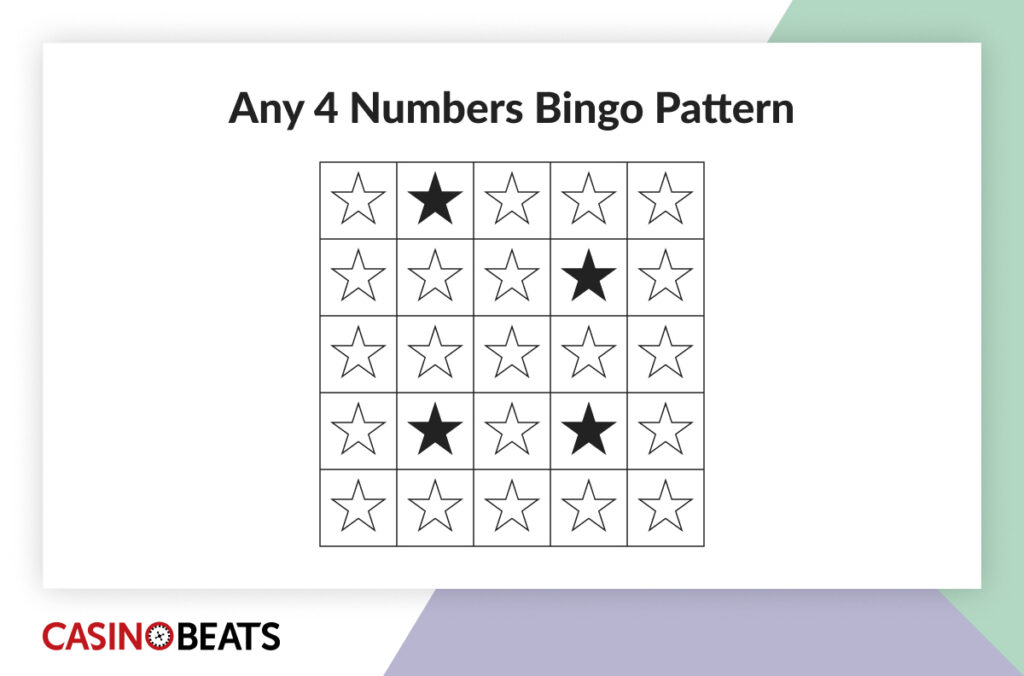
Any 4 Numbers
The simplest variant where dabbing any four numbers on the card results in a win.
Letter and Shape Bingo Patterns
Letter patterns and geometric shapes add variety to the game. These are fun, recognizable, and usually offer a mid-range prize.
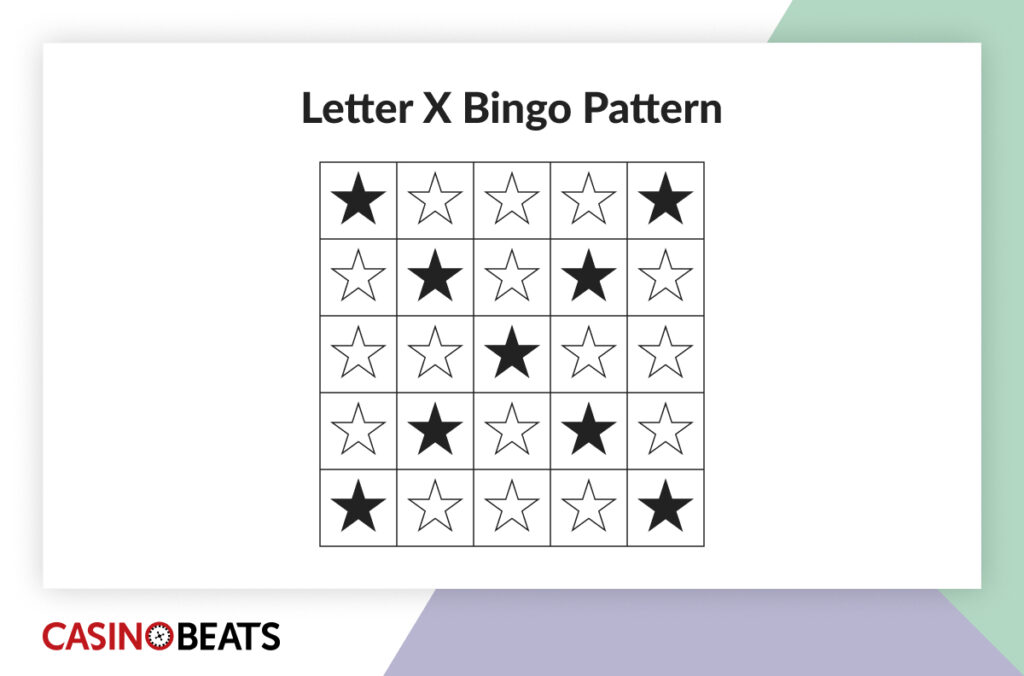
The Letter X
This pattern requires two diagonal lines that cross through the center. It is one of the most popular different bingo patterns because it is visually easy to follow. Since it uses the “Free Space,” you essentially start with one square already filled.
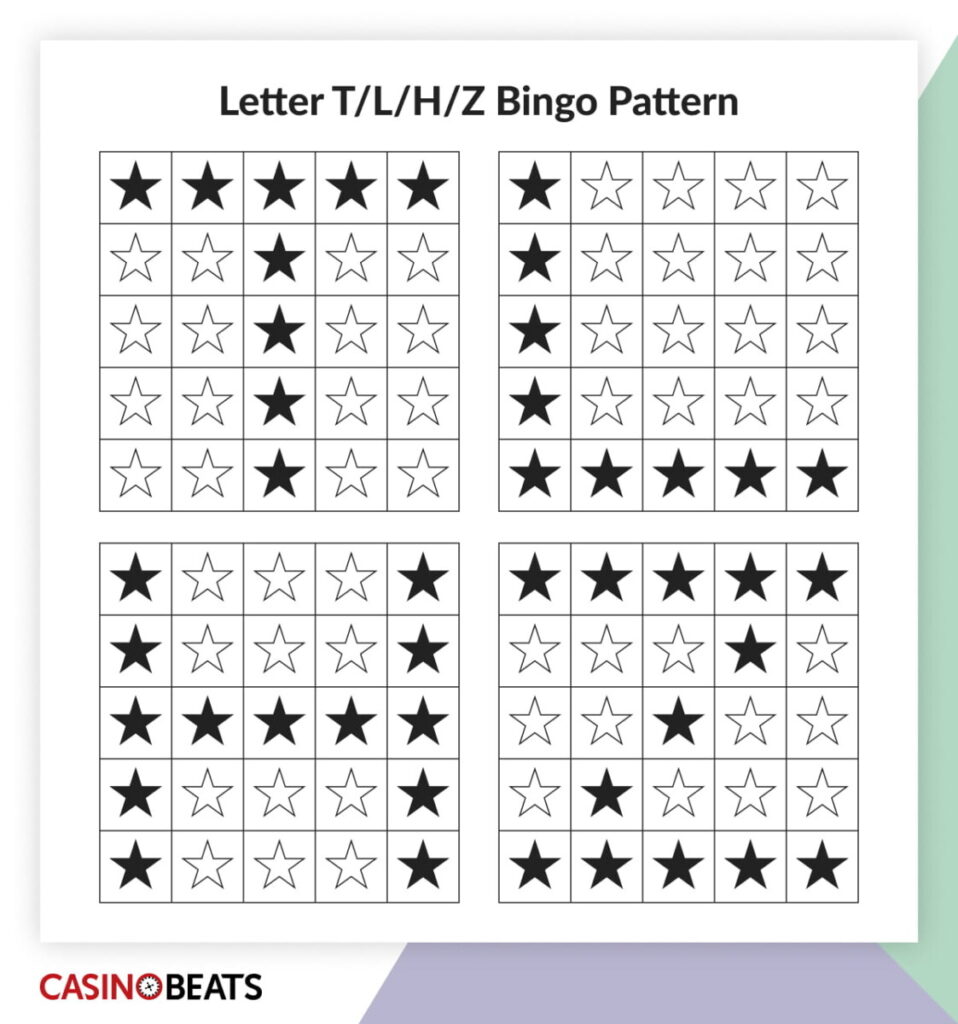
The Letters T, L, H, or Z
Players must form the specific letter. For example, the “L” uses the first column and the bottom row.
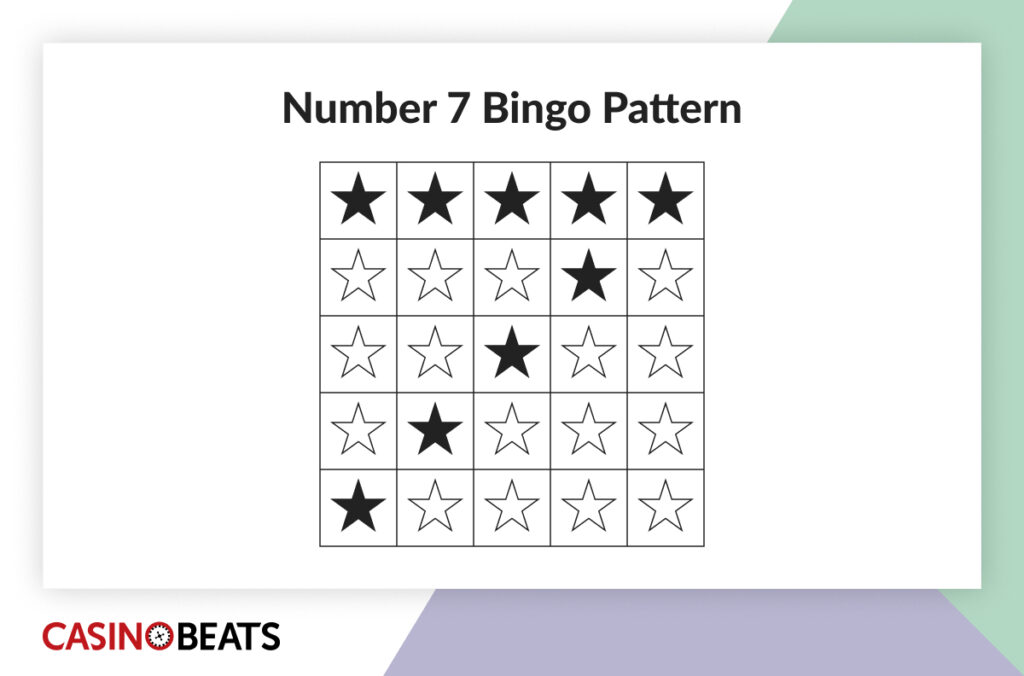
The Number 7
This involves dabbing the top row and one diagonal line to form a “7.”
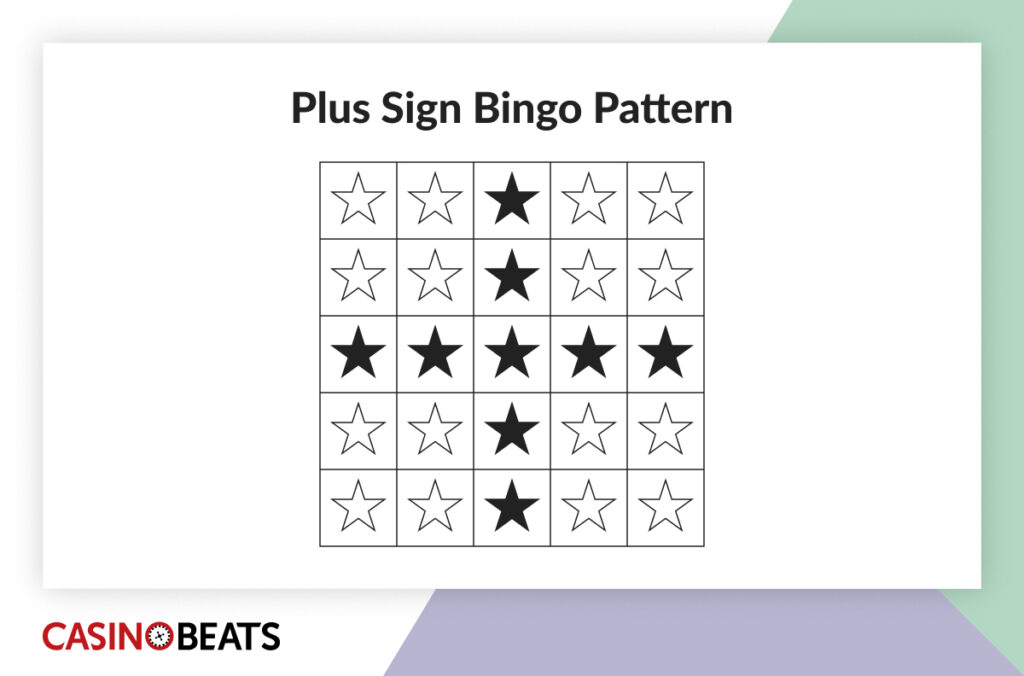
The Plus Sign (or Cross)
To win, you must complete the middle vertical column and the middle horizontal row, creating a large “+” shape. It is a very common “speed” pattern that is popular in U.S. bingo halls.
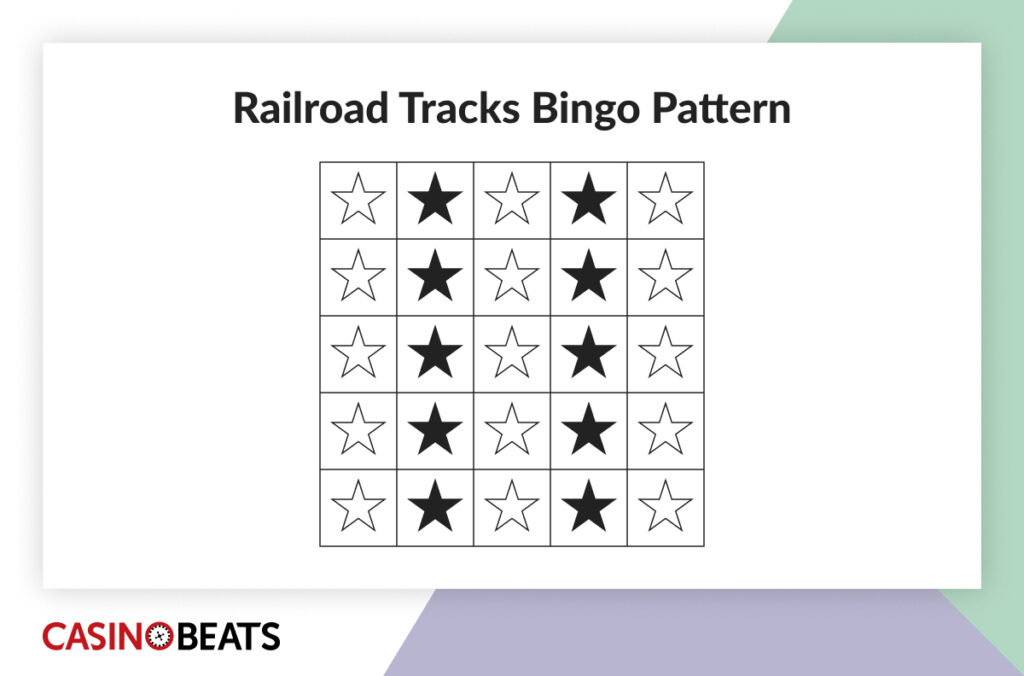
Railroad Tracks
Imagine two parallel lines running down your card. To win Railroad Tracks, you typically need to complete two full vertical lines (usually the “I” and “G” columns). It is a double-line pattern that keeps you on your toes.
Complex and Hardest Bingo Patterns
These patterns are for those chasing the big jackpots. They require a lot of dabs and a bit of patience.
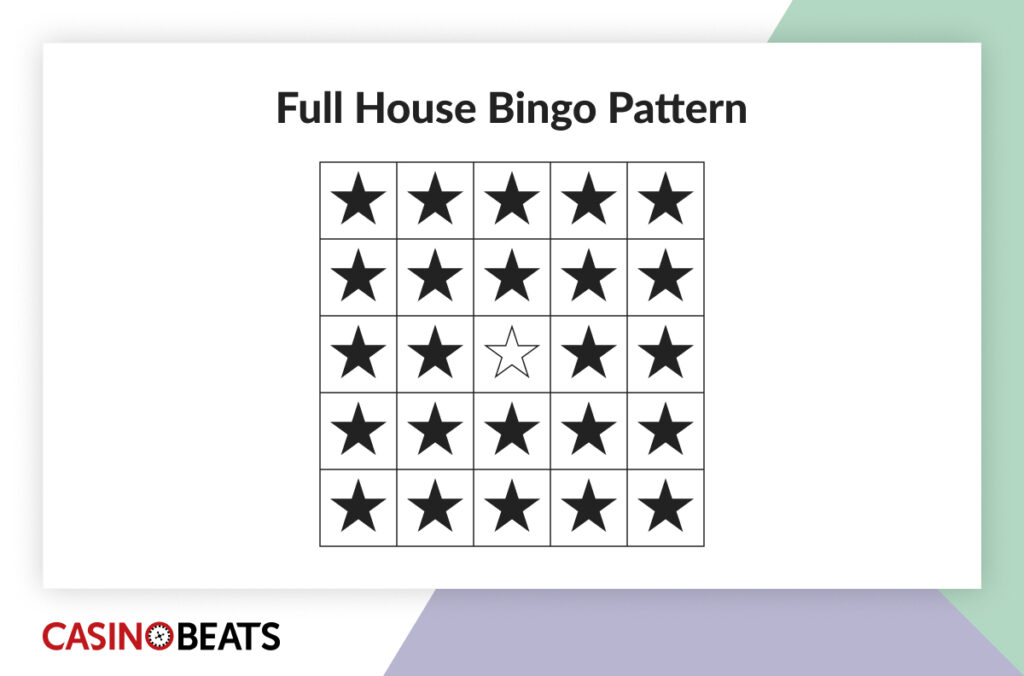
Full House (Blackout / Coverall)
The Full House is the most famous of all bingo winning patterns. To win, you must cover every single numbered square on your card. This means dabbing all 24 numbers around the center “Free Space.”
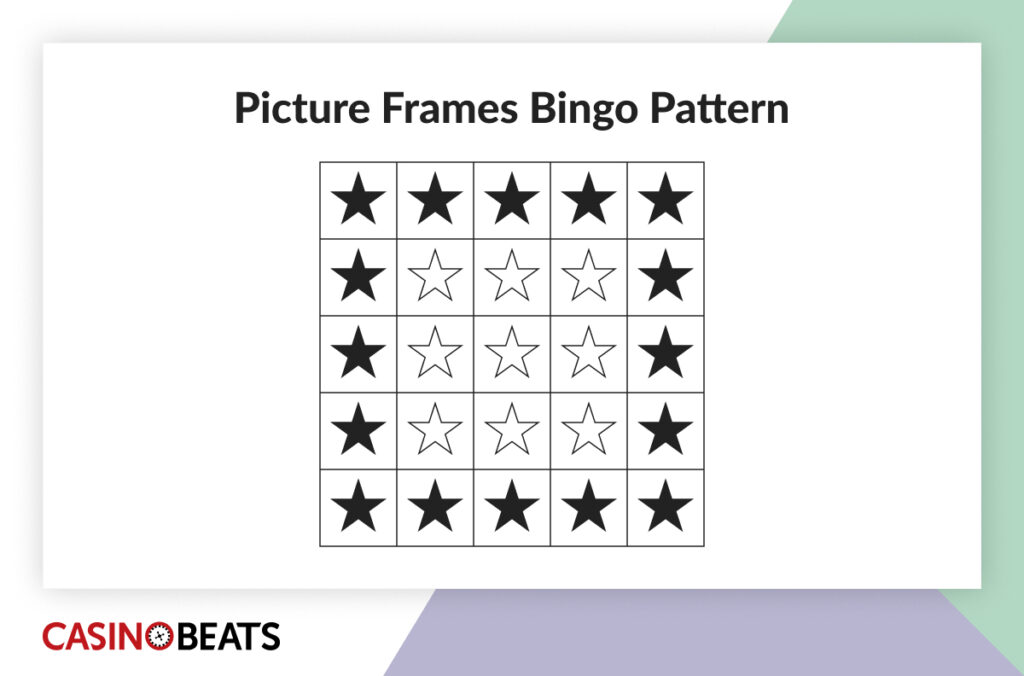
Picture Frames
These patterns require you to dab numbers around the edges of the grid. An “Outside Frame” means dabbing every square along the outer border, while an “Inside Frame” means dabbing the squares that surround the center “Free Space”.
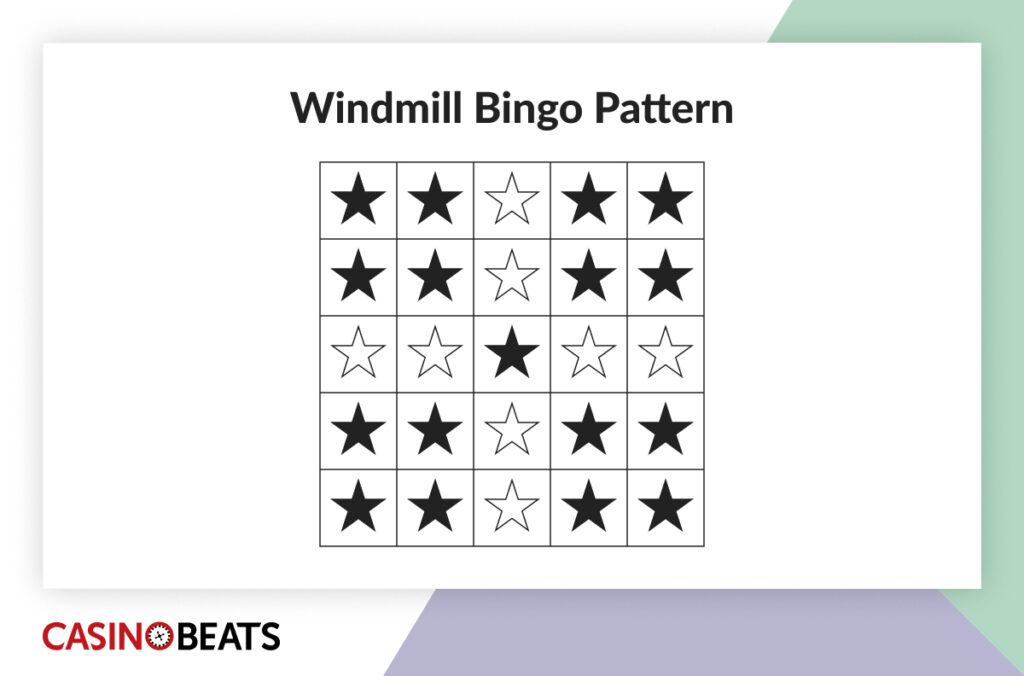
Windmill
A very difficult pattern consisting of four 2 x 2 squares in each corner, all connected by the middle square. While it looks like four Postage Stamps, you must complete all of them on one card to win.
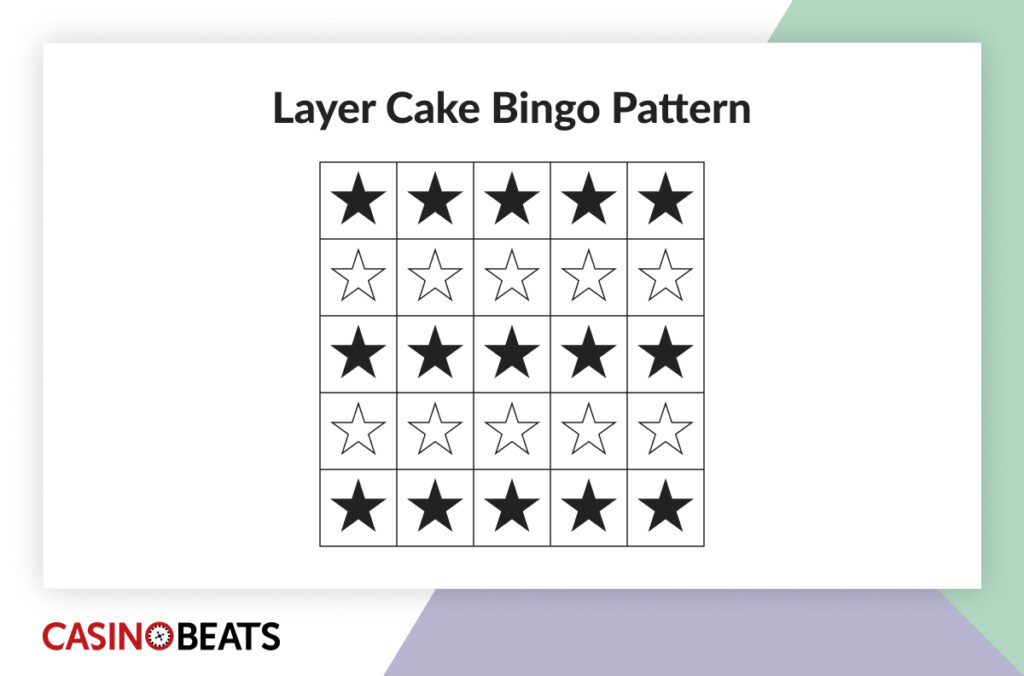
Layer Cake
This involves covering every other horizontal line (usually rows 1, 3, and 5). It looks like a striped cake and is a fun variation for longer gaming sessions.
Creative and Holiday Bingo Patterns
These patterns turn the bingo card into a piece of art. They are often used for themed nights or special events.
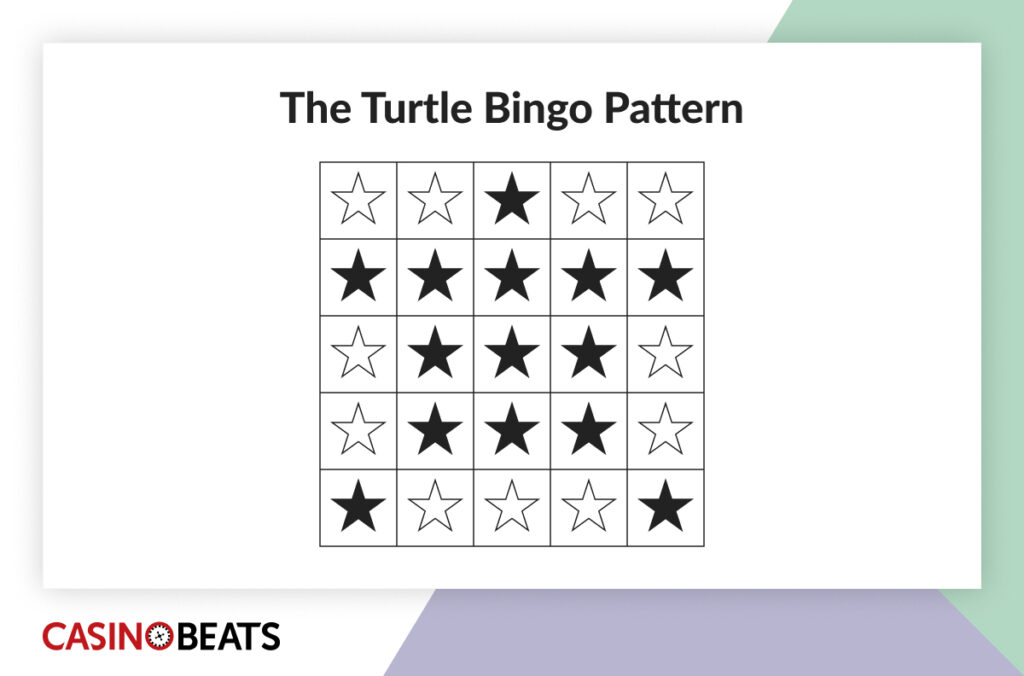
The turtle
A complex shape using the center, corners, and side spots to look like a turtle shell.
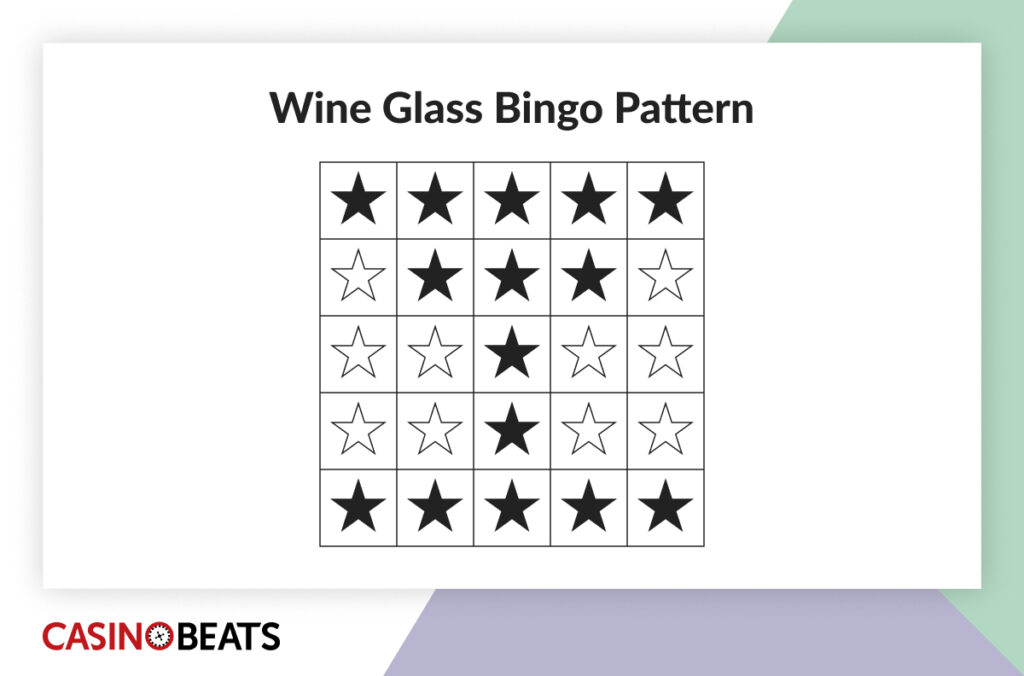
Wine glass
A shape that looks like a glass with a stem. Popular for evening or celebratory games.
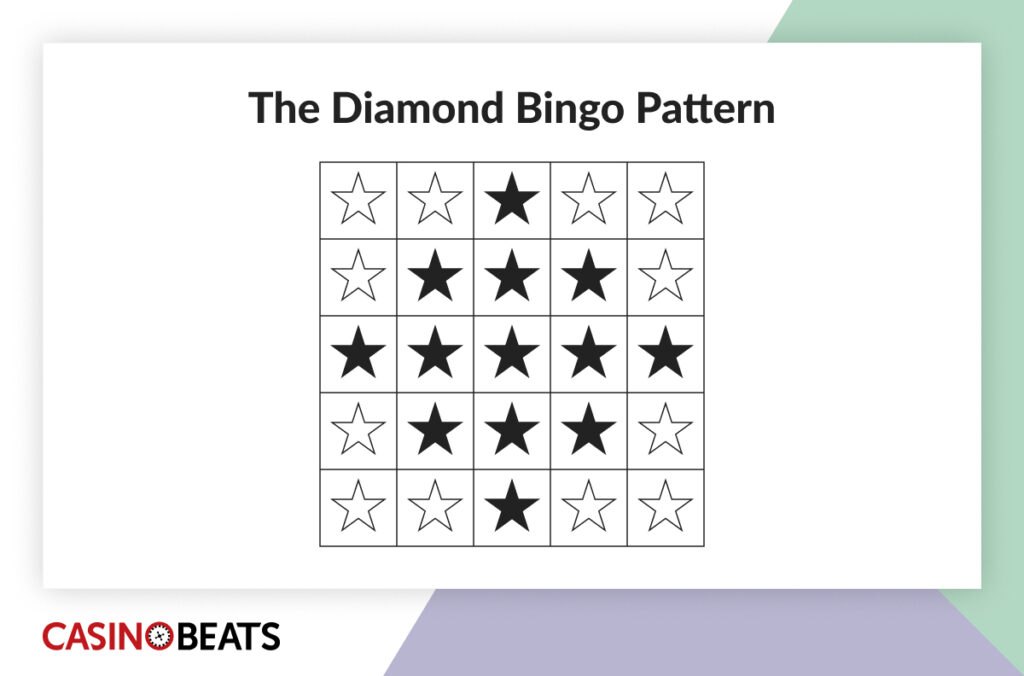
The diamond
Four points connected to form a diamond shape in the center of the card.
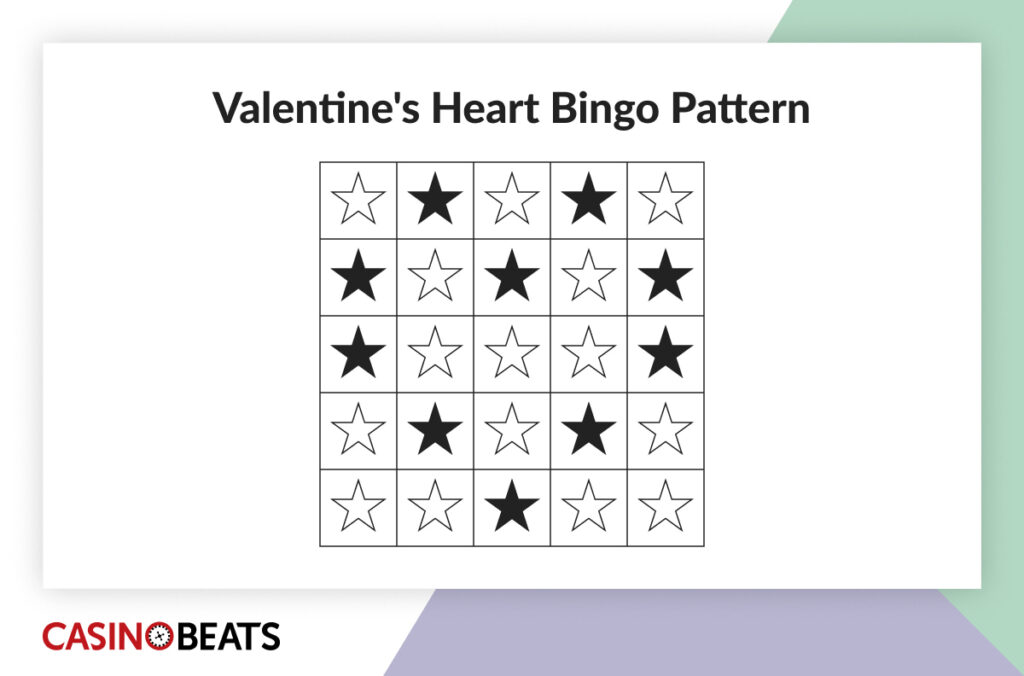
Valentine’s heart
A medium-difficulty pattern used on Valentine’s Day. It curves around the top and meets at the bottom.
Christmas Bingo Patterns
These bingo patterns are used during the winter season to add festive cheer to the game.
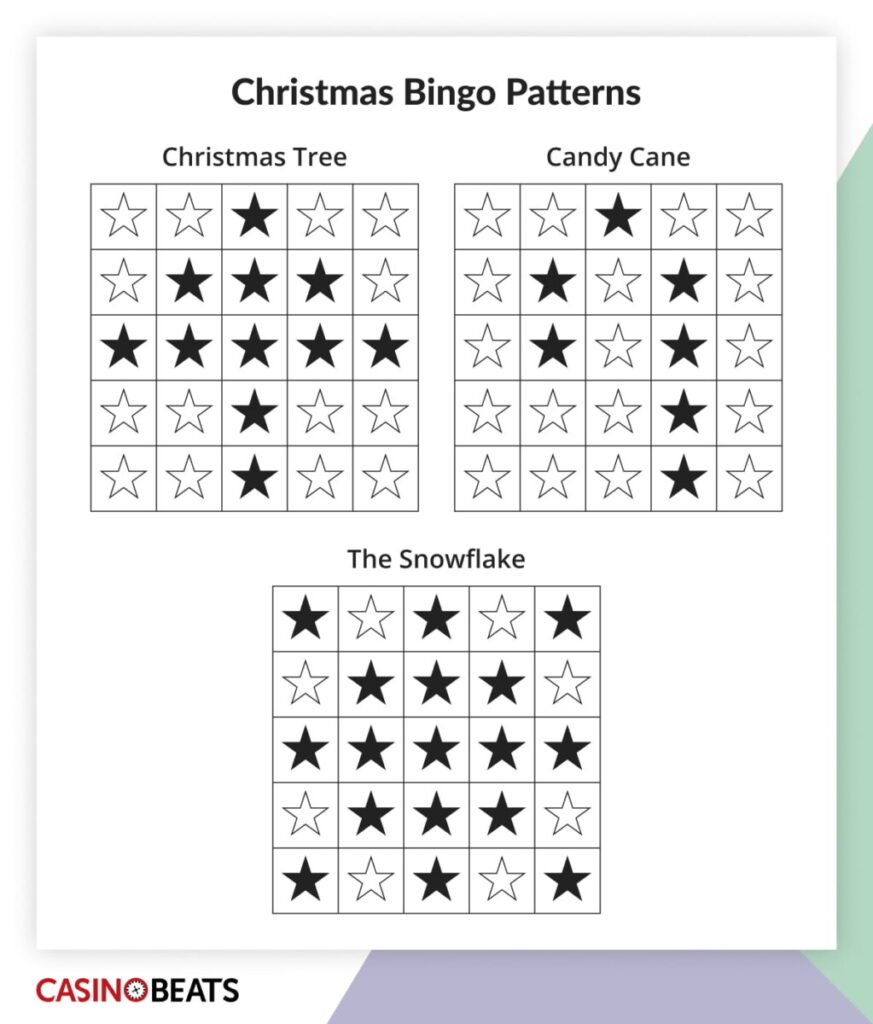
- Christmas tree: A pyramid-shaped pattern with a small “trunk” at the bottom.
- Candy cane: A “J” shaped pattern that curves at the top, just like the holiday treat.
- The snowflake: An intricate pattern that covers the diagonals and the middle cross to create a frozen star look.
Comparison Between Easy and Complex Bingo Patterns
| Feature | Easy Patterns (Lines, Corners) | Complex Patterns (Windmill, Frame) |
|---|---|---|
| Numbers Needed | Usually 4 to 5 | Usually 12 to 16 |
| Game Speed | Very fast | Slower, takes more calls |
| Commonality | Found in every session | Usually, for the final jackpot |
| Winner Payouts | Small, frequent wins | Large, rare jackpots |
Mathematical Structure Behind Bingo Patterns
There is a logic to how types of bingo game patterns work:
Symmetry factor
Symmetrical shapes (like the Diamond) are easier for players to track across multiple cards.
Center square logic
Patterns that use the center “Free Space” are mathematically faster because you start with one square already filled.
Density vs. spread
Dense patterns (like Postage Stamp) require numbers close together, while spread patterns (like the Frame) require at least one number from every column.
Bingo Pattern Odds and Payouts
Bingo game patterns, whether at online casinos or in person, alter the odds. The pattern required for a win directly affects how long a game lasts and how much the jackpot will be.
While bingo is a game of pure luck, understanding the mathematical structure behind bingo patterns helps you choose the right session for your goals.
Easy vs. Hard Pattern Odds
In any bingo game, the more numbers a pattern requires, the lower the mathematical probability of hitting it early.
- High probability: Patterns like the Single Line or Four Corners require only 4 or 5 numbers. These games end quickly, and it is common to have multiple winners sharing a smaller prize.
- Low probability: The Full House or Windmill requires 15 to 24 numbers. These games take much longer, but because they are harder to hit, they usually offer the biggest payouts.
If you want to save money, look for games that offer several ways to win in the same round (like 1 Line, then 2 Lines, then the Full House). Here’s why: hard shapes like the Windmill or Outside Edge are “card killers.” They can eat up your budget fast because you are chasing a very rare pattern that is hard to hit. By playing games that offer “progressive” wins on the same card, you stay in the game longer and give yourself three chances to win for the price of one buy-in.
Practice Recognizing Bingo Patterns in Free Games
You can learn to play bingo online or in person for free. If you are ready to practice, consider any of these titles and try them in demo mode:
| Game title | Provider | Feature/Highlight |
|---|---|---|
| Lucky Shamrock Bingo | Platipus | This one comes with an extra ball mode and a 4000x jackpot |
| Bingo Destiny | Platipus | There’s also a 4000x jackpot here, and players can buy up to 11 extra balls. |
| Bingo Bingo 2 | Caleta | Dynamic cards, 95% RTP |
| Bingo Bliss | Platipus | The 5×3 tickets here are used for a draw of 30 numbers from 1-60. There’s a 50,000x max win as well |
| Bingo Planets | Platipus | Bingo Planets is a space-themed slot game featuring multiplier bonuses and high volatility. |
Once you’ve finished playing around with these demo versions, remember to play responsibly should you start staking real money.
Conclusion
Different types of bingo patterns make every round enjoyable as they turn cards into tense but rewarding gaming sessions. There are simple classic lines and more modern shapes, so you have options based on your preference. Culture, environments, and even superstition have shaped how these patterns came to be. As the game evolves online, these patterns remain relevant and even add to how the odds and jackpot size change.
FAQs
-
What bingo pattern offers the biggest payout?
The Full House, also known as a Blackout or Coverall, typically offers the biggest payout. Because this pattern requires the player to cover every single square on the bingo card (all 24 numbers), the odds of winning are lower, which leads to much larger prize pools or progressive jackpots.
-
What is the pattern for winning bingo?
The pattern for winning bingo depends on the specific rules of the game being played. The most traditional winning pattern is a Straight Line (horizontal, vertical, or diagonal). However, players can also win by completing specific shapes like the Four Corners, Letter X, or a Full House, depending on what the caller announces at the start of the round.
-
What is the easiest bingo pattern?
The easiest way to win bingo is with a Single Line or the Four Corners. These are simple because you only need to match 4 or 5 numbers. Patterns that use the center Free Space are also easier to finish because everyone gets that middle square for free at the start of the game.
-
What are the different patterns of bingo?
Bingo patterns are generally grouped into four types: standard, letter/number, geometric shapes, and blackout.
-
What are the most common bingo patterns?
The most common bingo patterns are the Horizontal Line, Vertical Line, Diagonal Line, and Four Corners. In 75-ball bingo, the Postage Stamp (a 2 x 2 block in the corner) and the Letter X are also extremely frequent in both live and online games.
-
How many bingo patterns are there?
There are hundreds of different bingo patterns. While traditional bingo halls usually stick to 5 or 10 classic shapes, online bingo platforms have created over 100 unique variations, including complex themed designs for holidays, animals, and symbols.
-
What are the hardest bingo patterns?
The hardest bingo patterns are those that require a high number of dabs, such as the Full House (Blackout), the Outside Edge (Frame), and the Windmill. These are difficult because you must wait for a large portion of the 75 or 90 balls to be called before the shape can be completed.