


While the broader markets have been strong despite all the geopolitical turmoil, gaming stocks have been a different story. The Roundhill Sports Betting & iGaming ETF (NYSE: BETZ), which invests in a basket of gaming companies, fell 4.7% last week, which was much worse than the 0.38% decline in the S&P 500 Index.
Betr Entertainment Inc. and Light & Wonder were among the major gainers in what was otherwise yet another dismal week for U.S.-based gaming stocks. Meanwhile, Sea Limited and Melco Resorts underperformed.
Biggest Gainers
Betr Entertainment (ASX: BBT) +23.26%
With gains of over 23% last week, Betr Entertainment was the best-performing gaming stock in our coverage. The gains were led by a strong trading update and buyback announcement. On Wednesday, the company reported a 24.5% increase in turnover for the December quarter, which was supported by a growing base of over 163,000 active customers.
Additionally, the board announced an on-market buyback of up to 10% of its ordinary shares. Management stated the shares were trading “below their intrinsic value,” which signaled strong internal confidence to the market.
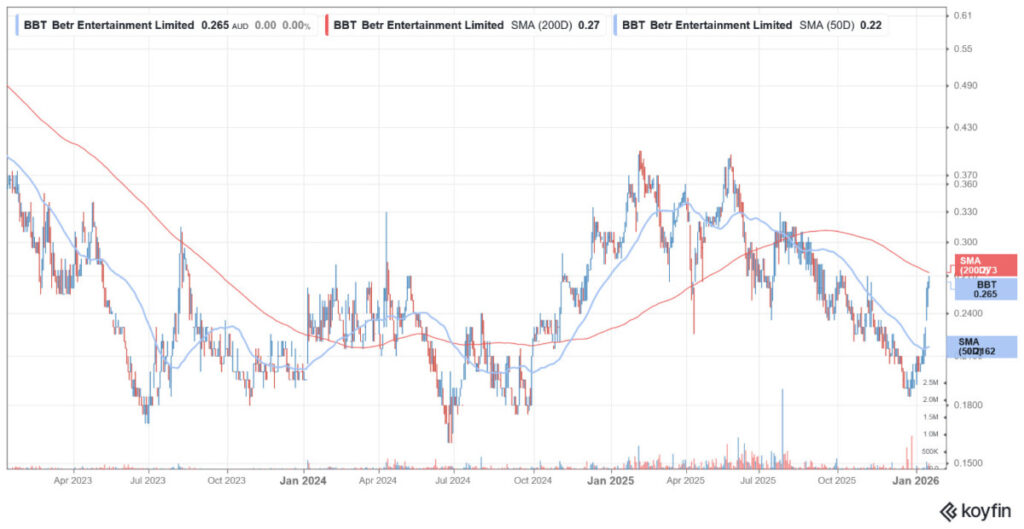
Betr Entertainment stock crashed last year but is up over 32% this year amid bottom-fishing. Notably, in December, the company had announced the sudden exit of its CFO, Darren Holley. Blake Matthews, who previously served as the Group Financial Controller, has assumed the role this year. While the stock fell after the surprise announcement, it has since recovered and has looked strong this year.
Light & Wonder Inc. (ASX: LNW) +16.7%
Light & Wonder was among the other major gainers last week and rose to a 52-week high. The key driver of last week’s price action was a joint announcement stating that Light & Wonder had agreed to settle all global legal disputes with Aristocrat Leisure.
The dispute centered on allegations that Light & Wonder used Aristocrat’s trade secrets and copyrighted work to develop its popular Dragon Train and Jewel of the Dragon game.
Light & Wonder agreed to pay US$127.5 million (approx. AU$190 million) to Aristocrat to settle the case. The company admitted that a former employee used some of Aristocrat’s work without its knowledge and has since strengthened its processes to ensure such issues don’t recur.
“This settlement protects the interests of our customers, employees, and shareholders, and allows us to continue our focus on developing and delivering the market-leading content our customers expect—without distraction or disruption,” said LNW CEO Matt Wilson in his prepared remarks.
Meanwhile, while it is a costly settlement for LNW, the stock still soared last week as it removed the legal uncertainty that had been weighing heavily on its price action.
Huya Inc. (NYSE: HUYA) +6%
Huya, the biggest gainer the previous week, continued its strong run, gaining 6% last week and extending its year-to-date rally to almost 29%.
While there wasn’t any major news last week, in the preceding week, Huya reported that the mobile version of the popular social deduction game Goose Goose Duck (which it co-published with Kingsoft Shiyou) reached No. 1 on the Apple App Store’s free games chart in mainland China.
The game launched on January 7 and recorded over 5 million new registered users in its first 24 hours of open beta.
Biggest Losers
Sea Limited (SE) –9.06%
Sea Limited, which was among the major gainers in the first week of the year, fell over 9% last week and turned negative for the year. The stock, which was quite strong in the first half of 2025, has looked shaky since then.
Analyst opinion has been somewhat divided on SE after the crash, and last week, Bank of America lowered its price target to $182 from $200 while maintaining its “buy” rating. The brokerage cited near-term margin pressures in Sea’s e-commerce business, despite strong underlying growth in its digital businesses (Shopee, Garena, and Fintech).
However, earlier this year, Maybank upgraded the stock from a “hold” to a “buy” while maintaining its target price of $156, as it views the sell-off as “overdone.”
Melco Resorts & Entertainment (NYSE: MLCO) –7.82%
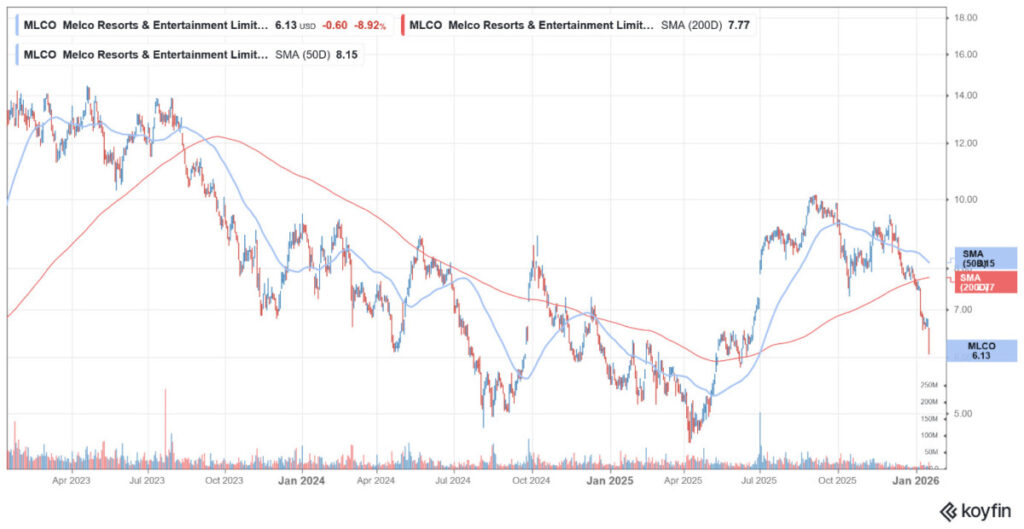
Melco Resorts, which was the biggest loser in the preceding week, also made it to the list of top losers last week. The most immediate catalyst for the drop was JPMorgan’s downgrade. Analyst Joseph Greff downgraded the stock from “Overweight” to “Neutral” while slashing the target price from $11 to $7.70.
Greff noted that while Gross Gaming Revenue (GGR) in Macau has been recovering, Melco’s profit margins are not keeping pace. This “profitless growth” is being blamed on higher operating expenses and a shift in the player mix that is less favorable to bottom-line earnings.
Melco’s decline was part of a broader caution across Macau gaming stocks. Several investment banks, including BofA and JPMorgan, flagged risks that 4Q25 earnings growth will lag revenue growth.
Notably, there are lingering concerns over the Macau market. The Macau government has projected 2026 GGR at approximately $29.4 billion, reflecting caution amid global economic uncertainties and external risks.
Also, there are concerns about rising labor costs at a time when growth is slowing. Earlier this year, Melco joined other major operators (like MGM China and Galaxy) in announcing a one-month discretionary bonus for non-management employees. While this supports staff retention, it signals higher operating expenses for the quarter.
Entain Plc. (LSE: ENT) –7.7%
Entain Plc shares dropped 7.7% last week. While there wasn’t any major company-specific announcement during the week, there are lingering concerns over the UK gambling market following the tax hike during last year’s Autumn Budget. Entain previously estimated that changes to remote gaming and betting duties could cost its UK & Ireland online business roughly £200 million annually.
Other Major Gaming Industry Developments
Last week, the Nevada Gaming Control Board filed a civil enforcement action against Polymarket. The regulator is seeking an injunction to stop the platform from offering unlicensed sports-event contracts, asserting that these constitute “wagering activities” that must be licensed under state law.
However, in a major reprieve for prediction market platforms, a federal judge in Nashville last week temporarily halted Tennessee from barring Kalshi from offering event contracts in the state.
Meanwhile, despite regulatory uncertainty, there are growing signs that Wall Street is warming to prediction markets. During Goldman Sachs’ Q4 earnings call last week, CEO David Solomon called prediction markets “super interesting” and confirmed that he had personally met with leaders of two major prediction market firms. This signals a significant shift as Wall Street banks begin to view event contracts as a legitimate new asset class for institutional hedging.
Across the Atlantic, the Court of Justice of the European Union (CJEU) issued a ruling granting EU citizens the right to seek legal recourse against gaming operators within their own jurisdiction, regardless of the company’s headquarters.