


Blackjack is one of the few casino games where a solid strategy can significantly boost your chances of success. It is also the one game where every other player at the table will have strong opinions on your decisions. To please them and also bend the odds in your favor, we recommend using a blackjack strategy chart. As it happens, we have one!
Key Beats
- A blackjack strategy chart helps you make the best decisions, based on your hand and the dealer’s upcard.
- Using a strategy chart can lower the house edge to less than 1%, boosting your long-term odds at the table.
- Learn how to read, decode, and understand the chart for every scenario and every format.
Why Use a Blackjack Strategy Chart?
A blackjack strategy chart is a mathematically-proven, visual roadmap that shows you the optimal decision for every possible hand you’ll face at the table. It compares your two cards with the dealer’s upcard and tells you exactly what your best possible play is.
Whether you’re just learning how to play blackjack or are a seasoned blackjack professional, these charts are perfect for fine-tuning your basic blackjack strategy. Every cell in the chart tells you the optimal blackjack move: to hit, stand, double down, split, or surrender.
By following the blackjack decision chart, players can reduce the house edge from around 2% to as little as 0.5%. That adds up and can soon make a huge difference when you are playing a lot of hands.
Of course, charts don’t guarantee a win – nothing does – but they ensure your choices are always mathematically sound and correct.
So why do you need to use a blackjack strategy chart? A better question might be, why wouldn’t you use one? With this tool you are statistically more likely to win.
How to Read & Apply the Chart
If you’ve never used one before, here’s how a blackjack chart typically works:
- The left column lists your hand total — both hard and soft.
- The top row lists the dealer’s upcard, from 2 through Ace.
- The intersecting cell tells you the optimal blackjack moves (consult the blackjack strategy chart for key codes).
For this example, we have used a multi-deck strategy chart where the dealer must stand on a soft 17 or higher.
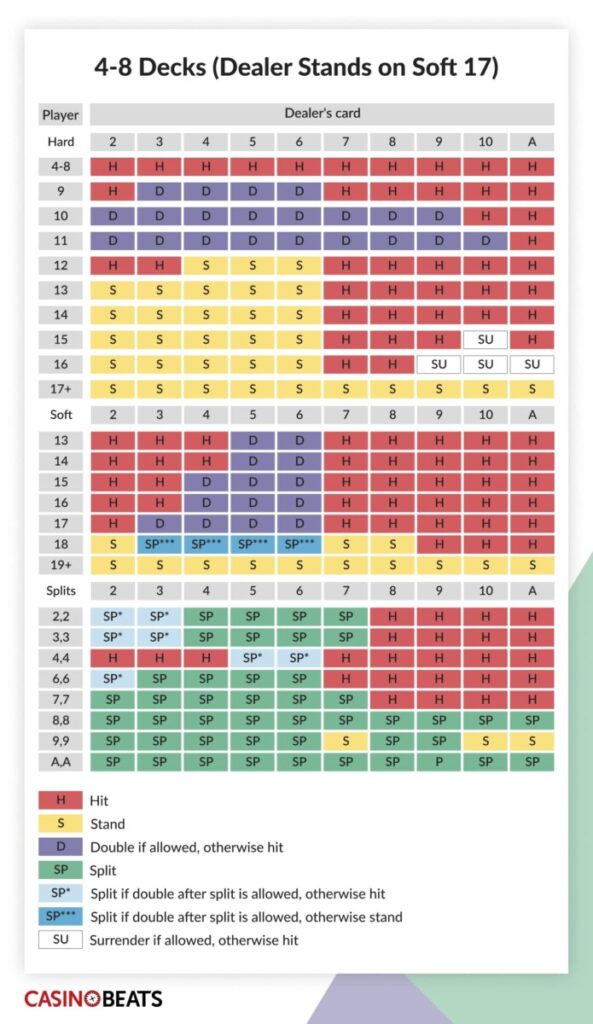
Using a blackjack chart for hitting and standing takes the guesswork out of the game. Once you understand how to read it, stay consistent.
Why the Chart Works: The Math Behind Counterintuitive Plays
Basic strategy isn’t based on guesswork or gut feeling — it was developed through computer simulations of millions of blackjack hands, calculating the expected value (EV) of every possible decision. EV tells you how much you win or lose per $1 wagered over time. The goal isn’t always to win the hand — it’s to lose less on the hands you’re likely to lose.
Here are the most commonly questioned plays, and why the math backs them up.
| Your Hand | Dealer Upcard | Correct Play | Why It Works |
|---|---|---|---|
| 12 | 2 | Hit | Hitting EV: -25% vs. Standing EV: -29%. Hitting loses less over time. |
| 12 | 4 | Stand | Dealer busts ~40% of the time. Standing lets the dealer beat themselves. |
| 14 | 4 | Stand | Dealer bust probability is high enough (40%) to make standing the lower-loss play. |
| 16 | 7 | Hit | Dealer likely has 17+. Standing is almost guaranteed to lose. Hitting gives you a chance. |
| 16 | 10 | Hit | Hitting EV: -54% vs. Standing EV: -54%. Near identical, but hitting marginally edges out standing. |
| 11 | 10 | Double Down | You’re most likely to land a 21. Doubling maximizes profit on your strongest position. |
| Soft 18 (A-7) | 9 | Hit | A 18 loses to dealer’s likely 19. Hitting gives you a chance to improve. |
| 8-8 | 10 | Split | Playing 16 as one hand is among the worst positions in blackjack. Two hands of 8 give you two fresh starts. |
The key principle: Basic strategy doesn’t tell you how to win every hand. It tells you how to make the decision that loses the least — or wins the most — across thousands of hands.
Over time, that’s what reduces the house edge from around 2% down to as little as 0.5%.
Variations by Deck Type & Rules
Not all games are created equal. Blackjack is no exception. The best blackjack strategy chart to reduce house edge will always depend on the game’s house rules and the number of decks in play.
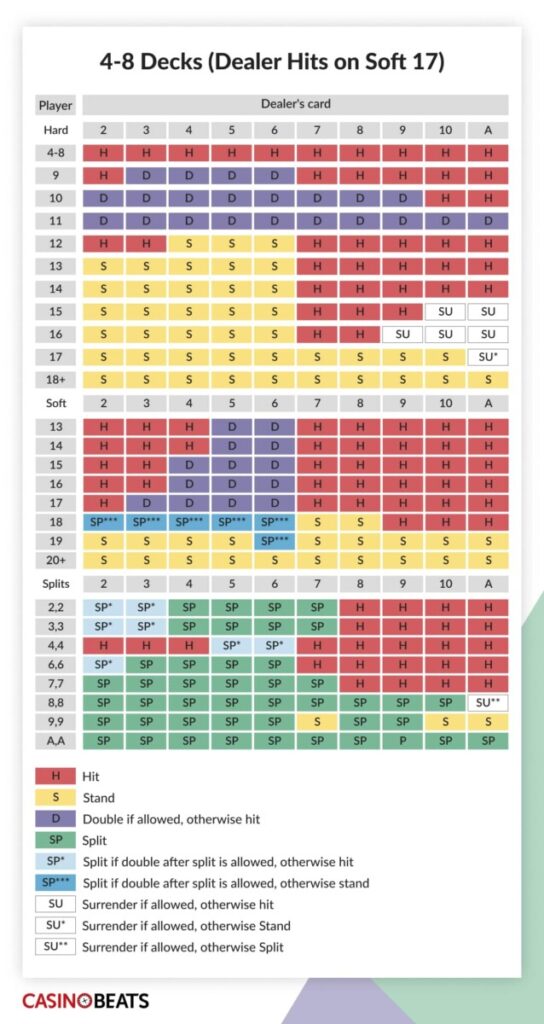
Variations on the rules of blackjack may include how blackjack insurance is offered or what constitutes a push. However, the main rule difference you will encounter is whether the dealer should stand or hit a soft 17. Below is the slightly different 4-8 deck blackjack strategy chart for when the dealer must hit on a soft 17.
Single Deck Blackjack Strategy Chart
Single-deck blackjack offers the lowest possible house edge (around 0.15%) when played correctly. Take a look at our single-deck blackjack tips and strategies for a complete single-deck blackjack strategy chart.
Using a Mobile Blackjack Decision Chart
If you’re playing blackjack on a mobile device, then there are scores of mobile tools that can improve your blackjack game. Many blackjack apps come with built-in strategy charts or allow you to upload your own. You can also download our printable blackjack strategy chart for casino play to keep with you.
Common Mistakes & Pro Tips
Even the best blackjack strategy chart can’t save your game if you’re reading it wrong. Here are some pitfalls to avoid:
- Confusing soft vs hard hands (an Ace-7 is not the same as a 7-10).
- Ignoring the dealer’s upcard strength.
- Deviating from the chart after a losing streak – that’s emotion, not logic.
Pro Tips for Chart Users
Next time you are playing at online blackjack casinos, here are some key things to think about.
| Tip | What To Do |
|---|---|
| Practice online first | Use free apps and simulators to test your decisions before playing for real money. |
| Memorize key decision points | Focus on tricky hands like 12–16 vs dealer 2–6. |
| Combine with bankroll management | Pair your chart use with structured systems, such as the 1-3-2-6 betting strategy. |
| Mind your seat | If you’re last to act (the ‘third base’ position), your decision can directly affect the dealer’s next card. Other players might blame you for ‘taking the dealer’s bust card’. Don’t let it rattle you. Stick to optimal blackjack moves, and the math will work out in the long run. |
| Stay discreet | Land-based casinos generally allow charts, but don’t push your luck. A quick glance at a blackjack chart for soft hands and splits on your phone is perfectly fine. |
Responsible gambling should always come first. Adopt proven safe gambling practices whenever you are gambling online.
FAQs
-
Can I use a blackjack strategy chart in a live casino?
Yes, most casinos allow it as long as it’s not disruptive. Keep a small printable blackjack strategy chart for casino play in your pocket or on your phone.
-
Do strategy charts guarantee wins?
No chart can override randomness. But following one ensures every decision you make is statistically optimal.
-
What’s the difference between soft and hard hands on the chart?
A soft hand includes an Ace counted as 11, while a hard hand doesn’t. Soft hands allow more aggressive plays.
-
Should you hit on 16 or 17?
On a hard 17, always stand regardless of what the dealer shows. On a hard 16, stand if the dealer shows 2–6 (they’re likely to bust), and hit if the dealer shows 7 or higher — your 16 won’t win by standing against a strong dealer hand.
-
Do you hit a 12 against a 2?
Yes. Most players stand here out of fear of busting, but the math says otherwise. Hitting 12 against a dealer’s 2 loses around 25 cents per dollar over time; standing loses around 29 cents. Hitting loses less, which is exactly what basic strategy is designed to do.
-
Should you always split Aces in blackjack?
Yes, always. Two Aces played as one hand gives you a weak soft 12. Split them and you have two separate chances to hit 21 — and it’s one of the few plays where the correct move is the same no matter what the dealer is showing.
-
What is the best strategy for blackjack?
Basic strategy is the best starting point for any player. Built from computer simulations of millions of hands, it tells you the correct play in every situation and reduces the house edge to as little as 0.5% — giving you the best possible odds at the table.