


Craps is a dice game where players bet on the outcome of two dice rolled by the shooter. Here’s how a round works:
- Place a Pass Line bet before the first roll.
- The shooter makes the come-out roll.
- Roll a 7 or 11 — Pass Line wins. Roll a 2, 3, or 12 — Pass Line loses.
- Any other number (4, 5, 6, 8, 9, or 10) becomes the Point.
- The shooter keeps rolling. Hit the Point before a 7 — Pass Line wins. Roll a 7 first — round ends.
That’s the core of the game. Everything else — odds bets, Come bets, Place bets — builds on these five steps.
Key Beats
- The Pass Line bet is your starting point — straightforward, low house edge, and the best bet for beginners.
- Once the come-out roll sets the Point, the round becomes a race: hit that number again before a 7 shows up.
- Avoid the center-table proposition bets. They look exciting but carry the highest house edge on the table.
- Odds bets are the only wager in the casino with zero house edge — always back your Pass Line bet with odds once a Point is set.
How to Play Craps: The Fundamentals
It can feel like being thrown in the deep end as a novice craps bettor, but take a look through our guide on how to play craps, and you’ll feel much more comfortable jumping into this game.
The Basic Concept of Craps
At its core, learning how to play craps dice is the foundation of the entire game — two six-sided dice are thrown by the shooter, and every bet on the table is determined by the outcome of those rolls. The objective of craps is to bet on the outcome of the roll of two dice. The most common bet is the Pass Line bet. This bet assumes that the shooter will roll a seven or an 11 on the first roll or hit a specific number (the Point).
If the shooter hits the Point before rolling a 7, it’s also a pass-line bet win for everyone.
The Shooter is the player who rolls the dice. At the start of a new round, a player places a Pass Line or Don’t Pass bet to be eligible to shoot. The roll rotates clockwise when a shooter ‘sevens out’ (rolls a seven after the Point is set). If you don’t want to be the Shooter, you can pass the dice to the next person.
The Come-Out roll is the first roll in a round and sets the stage for what happens next:
- If the shooter rolls a 7 or 11, Pass Line bets win (this is called a natural).
- If they roll a 2, 3, or 12, Pass Line bets lose (this is called craps).
- If they roll a 4, 5, 6, 8, 9, or 10, that number becomes the point.
Once a point is set (let’s say the shooter rolls a 6), the goal is to roll that number again before rolling a 7.
This changes the flow of the game; if the shooter rolls a six again, the Pass Line wins. If they roll a seven before that, the Pass Line loses (called a seven-out). The shooter keeps rolling until one of those two outcomes occurs. After all that, a new round begins.
Craps Table Layout
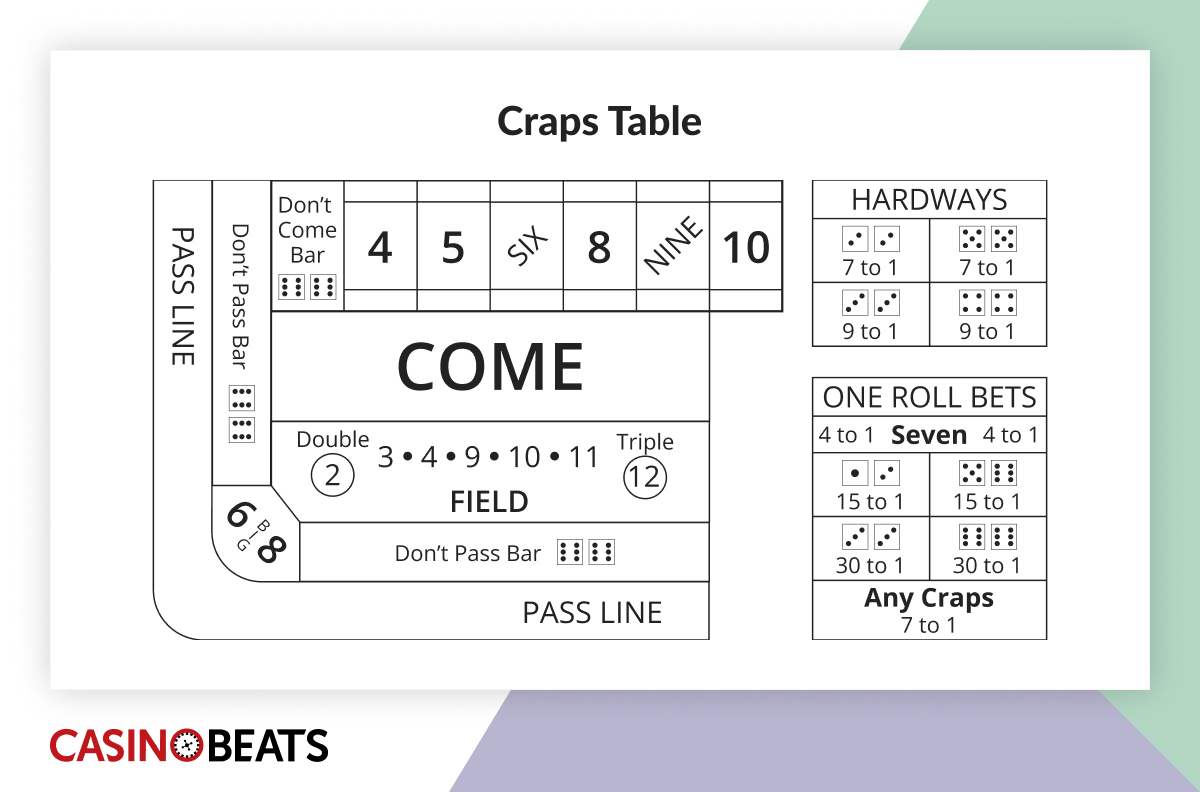
The craps table looks confusing at first. When you dig down, it all makes sense. Here are the basics:
- Pass Line / Don’t Pass Line: These are the classic even-money bets.
- Come / Don’t Come: Similar to Pass Line bets but placed after the point.
- Place Bets Section: Where players bet on specific numbers (4, 5, 6, 8, 9, 10).
- Proposition Bets (center table): Flashy but risky bets; high house edge and best avoided.
- Stick to the outer areas of the table for safer bets.
Craps is a high-maintenance game. You need at least three casino employees to run the game and maintain the craps table rules:
- Boxman: Oversees the table and handles chip issues.
- Stickman: Controls the dice with a stick and announces rolls.
- Dealers: Exchange chips and handle players’ bets.
Friendly Advice: Don’t be shy. Dealers are used to helping new players. Let them know you’re learning, and they will guide you through the game and show you how to play casino craps.
Craps Gameplay: Step-by-Step Guide
Now that we’ve broken down the basics of craps, let’s take a look at a step-by-step guide on the gameplay itself.
Step 1: Getting Started
- Buy chips: Never hand cash directly to the dealer. Wait until the dice are in the center of the table, then place your money on the felt. The dealer will swap it for chips and put them in front of you.
- Nominate a Shooter: The shooter is usually the first player to place a Pass Line bet when a new game starts.
- Handle the dice correctly: Always use one hand. Keep the dice above the table, throw them so they hit the back wall, and make sure they bounce. Dropping or sliding them isn’t allowed.
Step 2: Placing Your First Bet
Before the first roll (called the come-out roll), players must choose:
- Pass Line – betting with the shooter.
- Don’t Pass – betting against the shooter.
Step 3: The Come Out Roll
The shooter rolls the dice for the first time. The result determines what happens next:
- 7 or 11 (“Natural” / “Yo”) – Pass Line wins, Don’t Pass loses.
- 2, 3, or 12 (“Snake Eyes,” “Ace-Deuce,” “Boxcars”) – Pass Line loses.
- Don’t Pass wins on 2 or 3, but 12 is a push (tie).
- 4, 5, 6, 8, 9, or 10 – A “Point” is set, and the game moves to the next phase.
Step 4: Hitting the Point or Sevening Out
If a Point is set (say, 6), the shooter keeps rolling:
- Rolls the Point (6) – Pass Line wins, and the shooter continues with a new come-out roll.
- Rolls a 7 first – “Seven-out.” Pass Line loses, the round ends, and the dice pass to the next shooter.
Rolls any other number – The game continues until the Point or a 7 appears.
Step 5: Switching Shooters
If the shooter “sevens out,” their turn is over, and the dice move clockwise to the next player. If the shooter makes the Point, they keep rolling into the next round.
You only have to shoot if the dice come to you and you’ve placed a Pass/Don’t Pass bet. If you’d rather not, you can pass the dice along.
Quick Reference: Come-Out Roll Outcomes
| Roll | Nickname | Result |
|---|---|---|
| 7 | Natural | Pass Line wins |
| 11 | Yo | Pass Line wins |
| 2 | Snake Eyes | Pass Line loses (Don’t Pass wins) |
| 3 | Ace-Deuce | Pass Line loses (Don’t Pass wins) |
| 12 | Boxcars | Pass Line loses (Don’t Pass is a push) |
How to Bet on Craps
Getting to grips with basic craps rules is key to enjoying the game and avoiding costly mistakes.
Pass Line Bet
Place it before the come-out roll. It means you’re betting that the shooter will win by rolling a seven or 11 on the come-out or hitting the point before rolling a seven. The payout: 1:1
- Example: You bet $10 on the Pass Line:
- The shooter rolls seven or 11. You win $10.
- The shooter rolls four. That’s now the point.
- If they roll a four again, before a seven, you win $10.
Don’t Pass Bet (Betting against the shooter)
You place it before the come-out roll, which means you’re betting that the shooter will lose by rolling a two, three, or 12. The payout: 1:1
- Example: You bet $10 on Don’t Pass.
- The shooter rolls two or three. You win $10.
- The shooter rolls 12; it’s a push (tie).
- If a point is set, you win if the shooter rolls a seven before the point.
Come Bet (Like a new Pass Line bet)
Place this after the point is set. It acts like a mini-game for you: your next roll is your personal come-out roll.
- If 7 or 11 is rolled, you win.
- If 2, 3, or 12 is rolled, you lose.
Any other number becomes your Come Point. If that number is rolled again before a 7, you win.
Don’t Come Bet (Like a Don’t Pass mid-round)
You place this bet after the point is set. This is the opposite of the Come bet. You are betting against the new roll. You win if the shooter rolls a seven before your Don’t Come point is hit.
Place Bets
Place bets can be made at any time, but are typically placed after the Point is established. You’re betting that a specific number will be rolled before a 7. Most players place bets on 6 or 8. They hit more often and offer the best odds. For example, you bet $6 on Place Six.
- If the shooter rolls a six before a seven, you win $7.
- If a seven comes first, you lose your $6.
| Place Bet Number | House Edge | Payout |
|---|---|---|
| 6 or 8 | ~1.52% | 7:6 |
| 5 or 9 | ~4.00% | 7:5 |
| 4 or 10 | ~6.67% | 9:5 |
Sucker Bets to Avoid
These are bets with high house edges. They are designed to tempt, but usually just drain your bankroll.
| Bet | Why to Avoid | House Edge |
|---|---|---|
| Hardways | Requires doubles to hit specific totals | 9-11% |
| Any 7 | One-roll bet that seven will come up | 16.9% |
| Horn Bets | Flashy high-risk bets on 2, 3, 11, or 12 | 12.5%+ |
| Proposition Bets | Centre-table one-roll bets with poor odds | Varies but bad |
If it’s in the center of the table and sounds exciting, it’s probably a sucker bet. When learning, stick to Pass Line, Come, and Place 6/8.
Craps Betting Strategies
Craps is a fast-moving game. Stick to simple, low-risk bets to maximize your bankroll, build your confidence, and enjoy some time at the table. Here are three options:
Pass line + odds strategy
Place a Pass Line bet before the come-out roll. Once a point is set, take full odds behind your Pass Line bet. Why? Odds bets have no house edge. They pay true odds.
Example: Bet $10 on the Pass Line. Point is six. You place $10 in odds. If six is rolled again, you win $10 (Pass Line) + $12 (odds at 6:5).
✔️ Low complexity
✔️ Low house edge
✔️ Great way to build confidence
Place 6 & 8 strategy
Wait until a point is established. Then place bets on six and eight (they’re rolled the most after 7). Bet in units of $6 to get proper payouts (7:6).
Example: Place $6 on six and $6 on 8. If six or eight is rolled before a 7, you win $7. You can press (increase) or collect winnings.
✔️ Easy to follow
✔️ Frequent wins
✔️ Slower loss rate
Don’t pass with lay odds
Place a Don’t Pass bet before the come-out roll. After the point is set, place lay odds behind your bet (betting a seven comes before the point is hit). This is for players who don’t mind going against the table vibe.
Example: You bet $10 on Don’t Pass, and the point is ten. You lay $20 in odds (pays 1:2). If seven comes before ten, you win $10 + $10.
✔️ Still low house edge
✔️ Wins come more frequently
✔️ Less risky long-term
Why Odds Bets Are the Best Value in the Casino
Odds bets are the best value in the casino because they pay true mathematical odds (no built-in house advantage). You can add them only after a point is set on a Pass, Come, Don’t Pass, or Don’t Come bet. The more odds you take (if the casino allows 2x, 3x, 5x), the lower the house edge on your bet.
And as a helpful tip, always back your Pass/Don’t Pass with odds if your bankroll allows; even small amounts help.
Playing Craps in Different Environments
The rules of craps remain the same in different environments, but it’s worth noting that your overall experience can be different. Below, we’ll cover the key differences between playing craps at a casino and playing craps online.
How to Play Craps at a Casino
Look for tables with low minimums. If you want to know how to play craps in Vegas specifically, head to downtown casinos rather than the Strip — minimums are lower, tables are less crowded, and the atmosphere is more forgiving for beginners. Peak times are more exciting but can be intimidating. Try early afternoons or weekdays to learn the ropes.
Be polite and respectful to dealers and fellow players. They can help you out. Tip periodically if you’re winning or enjoying good service.
Casino Craps Checklist:
✅ Bring ID and cash
✅ Know basic etiquette
✅ Stick to beginner bets
✅ Practice patience
How to Play Craps Online
There are two main types of online play, which can also be played internationally at offshore casinos.
- Live dealer craps: Streamed from real tables: social and immersive.
- RNG craps: Fast and controlled by a random number generator.
You need to look for low-house-edge games, user-friendly interfaces, and demo or free-play modes.
How to Play Craps at Home
Want to bring the action to your living room? You’ll need the following equipment:
✅ Dice (two six-sided)
✅ A layout or mat (optional)
✅ Chips or counters
✅ A basic understanding of craps table rules
For casual games, it’s best to use simplified rules like Skip Come/Don’t Come bets. Rotate the shooter after each round and always keep the game light-hearted and fun.
How to Play Bubble Craps
Bubble craps is an electronic version of the game played on a self-contained machine with a clear dome enclosing real dice. There’s no shooter, no stickman, and no dealer — the machine rolls the dice automatically. If you’re looking to learn how to play bubble craps, it’s the ideal starting point — you play at your own pace with no social pressure and lower minimum bets than a live table.
Key differences from table craps:
- You play solo or alongside other players at individual terminals
- Bets are placed on a touchscreen rather than a felt layout
- The pace is slower — you control when the dice roll
- Minimum bets are typically lower than live tables
- Available at most large casinos, particularly in Las Vegas
The betting rules are identical to standard craps. Pass Line, Don’t Pass, Come, Place bets — all work the same way. If you’re nervous about joining a live craps table for the first time, bubble craps is the best place to practice with real money at low stakes.
Conclusion
There is no question that, at first glance, craps can appear to be one of the most confusing games in the casino; it’s intimidating, brash, and noisy. Often crowded with players who know precisely what they are doing.
However, like many of the best things in life, it’s worth exploring. Dig into this game and you’ll find genuine fun, plus one of the only bets in the casino with no house edge.
With some knowledge and a few practice rounds, you’ll be rolling high. Start with the Pass Line bet, add Odds when you’re ready, and avoid the tempting sucker bets. Enjoy the ride responsibly and roll with the best.
FAQs
-
What are the basic rules of craps?
Craps is a dice game where players bet on the outcome of two dice. On the come-out roll, a 7 or 11 wins the Pass Line bet, while a 2, 3, or 12 loses it. Any other number becomes the Point, and the shooter must roll that number again before rolling a 7 to win.
-
How do you bet on craps for beginners?
Start with the Pass Line bet — place your chips on the Pass Line before the come-out roll. It’s the simplest bet on the table, pays 1:1, and carries a house edge of just 1.41%. Once a Point is set, back your bet with an odds bet for the best value in the casino.
-
What is the most successful craps strategy?
The Pass Line plus odds strategy gives you the best long-term results. Place a Pass Line bet, wait for a Point to be set, then add an odds bet behind it. Odds bets carry zero house edge, bringing your overall edge as low as possible. Combining this with Place bets on 6 and 8 keeps variance low.
-
What not to do at a craps table?
Avoid proposition bets and hardways in the center of the table — house edges run from 9% to nearly 17%. Don’t hand cash directly to the dealer; place it on the felt. Never use two hands when handling the dice, and always make sure the dice hit the back wall on every throw.
-
Why bet $6 on 6 and 8 in craps?
Six and 8 are the most frequently rolled numbers after 7, each with five ways to appear out of 36 possible dice combinations. Place bets on 6 and 8 pay 7:6, meaning you need to bet in multiples of $6 to receive the full payout. A $6 bet returns $7 — any other amount results in a rounded-down payout.
-
What are the most common mistakes new craps players make?
The three most common mistakes are betting on proposition bets before understanding the house edge, failing to add odds bets behind a Pass Line bet, and joining a game mid-round without knowing the current Point. Starting with Pass Line only and learning the flow of a full round eliminates most beginner errors.
-
How do you play street craps?
Street craps is a simplified version of the game played without a table or casino structure. One player acts as the shooter and sets a wager; others bet against or alongside them. The core rules apply — roll a 7 or 11 to win, roll a 2, 3, or 12 to lose, and any other number becomes the point to hit before a 7.
-
How do you play crapless craps?
Crapless craps is a casino variant where rolling a 2, 3, or 12 on the come-out roll doesn’t immediately lose — those numbers become Points instead. It sounds beginner-friendly, but the house edge on the Pass Line jumps from 1.41% to around 5.38%, making it a worse bet than standard craps despite the reduced risk of crapping out.