


Roulette is a casino table game where players bet on where a ball will land on a spinning wheel. The wheel contains numbered pockets from 1–36, plus one or two zeros. Place your bet, spin the wheel, and win if the ball lands on your chosen number, color, or group.
How to play roulette:
- Choose a table — European roulette has the lowest house edge at 2.7%.
- Exchange cash for chips.
- Place your bet on the numbered layout before the dealer closes betting.
- Watch the wheel spin and the ball drop into a pocket.
- Collect your payout if your bet wins — or place a new bet and repeat.
Key Beats
- Learn the rules, table layout, and differences between European, American, and French wheels so you know which version to play.
- Inside bets offer higher payouts but lower odds, while outside bets give you nearly 50/50 chances, which is the best place for beginners to start.
- Try online roulette to practice risk-free, explore betting systems like Martingale or Fibonacci, and always manage your bankroll responsibly.
Roulette Table Layout Explained
Before placing your first bet, it helps to understand how the roulette betting table is structured. The layout is designed to show all possible betting options in one place.
At the center of the table is the number grid, which contains numbers from 1 to 36 arranged in three vertical columns. These are where inside bets are placed, including straight-up, split, street, corner, and line bets.
Surrounding the number grid are the outside betting areas. These sections allow players to bet on broader outcomes such as red or black, odd or even, high or low numbers, dozens, and columns.
Although the layout can look overwhelming at first glance, it quickly becomes intuitive once you understand that every position on the table corresponds to a specific bet type. Online roulette tables use the same structure as casino tables, making it easy to move between the two.
Roulette Bets & Odds Explained
The rules of roulette are straightforward — place your bet before the dealer closes betting, watch the spin, and collect your payout if you win. Roulette is a game of chance. It’s not a career option. No strategy can improve your odds of winning.
However, you can make wise choices. Understanding roulette odds, bet types, and the risk versus reward is key to maximizing your time at the table. There are two main categories of roulette bets: inside bets and outside bets.
Inside Bets Mean Larger Payouts
These are placed on specific numbers or small groups of numbers. Inside bets offer higher payouts in exchange for lower chances of winning.
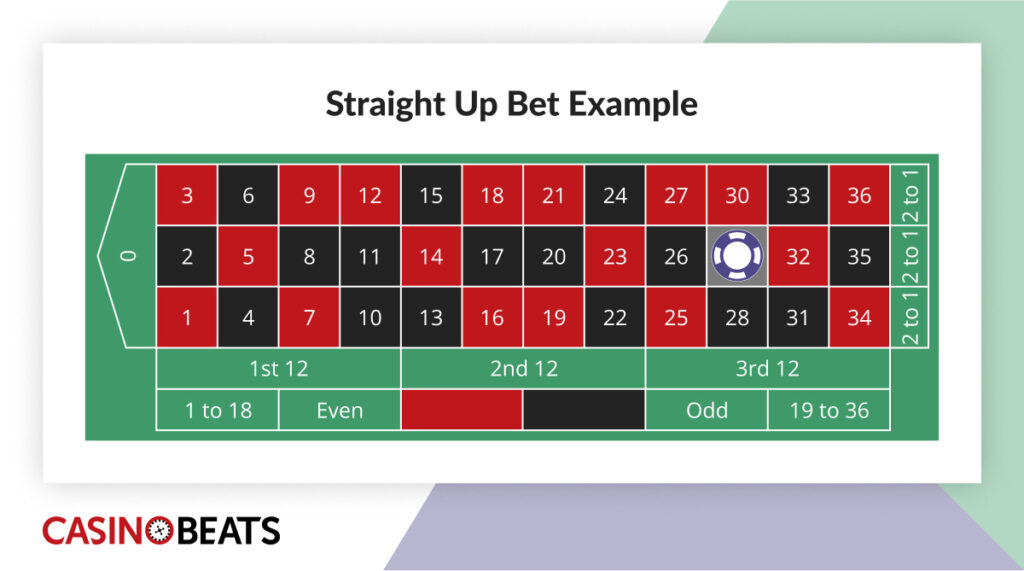
Straight Up
Bet on a single number. Payout: 35:1
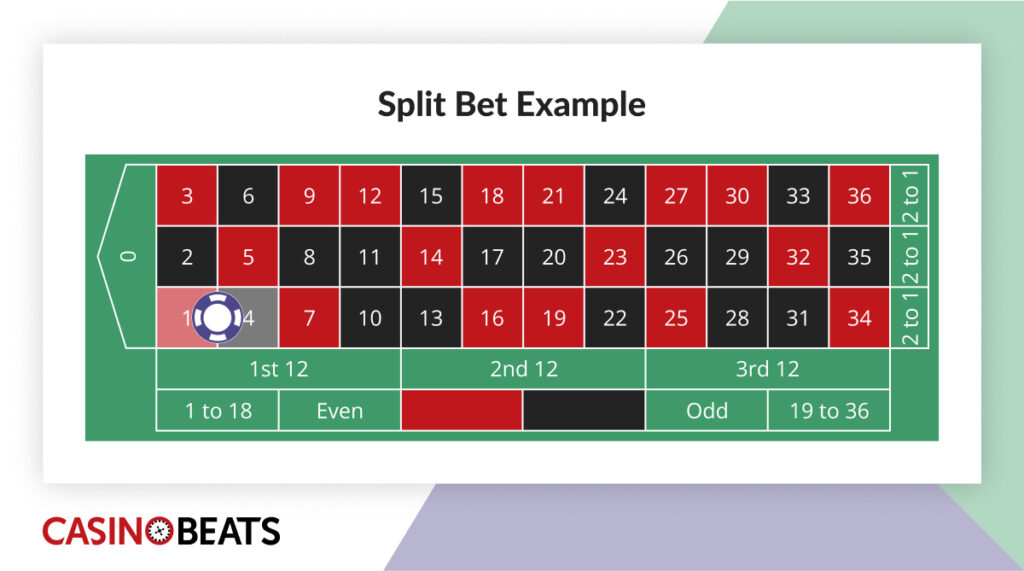
Split
Bet between two adjacent numbers. Payout: 17:1
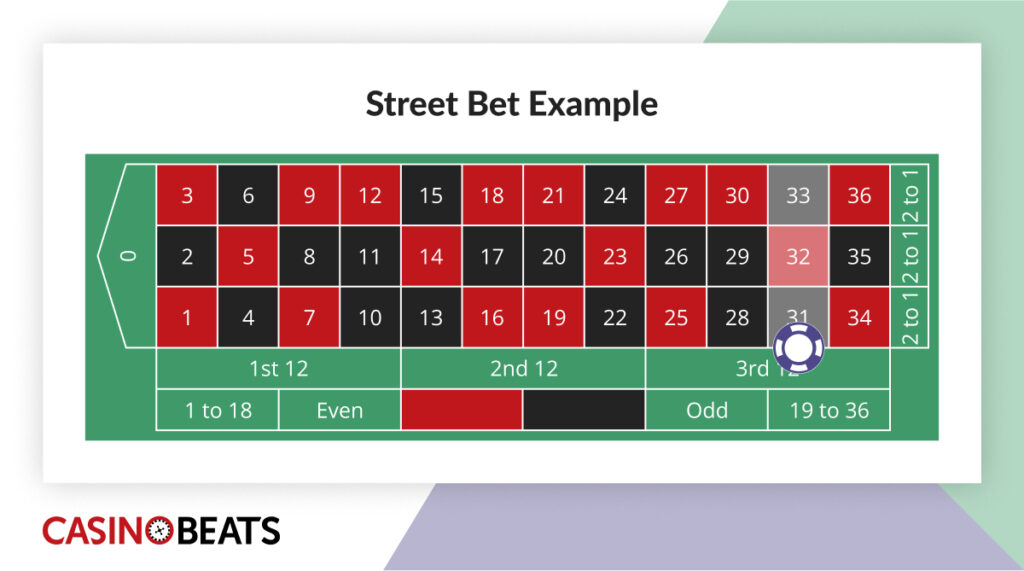
Street
Bet on a row of three numbers. Payout: 11:1
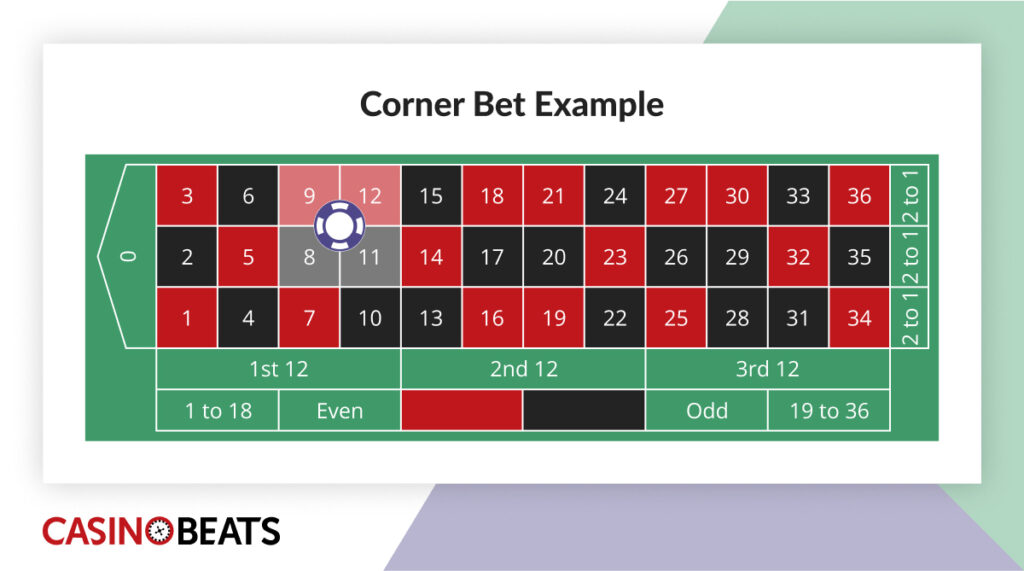
Corner
Bet on a square of four numbers. Payout: 8:1
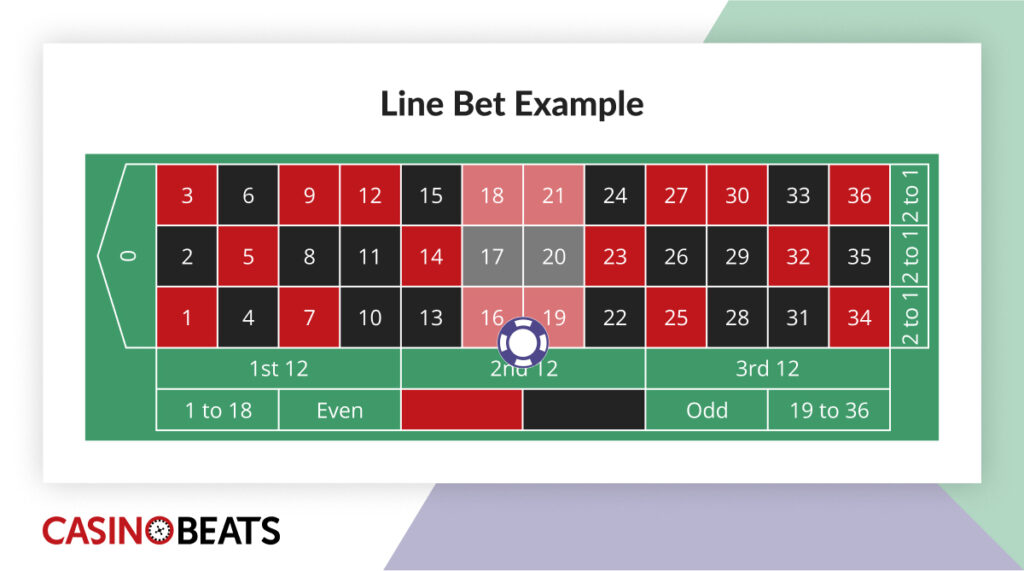
Line (Double Street)
Bet on two rows (six numbers). Payout: 5:1
Outside Bets Lead to Smaller Payouts
These cover larger groups of numbers and offer lower payouts but higher chances of winning. They are made outside the central numbered betting area. Ergo: ‘outside’.
- Red or Black
- Odd or Even
- High or Low (1–18 or 19–36). Each pays 1:1
- Dozens (1–12, 13–24, 25–36). Payout: 2:1
- Columns (vertical set of 12 numbers). Payout: 2:1
Risk vs. Reward
| Bet Type | Payout | Probability | Risk Level |
|---|---|---|---|
| Straight Up | 35:1 | 2.7% | High |
| Split | 17:1 | 5.4% | High |
| Street | 11:1 | 8.1% | Medium |
| Red/Black | 1:1 | 48.6% | Low |
| Even/Odd | 1:1 | 48.6% | Low |
| Dozen/Column | 2:1 | 32.4% | Medium |
Recommended Bets for Beginners
If you’re new to roulette and you want to make your bankroll last for more than a few spins, start with some basic outside bets:
- Red/Black
- Odd/Even
- High/Low
These bets are simple, easy to track, and give you nearly 50/50 odds. You’re not going to win big. You just double your money. The zero will make all the outside bets a loss if it lands on that.
Of course, you won’t win every time. However, you’ll stay in the game longer and get a feel for how roulette works.
An Example of a Winning Roulette Hand
Let’s say you place $5 on Red, $2 on the First Dozen (1–12), and $1 on Number 7 (Straight Up). The ball lands on Red 7. Here’s your return:
- Red (1:1): Win $5
- First Dozen (2:1): Win $4
- Straight Up (35:1): Win $35
- Total Winnings: $44 from an $8 stake
You’ve just scored a roulette hat trick. It’s rare, but it does happen. One of the primary attractions of roulette is the possibility of a substantial win. If you are lucky enough to land a loaded single, you’ve usually paid for your night out.
Winner winner, chicken dinner. One lucky spin can change the entire session.
How to Play Roulette Online: Detailed Walkthrough
How do you play roulette online? The process is identical to a casino table — place your bet, spin the wheel, collect your payout — but from anywhere, at your own pace. Free from peer pressure, impatient croupiers, and disgruntled gamblers at the thin end of their bankroll, you can take the time to learn the bets, the probabilities, the options, and the reality of roulette.
- Choose a reputable online casino
It’s obvious, but don’t forget it. Make sure you’re betting with the best. Find a trustworthy place to play.
- Pick your roulette table
Most platforms offer dozens of different versions of the roulette game. To start, pick European roulette. With just a single zero in play, it has the lowest house edge of all the games.
- Understand the betting layout
Get to grips with the layout. At first glance, the roulette betting layout looks confusing. Once you get your head around it, you will realize it is a design classic, clearly displaying all the possible bet types, from straight-up numbers to red/black and odd/even.
- Place your bet
Once you’ve got your betting bearings, just click or tap on your chosen area of the table to make a bet. Set your stake. Pick your spot and hit spin.
- Spin and watch the result
Once the bets have closed, the wheel spins until the ball drops into a slot. The result will be displayed. If you have won, your account will be automatically credited with any winnings.
Key Differences: Online vs. In-Person Roulette
There are some key differences between online roulette and in-person roulette. The table below covers the basic variations between the two.
| Feature | Online Roulette | Casino Roulette |
|---|---|---|
| Convenience | Play anywhere, anytime | Must visit a physical location |
| Pace | Faster, player-controlled | Slower, dealer-controlled |
| Atmopshere | Simulated or live-dealer | Immersive, social, lively |
| Betting chips | Visual interface | Color-coded physical chips |
| Table limits | Wide range, low minimums | Higher minimums |
| Game variants | Easy access to all types | Usually limited to one or two styles |
Popular Roulette Systems: Quickfire Overview
Knowing how to play roulette strategy means understanding that no system beats the house edge — but some approaches help you stay in the game longer. There is no strategy for predicting the outcome of roulette. However, there are some intriguing mathematical formulas designed to extend your bankroll. Most work only on even money bets. Whilst they are ingenious, none of them has any effect on the house edge.
Here’s a summary of the best-known betting systems:
Martingale system
Double your bet after every loss to chase a single win.
Reverse martingale (Paroli)
Increase your bet after a win, not a loss.
D’Alembert system
A gentler progression: increase bets by one unit after a loss, decrease after a win.
Fibonacci system
Follow the famous sequence to structure your bet progression.
Labouchère system
Cross numbers off a betting line as you win; add to it when you lose.
James Bond strategy
A flat betting system covering high and low ranges in one go.
Oscar’s grind
Small, measured bets to lock in gradual profit.
How to Play Roulette at a Casino
Are you ready for the real thing? Online is fine, but it’s not the same. If you’re heading to the casino, roulette is the perfect game to play. There’s no strategy. There’s no skill. You just need the nod from Lady Luck. Here are some pointers to keep you looking cool, and in control, at the casino:
- Find the right table. Tables are usually labelled with minimum and maximum bet limits. Find the price that suits your budget.
- Buy chips. Unlike online play, in the casino, you exchange your cash for color-coded chips. These are specific to your session and can’t be used elsewhere. Don’t worry: the croupier knows what’s what.
- Place your bets. Wait for the dealer to say ‘Place your bets!’ and put your chips on those (winning!) numbers, lines, corners, and combos. Stop betting when the dealer says, ‘No more bets.’
- Watch that etiquette. Be cool and be respectful. It’s not the croupier’s fault that you keep missing your number by one pocket. Don’t touch the chips after the spin and avoid leaning over the table when the game’s in motion.
- Wait for payouts. If you win, the dealer will put a dolly on top of the winning number. The remaining chips are swept away.
American vs. European Roulette: Which Should You Play?
The most important decision before you sit down is which version of roulette you are playing. The wheel layout directly affects your odds, and the differences are significant enough to matter on every single spin.
| Feature | European Roulette | American Roulette | French Roulette |
|---|---|---|---|
| Pockets | 37 (0–36) | 38 (0, 00, 1–36) | 37 (0–36) |
| House Edge | 2.70% | 5.26% | 1.35%* |
| Single Zero | Yes | Yes | Yes |
| Double Zero | No | Yes | No |
| La Partage Rule | No | No | Yes |
| Best For | Beginners | Avoid if possible | Outside bet players |
*French roulette house edge of 1.35% applies to even-money bets only under La Partage rules.
European roulette is the standard choice for most players. The single zero keeps the house edge at 2.7% and it is available at virtually every online casino and most physical ones.
American roulette adds a double zero pocket, which nearly doubles the house edge to 5.26%. The bets and payouts are otherwise identical to European. You are getting a worse deal for the same game. Avoid it unless it is your only option.
French roulette uses the same single-zero wheel as European but adds two player-friendly rules. La Partage returns half your even-money stake if zero lands. En Prison holds your bet for the next spin instead. Either way, the house edge on even-money bets drops to 1.35% — the best odds available in roulette.
Our Expert Tips for Playing Roulette
If there was one singular tip to take to the roulette table, it’s this: have fun. Roulette is about managing both your mindset and your bankroll.
The two are fundamentally interlinked. Here are our top tips to help you stay in control and enjoy the game for longer.
Observe Before You Play
What’s the rush? Before you dive in, spend a few spins watching the table.
- Online: watch how quickly the game moves and where the betting options are. Some platforms offer demo modes. Use them.
- In-Person: take note of table limits, how the dealer interacts, and the pace of the game.
Bankroll Management: Set a Budget and Stick to It
Roulette is relatively quick, and so are the losses if you don’t plan.
- Set a maximum limit before you start playing.
- Break your bankroll into smaller session chunks.
- Avoid the temptation to increase your bet size after a loss (also known as the Martingale trap – see below).
- Gamble responsibly and only with funds you can afford to lose, as there aren’t ever guaranteed wins in betting.
Mix Up Your Bets Without Overcommitting
While outside bets like red/black or odd/even keep things steady, sprinkling in the occasional inside bet can add excitement without blowing your budget.
- Use small wagers on individual numbers or sections of the wheel for bigger potential payouts.
- Keep your main bankroll focused on safer bets so you’re not overexposed.
Know When to Walk Away
It’s easy to get caught up in the excitement, but knowing when to bail out is crucial.
- Set both win goals and loss limits. ‘If I double my bankroll, I’ll cash out. If I lose half, I’ll stop.’
- Don’t chase losses. The wheel doesn’t owe you anything.
Conclusion
Roulette is the perfect casino table game. The house edge is elegantly represented by the zero. The odds of the game are displayed in a brilliantly designed format.
Easy to play, simple to understand, and full of drama. Where will the ball stop? Will my number hit? Should I play even-money bets or try to pick a single number? For most people, roulette is the first game they try at the casino. Why not find out why? If you’ve never tried it, give it a spin.
FAQs
-
What are the basic rules of roulette?
Place your bet on the table layout, the dealer spins the wheel, and you win if the ball lands on your chosen number or outcome. Bets must be placed before the dealer closes betting. Once the ball drops, no changes can be made. Note that zero is neither red nor black — all even-money outside bets lose if it hits.
-
What is the safest bet in roulette?
The safest bets are the even-money outside bets: red/black, odd/even, and high/low. Each covers 18 of the 37 pockets on a European wheel, giving you a 48.6% chance of winning and a 1:1 payout. In French roulette, the La Partage rule returns half your stake if zero lands, cutting the house edge to 1.35%.
-
What is the most successful roulette strategy?
No strategy beats the house edge — the math is fixed. The most popular systems are Martingale (double after each loss), D’Alembert (increase by one unit after a loss), and Fibonacci (sequence-based progression). For bankroll longevity, D’Alembert is the most conservative. All three only work on even-money bets and none change your long-term odds.
-
How much do you win if you bet $10 on a number?
A $10 straight-up bet pays 35:1. If it wins, you receive $350 in winnings plus your $10 stake back — $360 total. The catch is that a single number hits roughly 2.7% of the time on a European wheel, so while the payout is significant, it is a high-risk bet that will lose far more often than it wins.
-
What is the best bet in roulette for beginners?
Red/black, odd/even, and high/low are the best starting bets. They are simple to place, easy to track, and give you close to a 50/50 chance on every spin. They pay 1:1, so you won’t win big, but they keep you in the game longer and help you get comfortable with how roulette works before trying riskier bets.
-
How do roulette payouts work?
Payouts are based on how many numbers your bet covers — fewer numbers means a higher payout. A straight-up bet on one number pays 35:1. A split across two numbers pays 17:1. Outside bets covering roughly half the wheel pay 1:1. The zero is what gives the house its edge, as it is not covered by any standard outside bet.