









Paul started his career in newspaper journalism before exploring the emerging world of online gaming in 1998, joining Intertops in Antigua - the pioneering force behind the first online sportsbook. Since then, Cullen has enjoyed...
Read Full Bio
Nick Shepherd Contributor
Nick is an ex-casino manager turned PR specialist. He began his career as a croupier in the UK, and went on to work in Europe, Russia, Africa, Asia, and the USA. Previously he has worked...
Read Full BioProvably fair slots are more than just another casino trend. They are a fundamental shift in how players evaluate and experience trust online. By harnessing blockchain verification, these games turn every spin into something transparent, testable, and empowering. Which begs the question: Are the days of the RNG numbered?
Key Beats
- Provably fair slots utilize blockchain-style cryptography, allowing players to verify that every spin is random and untampered with.
- They’re changing player psychology and trust, turning skepticism into loyalty through transparency and control.
- Adoption is skyrocketing, with crypto casinos leading the way and hybrid operators following closely.
Are online slots giving you cause for concern? Do you get the feeling that you’re being taken advantage of? Well, worry no longer, as we seek to explain provably fair gambling and why it may just conquer the world.
What Are Provably Fair Slots?
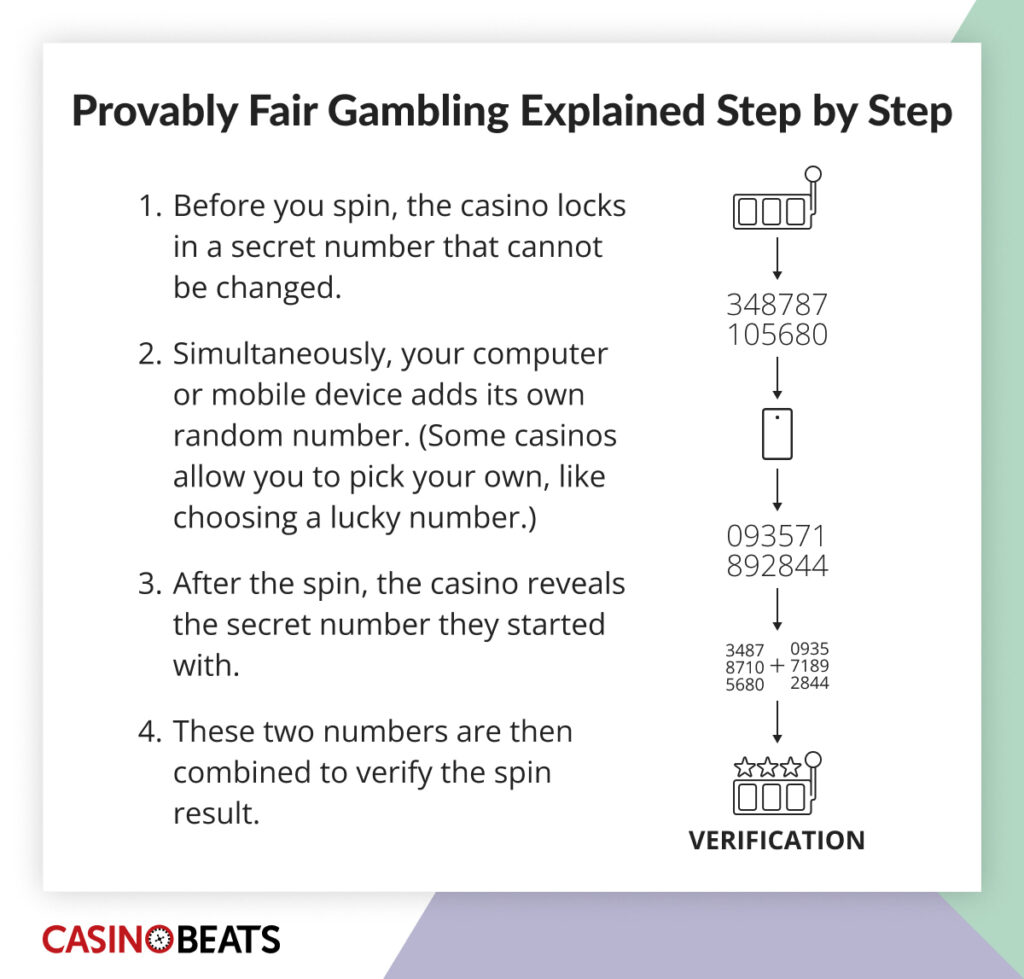
Provably fair slots are online slot games that allow players to independently verify the fairness of every spin. They use a provably fair slot algorithm to prove that the casino didn’t manipulate the outcome of a game round.
The process relies on three building blocks:
- ✅ Server Seed: a secret number generated by the casino.
- ✅ Client Seed: a number provided by the player’s device, which can be chosen manually.
- ✅ Nonce: a counter that increases with each spin, ensuring results can’t be duplicated.
Before play begins, the casino provides an encrypted version of the server seed, known as a hash. Hashes are irreversible, so the casino can’t change them mid-game. Once the spin is complete, the casino reveals the original server seed, allowing the player to combine it with their client seed and nonce to check the outcome.
What if every single spin of an online slot could be precisely verified for fairness, allowing you to remove the question of ‘trust’ from the equation? That’s the bold promise behind provably fair slots, a new generation of blockchain-powered games where every result is verified in real time.
This stands in sharp contrast to traditional RNG slots, where the random number generator works invisibly behind closed systems.
Provably Fair Slots: The Quest to Eliminate Doubt
In an industry built on chance, fairness has always been both the cornerstone and the question mark. Traditional slot players rely on random number generators (RNGs), but the process is hidden behind black-box software.
Provably fair systems flip that dynamic by giving players the tools to confirm outcomes themselves. This isn’t just a technical upgrade. It’s a fundamental shift in how players experience trust.
Provably Fair Slots vs. Traditional Slots
To understand why provably fair slots are shaking up the market, it is helpful to compare them directly with traditional online slots.
Traditional real money slots rely on random number generators (RNGs). These algorithms are tested and certified by regulators. However, the actual process is hidden from players. You’re asked to trust that the maths has been done correctly and that auditors have kept the operators honest.
Provably fair slots put that power in the player’s hands. Instead of invisible RNGs, each spin produces cryptographic proof. You receive the casino’s hashed number upfront, and your device adds its own. In this way, you can check that the outcome matches both inputs. Here’s how the two models compare:
| Feature | Traditional Slots | Provably Fair Slots |
|---|---|---|
| Outcome | Hidden RNG | Provably fair slot algorithm |
| Transparency | Regulated and audited | Players verify the results themselves |
| Third-Party Role | Testing labs and regulators) | Optional – proof is built in |
| Player Input | None | Client seed can be customised |
| Verification | Not possible | In-game or third-party verification tools |
| Trust Model | Faith-based | Math-based |
For players, the difference is simple: traditional slots scream trust me, while provably fair slots say see for yourself.
Provably Fair Doesn’t Mean Generous
It’s essential to understand what provably fair doesn’t guarantee.
It does not prove that the slot’s long-term RTP (Return to Player) is as generous or even as advertised. A casino could, in theory, create a provably fair slot with an RTP of just 10% and it would still count as ‘provably fair’, because the results are mathematically verifiable.
Provably fair is all about honesty, not value for money.
Gameplay Experience & Design Evolution
The gameplay of provably fair games can vary significantly, depending on the platform. At one end of the spectrum, crypto-native casinos often strip things back to bare-bones, reels, bet sizes, and a ‘provably fair’ tab where players can customize seeds or verify results.
It’s minimalist, functional, and aimed squarely at transparency.
At the other end, traditional slot providers exploring the provably fair space are starting to blend the technology with the atypical themes that slot players expect, such as Egyptian themes, neon fruit slots, and branded slots.
In these hybrids, the fairness tools often sit quietly in the background, available if you want them but not in the way of the fun.
Verification Tools
A hallmark of provably fair design is the inclusion of verification tools. Players can open built-in validators to check previous spins, customise their client seed for extra control, or use third-party checkers to crunch the numbers. While most players don’t verify every round, the option itself builds confidence.
| Feature | Traditional Slots | Provably Fair Slots |
|---|---|---|
| Fairness | Trust the casino’s RNG | Verifiable outcomes with cryptography |
| Interface | Immersive themes, flashy graphics | Minimalist, with fairness tools built in |
| Player Control | No input into results | Option to customise client seed |
Player Psychology & Trust
Slots have always been built on faith. You press spin, the reels tumble, and you trust that the software behind them is doing what it claims. But faith has its limits. This is an online industry where trust can be fragile. Provably fair slots are rewriting the psychology of play.
When players know they can verify every outcome, the sense of control increases. It’s not about checking every spin (most don’t), but about knowing the option exists.
Behavioral hooks
- Players who customise their client seed get an added feeling of control.
- While others use built-in validators to double-check past results.
- Those who don’t verify every spin feel reassured simply by having the option.
Loyalty drivers
- Players who feel cheated rarely return.
- Players who feel protected are more likely to stick around.
- Casinos that prioritize transparency build stronger, trust-based communities.
In an industry often accused of opacity, provably fair gambling reframes the relationship: no longer house vs. player, but the house proving itself to the player.
Market Adoption & Industry Impact
The adoption of provably fair slots has followed a clear pattern: first embraced by crypto casinos, then cautiously integrated by hybrid platforms, and now slowly entering mainstream aggregator portfolios. The result is a growing sense that fairness itself can be marketed as a feature, rather than just assumed.
An emerging trend sees operators that position provably fair games front and centre are winning loyalty with an audience that increasingly values transparency.
| Trend | Description | Example |
|---|---|---|
| Crypto-first leadership | Platforms built around crypto payments | Stake, BC.Game |
| Hybrid integration | Other casinos add provably fair games | Curacao-licensed sites |
| Aggregator adoption | Distribution of provably fair games | Game aggregators |
| Fairness as a USP | Provably fair as a trust-building feature | Marketing verifiable spins |
Regional Trends & Regulatory Influence
The uptake of provably fair slots isn’t uniform worldwide; it’s being shaped by regulation, technology, and player culture in different regions.
Europe
The EU leads adoption thanks to stricter transparency mandates. Regulators in several jurisdictions encourage fair-play verification, making provably fair slots a natural fit.
Asia and Latin America
These two regions enjoy strong growth from mobile casinos targeting crypto players. With fewer legacy systems, adoption is being driven by demand rather than regulation.
North America
Pace remains slower. Fragmented state-by-state laws, combined with a reliance on established providers, mean that provably fair slots have yet to gain significant traction.
Regional Snapshot
| Region | Trend | Key Driver | Adoption |
|---|---|---|---|
| Europe | Transparency mandates | Regulatory pressure | Fast |
| Asia | Crypto & mobile casinos | Player demand | Accelerating |
| Latin America | Mobile casinos | Crypto adoption | Accelerating |
| N. America | Fragmented laws | Regulation + legacy providers | Slow |
Challenges & Opportunities for Designers
Designing provably fair slots isn’t just about adding cryptography in the background; it changes
how games need to look and feel. Developers face hurdles in making the system intuitive. At the same time, there are opportunities to build new kinds of player experiences.
Challenges
⚠️ UX complexity: Verification tools can be intimidating. Designers must find ways to explain cryptographic proofs without scaring off casual players.
⚠️ Education curve: Most players don’t understand server seeds or hashes. Clear tutorials, tooltips, or simple ‘verify’ buttons are vital.
⚠️ Balancing fun and fairness: Slots are meant to entertain, not overwhelm with math. They also utilize design to blend transparency into gameplay without killing the magic.
Opportunities
💡 Gamified verification: Turning the fairness check into a fun interaction, like mini animations or rewards for checking spins.
💡 Branded provably fair slots: Big popular slot themes (Egyptian, Greek Gods, TV & movie tie-ins, etc.) combined with verifiable fairness could bring mainstream adoption.
💡 Trust as a feature: By putting fairness front and centre, designers can differentiate their titles in a crowded market.
The Future of Provably Fair Slots
Provably fair slots may have started in niche crypto casinos, but the trajectory suggests they’re heading for mainstream recognition.
This is where the future is heading:
Regulatory standardization
Expect regulators to push for provably fair systems as part of consumer protection, especially in Europe.
Cross-format expansion
Verification tools will spread beyond slots into live dealer games, crash titles, and new social formats.
AI personalization
Future platforms could merge provably fair systems with AI-driven suggestions, offering tailored play while guaranteeing fairness.
Mobile-first integration
Lighter, friendlier verification tools designed for mobile devices will make cryptography more accessible.
Ethical gaming baseline
Over time, provably fair could be seen not as a feature but as the minimum standard for all online casino games.
For players, that means less guesswork, more trust, and games that feel both fun and transparent.
For operators, it means adapting now, because once fairness becomes provable everywhere, casinos that can’t prove it may find themselves left behind.
Conclusion
Provably fair slots are more than just a blockchain gimmick. They represent a shift in online
gaming where fairness is no longer hidden, but proven in real-time. By combining cryptographic transparency with the entertainment value of slots, these games empower players, rebuild trust, and challenge operators to raise the bar.
As adoption spreads from crypto-native casinos to hybrids and eventually mainstream platforms, the message is clear: fairness is no longer a negotiable aspect. Provably fair slots aren’t just a trend; they’re the beginning of a revolution in responsible gambling.
FAQs
Every spin is decided using two numbers: one from the casino (server seed) and one from your device (client seed). These are mixed together, and after the spin, the casino reveals its number so you can verify that nothing was changed.
No. The math behind cryptographic hashing makes the outcome impossible to predict in advance. You can prove fairness afterwards, but you can’t “hack” the result.
Yes. In fact, they’re designed to be safer than traditional slots. Because you can verify the results yourself, the casino can’t secretly adjust outcomes without being caught.
Not at all. Most players only check occasionally. The important thing is knowing the option is there whenever you want reassurance.
Traditional slots rely on hidden RNGs and third-party audits. Provably fair slots allow you to personally verify fairness. It’s the difference between trusting the system and proving the system.