


Open banking is a system that lets your bank securely share your financial data with other trusted platforms — but only when you say so. Instead of typing in card details or waiting days for payments to clear, your bank connects directly to the platform in seconds. The result is faster deposits, quicker withdrawals, and better fraud protection, without ever exposing your account credentials.
Key Beats
- Open banking allows your bank to connect directly to casinos. It eliminates slow intermediaries, providing faster and safer deposits and withdrawals.
- This lightning-fast payment service also enables users to take advantage of features such as biometric logins, real-time monitoring, and instant deposits.
- Open banking is still making its way into the payment ecosystem, with challenges including building consumer trust and adapting to changing regulatory frameworks.
What Is Open Banking and How Does it Work?
Once upon a time, it took forever (not literally) to verify your information when signing up or withdrawing at a casino. Nowadays, it takes less time because open banking allows banks and licensed platforms to share information quickly among themselves through secure APIs.
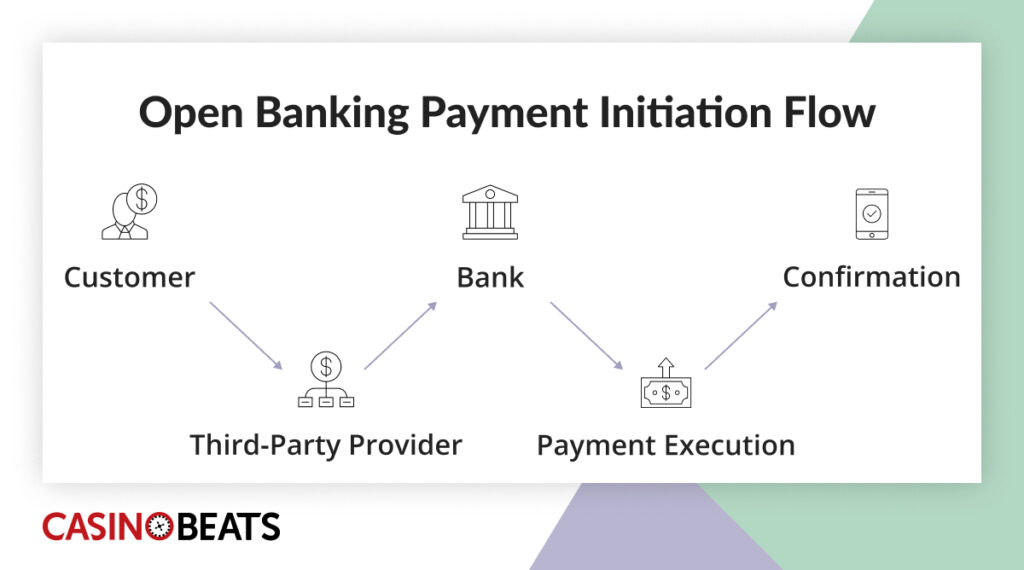
Open banking is essentially a framework that enables banks and other authorized third-party providers to communicate securely with each other using APIs. It’s a modern and faster way of banking where you can manage your financial information across multiple platforms. With it, you can connect directly to your bank through a trustworthy platform without needing to share your card numbers or visit the bank.
So what does open banking mean in practice? It means your bank can securely share your financial data with licensed platforms — but only with your permission.
How Is It Different From Traditional Banking?
Traditional online payments often require multiple checks, which slows things down to a crawl.
Open banking eliminates the go-betweens, such as processors and card networks, responsible for slow service. Essentially, payments can be transferred directly between your bank and the service you’re using instantly.
If you need open banking explained simply, then it gives you these four benefits:
- Faster payments.
- Better tools to set your budgets.
- More control over personal data.
- Stronger security.
This is made possible through an open banking API — a secure digital connection that lets your bank talk directly to the casino.
The open banking architecture behind this is built on regulated API standards, meaning every connection between your bank and a platform must meet strict security requirements. If you’re wondering what is API in open banking, think of it as a secure messenger that carries approved data between your bank and the casino — nothing more, nothing less.
How Open Banking Applies to Online Gambling
For bettors, open banking igaming allows you to connect your bank directly to a casino through secure channels. This has helped to transform the way bettors move money in and out of their casino accounts.
It’s a stark difference from the old days, when payments took a long time to process.
To understand what open banking examples look like in practice, think about instant casino deposits, real-time identity checks, and automated spending limits. Open banking online gambling connects your bank directly to the gambling site, so payments are made through the bank’s secure system.
Apart from faster payments, this modern banking method offers numerous other advantages.
| Feature | Open Banking |
|---|---|
| Payment path | Direct banking with a casino |
| Speed | Nearly instant or within a reasonable time |
| Security | Bank-to-bank verification |
| Fraud risk | Lower, due to bank-level verification |
| Responsible gambling tools | Real-time monitoring and personalized limits |
| KYC | Faster due to real-time info sharing |
Open banking has been a significant upgrade to the way payments are made. The best part is it’s super safe. Your login details remain with your bank, and the info shared between the banks is tightly regulated. So, you get speed alongside secure gambling transactions.
Open Banking Examples
Open banking is already changing how players interact with casinos in concrete, everyday ways. Here are three examples of what it looks like in practice:
- Instant deposits: Instead of entering card details manually, you approve a payment through your bank’s app using Face ID or a passcode. The funds appear in your casino account immediately, with no processing delay.
- Faster KYC: When you sign up at a new casino, open banking can verify your identity in seconds by pulling the information directly from your bank. What used to take days now takes moments.
- Automated spending limits: Casinos can use open banking data to set personalized deposit limits based on your real spending patterns. If your habits change, the limits can adjust in real time rather than waiting for manual review.
Open banking examples like these show why adoption is accelerating across major iGaming markets — the benefits are immediately visible for both players and operators.
Security & Player Protection
Every player wants to know their money is safe, and open banking delivers on that front in ways traditional payments simply cannot.
Your login credentials stay with your bank at all times, card details are never transmitted to the casino, and you retain full control over what data gets shared and when. Casinos also benefit — direct bank verification means they can spot irregular spending patterns faster, making it easier to flag problem gambling before it escalates.
Is Open Banking Safe?
For most players, open banking is safer than traditional card payments.
Your card details are never transmitted — instead, your bank handles authentication directly using the same security infrastructure it uses for everyday banking. That means the platform you’re paying never sees your account number, sort code, or login credentials at any point during the transaction.
What Is an Open Banking API?
Many players ask what is open banking API — in simple terms, it’s the secure channel your bank uses to share only the data you’ve approved, and nothing else. Every request goes through this channel with your explicit permission attached. No API access means no data sharing, which is why the system is fundamentally more secure than traditional card payments.
You Stay in Control of Your Data
Open banking runs on a consent-based model. You decide what information gets shared, with whom, and for how long. If you change your mind, you can revoke access through your bank’s app at any time without contacting the casino.
No data continues to flow once permission is withdrawn.
Authentication Is Handled by Your Bank
Every open banking transaction is authenticated through your bank’s own security systems.
Depending on your bank, this means Face ID, fingerprint login, or a one-time passcode — the same methods you already use to access your account. The casino never handles this step, which removes a significant point of vulnerability.
Regulation Keeps Providers Accountable
In the UK and EU, open banking providers must be authorized by financial regulators before they can access any banking data. In the UK, the Financial Conduct Authority maintains a public register of approved providers. Using an unauthorized provider carries serious legal consequences, which is why regulated casinos only work with vetted partners.
What Open Banking Cannot Protect You From
No payment method is entirely without risk. Open banking won’t protect you if you approve a transaction on a fraudulent site, share your bank login with someone else, or use a casino that isn’t properly licensed.
The system is only as safe as the platforms on both ends of the connection.
Regulatory Landscape: Open Banking Regulations in Gambling
As expected, numerous regulatory processes underpin open banking and its impact on the gambling industry. Different regions have adopted varying policies, thereby changing how gambling regulatory bodies perceive safe and transparent gambling.
The EU and UK lead the way
Europe was the first to implement PSD2, which enabled banks to share information with regulated platforms. The UK quickly adopted it and paved the way for open banking in gambling.
The U.S. and others are playing catch-up
The US had initially allowed the banks to find payment solutions on their own. This was beneficial, but it created gaps and inconsistencies in practices. Now, the U.S. has adopted “Pay By Bank,” an initiative that allows streamlined payments directly from user bank accounts.
Gambling regulators react
Now, regulators like the UKGC and MGA are paying close attention to how casinos and other betting platforms handle financial data. Open banking empowers them with a clear money trail, which helps identify problem gambling and even potential fraud.
Casinos must abide
All casinos must make use of only regulated partners to protect your data and provide strong identification.
Open Banking vs Traditional Payment Methods
Nowadays, we all have different ways to fund our online casino accounts. You may choose to use e-wallets, while I decide to use crypto. You also have the option of using any of the best instant withdrawal casinos. It’s a world of variety, but where does open banking fit in?
| Payment method | Speed | Security | Transparency | Fees |
|---|---|---|---|---|
| Open banking | Instant deposits Fast withdrawals | Bank-level encryption Strict Identity verification | Complete visibility on shared data | Usually free deposits Low withdrawal fees |
| Credit/Debit cards | Instant deposits Moderately slow withdrawals | Risks of card theft or information hack | Limited transparency | Varies |
| E-wallets | Very fast | Secure, but relies on a third-party account | Decent | Low fees |
| Prepaid cards | Instant deposits No withdrawals | Safe | Low to no transparency | Varies |
| Cryptocurrencies | Lightening fast (depends on Blockchain) | Secure Volatile | Public ledger Not beginner-friendly | Varies |
As seen from the table above, open banking is much more in line with the fast and furious nature of modern bettors. However, the message needs to be clear about the benefits of open banking, as people are generally cautious about trusting new technology with their money.
The Future of Open Banking in Gambling
We’ve experienced the advantages that Open banking brings to gambling transactions, and with such a promising future, I’m sure it’s here to stay. But what can we expect in the future?
- Wider adoption: We can expect to see increased engagement of open banking in major iGaming markets. This will result in smoother payments, instant withdrawals, greater transparency in online gambling payments, and, most importantly, satisfied bettors.
- Responsible gambling technology: AI is already making a significant impact, and we will likely soon start to see AI-driven responsible gambling tools being integrated. With more open data between casinos and banks, AI can analyze and catch risky gambling habits in earlier time frames.
- Global standardization: Regulators are already exploring ways to make open gambling more consistent and transparent. With new open banking regulations in gambling, the future of open banking gambling is really looking great.
Although issues such as consumer trust and regulatory differences remain, the next evolution of open banking points toward a better future for you and me.
Conclusion
Everyone dreams of easier, safer deposits and withdrawals for players, and open banking online gambling is doing precisely that, by cutting out intermediaries. Therefore, making payments faster, safer, and far more transparent.
However, with payments becoming easier than making an excellent cup of coffee, there’s a risk that players will gamble more money than they planned.
That said, open banking can only do so much in terms of protecting you.
It helps with safer online gambling payments, yes, but still requires you to play responsibly in order to truly protect yourself. Absolute safety comes from combining innovation with fair regulation and making healthy gambling decisions.
FAQs
-
Do all online casinos currently support open banking?
Most casinos are still catching up. While adoption is growing fast across major iGaming markets, plenty of operators still rely on traditional card payments and e-wallets. Check the casino’s banking page before signing up — look for “Pay by Bank” or your bank’s name listed as a deposit option.
-
Is open banking risky?
The risk is low compared to traditional payment methods. Your card details are never shared, and access requires your explicit approval each time. Regulated providers must meet strict security standards, and you can revoke access at any time. The bigger risk is using unregulated platforms that aren’t authorized to access your data.
-
What are the pros and cons of open banking?
The main advantages are faster payments, stronger fraud protection, and better responsible gambling tools. The downsides are limited adoption across casinos and some consumers remaining cautious about sharing bank access with third parties. For most players, the security benefits outweigh the concerns — provided the platform is fully regulated.
-
Can open banking see your balance?
It can, but only if you grant permission for that specific data. Open banking works on a consent-based model — platforms can only access what you authorize, whether that’s your account balance, transaction history, or identity details. You stay in control and can withdraw that permission whenever you choose.
-
Can I refuse to use open banking?
Yes, entirely. Open banking is optional at every stage. Casinos that offer it will always provide alternative payment methods alongside it. No operator can force you to connect your bank account, and declining won’t affect your ability to deposit or withdraw through other available methods.
-
Will open banking make gambling safer?
It strengthens several layers of protection — biometric logins, real-time spending alerts, and instant identity checks — all of which become more effective with open banking in place. That said, it works best when combined with your own responsible gambling habits. The technology reduces risk; it doesn’t eliminate it.
-
What are the benefits of open banking for online casinos?
Casinos gain cleaner fraud detection, fewer chargebacks, and faster KYC processing. With direct bank verification, operators can confirm identity in seconds rather than days, reducing both compliance costs and player drop-off at registration. Better data also allows casinos to offer more personalized responsible gambling tools.
-
Is open banking faster than using e-wallets like PayPal or Skrill?
Generally yes. Deposits are instant, and withdrawals typically clear faster than e-wallets because there’s no intermediate account involved — the money moves directly between your bank and the casino. Processing times vary by bank, but open banking consistently outperforms traditional card and e-wallet timelines.
-
What is API in open banking?
An API in open banking is the secure connection that allows your bank to share approved financial data with a licensed platform. It works silently in the background — you grant permission, the API carries only the data you’ve authorized, and the casino receives what it needs to process your payment or verify your identity. Nothing more is shared.
References
- The revised Payment Services Directive (PSD2) and the transition to stronger payments security (European Central Bank)
- Board of Governors of the Federal Reserve System (US Federal Reserve)