










Martin Booth brings decades of experience across UK sports journalism and the wider gambling industry. After more than 20 years in senior roles on the sports desks of national newspapers, he moved into both B2C...
Read Full Bio
Nick is an ex-casino manager turned PR specialist. He began his career as a croupier in the UK, and went on to work in Europe, Russia, Africa, Asia, and the USA. Previously he has worked...
Read Full BioOn a chilly November evening in 1928, Arnold ‘The Brain’ Rothstein strolled into the Park Central hotel in Manhattan to attend a business meeting. Rothstein was a renowned bootlegger and inveterate gambler. This day turned out to be his last throw of the dice, however, as George ‘Hump’ McManus gunned him down over a $320,000 gambling debt.
Key Beats
- Arnold Rothstein was a key figure in organized crime in early 20th-century New York.
- He was a gambler, bootlegger, and mob boss with considerable political influence.
- Rothstein’s activities made him one of the richest — and most controversial — criminals of his time.
Arnold Rothstein Biography
Arnold Rothstein, a gambler from his earliest days, rose to become one of the most notorious men in organized crime in the first decades of the 20th century.
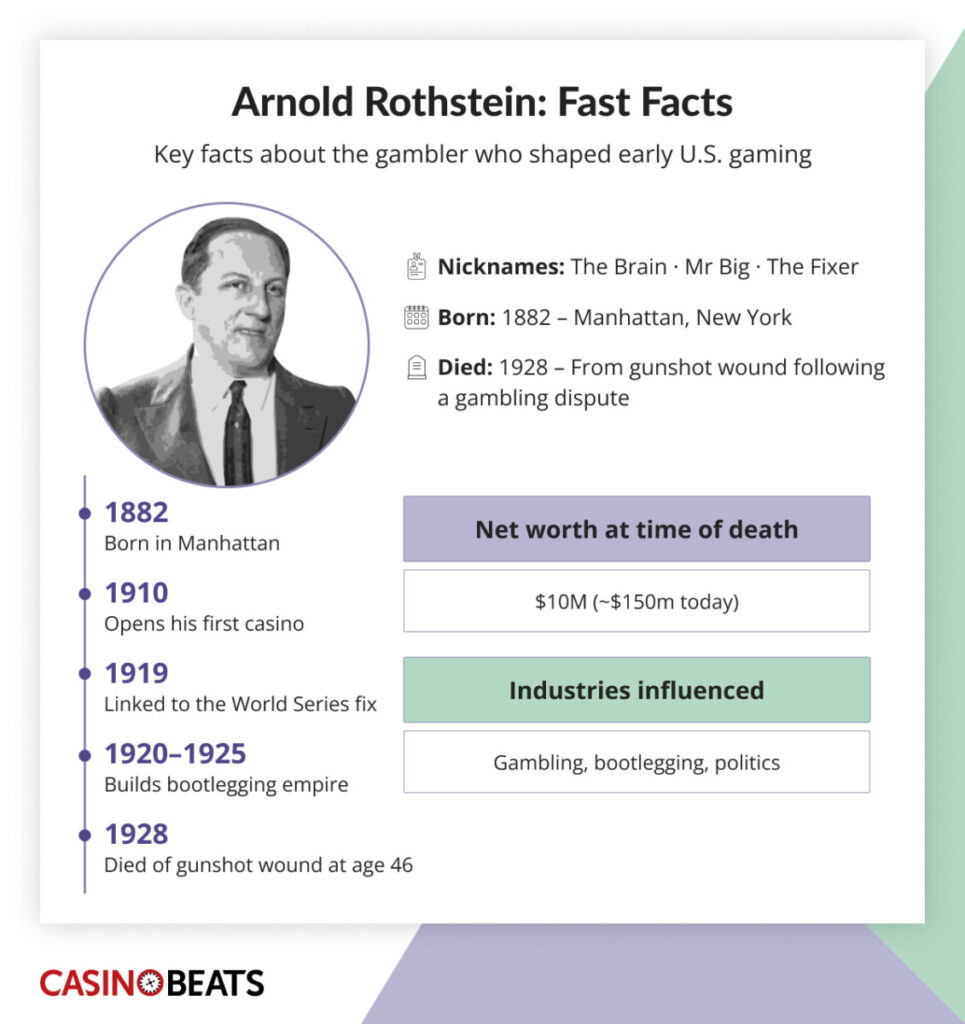
Known as ‘The Brain’, Arnold Rothstein’s career earnings ran into tens of millions of dollars as his influence extended across gambling and politics. Let’s look in more detail at Rothstein’s life, death, fortune, and legacy.
Early Life and Background
One of Arnold Rothstein’s most famous lines was: “I always gambled. I can’t remember when I didn’t.”
That may not have been an obvious pursuit for a boy born into an affluent Jewish family in Manhattan in 1882.
Perhaps it was a desire to rebel against his straight-laced father, Abraham, a businessman known as ‘Abe The Just’, that drove the young Arnold to become a gambler.
Even when he was punished for shooting dice, or playing pool or poker, Rothstein could not resist the lure of gambling. He was helped by the fact that, while school held little interest for him, he was extremely gifted at math.
Rise in Gambling and Racketeering
In 1910, when he was just 28, Arnold Rothstein opened his first casino. His establishment, on West 46th Street in New York City, prospered – helped, no doubt, by the protection money he paid to the City’s Tammany Hall rulers.
Rothstein was not just content to run one of the City’s most successful casinos. He saw the value in political influence and developed an enviable network of informants who passed him inside information.
He opened more casinos and moved into the world of horse racing by owning stables and tracks. Gambling houses were strictly illegal at this time – but if there was a crackdown by the authorities, he simply staged floating craps games instead.
By the end of the 1910s, Rothstein had risen from being a small-time gambler to a major player with influence and power – the kind of power that eventually enabled him to fix the most significant event on the American sports calendar.
The 1919 World Series Scandal
Even now, more than 100 years after the event, we can’t be sure about the extent of Arnold Rothstein’s involvement in the 1919 World Series fix. What we do know is that several Chicago White Sox players colluded with gamblers to deliberately lose the series, in which the Sox were heavy favorites over the Cincinnati Reds.
Rothstein testified before a grand jury investigating the affair that he had been asked to get involved in, but he declined. At the same time, there is evidence that he did put up the money for the players, then made a killing when they duly lost.
Whether he was behind the idea or only partly involved, the mere suggestion that he had the power to fix the World Series confirmed his reputation as a man of substantial influence. One legacy of the ‘Black Sox’ episode was that baseball and other sports recognized the need to have much stricter controls to ensure the integrity of their games and avoid scandals related to sports betting.
Prohibition and Bootlegging
When the Prohibition era began in the USA in 1920, one man was quicker than most to realize the potential it offered for making vast sums of money illegally.
Arnold Rothstein’s bootlegging operation swung swiftly into action, safe in the knowledge that people would still want to drink, and that he had the political influence to help deliver alcohol.
He purchased vast quantities of liquor overseas, then smuggled it into New York through Canada via the Hudson River. Rothstein also bought stakes in numerous speakeasies across the city where the booze could be served.
His immense wealth and the power he exerted through his political connections meant that this was an enormously profitable time for Rothstein. The proceeds from his illicit activities during Prohibition greatly increased Arnold Rothstein’s net worth and made him one of the most powerful men in New York City.
Mentorship and Influence
It was during Prohibition that Arnold Rothstein’s influence in organized crime extended to mentoring the next generation of mob bosses.
The operation to bring illicit alcohol into New York City and distribute it was so big that Rothstein needed partners. One of these was a young Meyer Lansky, who also brought on board his close friend Charles ‘Lucky’ Luciano.
This alliance moved Rothstein’s affairs to a whole other level because Luciano was one of the few Italian gangsters who would work with their Jewish counterparts.
Other senior mob figures, including Frank Costello and Bugsy Siegel, also benefited from their friendship with Rothstein. This was an era when the image of gangsters as violent criminals was upgraded as their operations became more corporate and business-like.
At the center of it all was Arnold Rothstein, building a fortune and becoming known as Mr Big, The Fixer, and simply The Brain.
Career Earnings and Wealth
As with so many other details of his life, it is not possible to know just how substantial Arnold Rothstein’s career earnings were.
Over the course of his life as a gambler, bootlegger, and businessman, he may have earned more than $200 million. Those earnings from organized crime were bolstered by ventures into real estate and loan sharking.
Estimating Arnold Rothstein’s net worth when he died is equally tricky. Officially, he was worth $10 million at the time of his death in 1928, which is about $150 million in today’s equivalent.
However, Rothstein always enjoyed a lavish lifestyle and, while he had a shrewd, insightful business mind, he never lost his love of gambling. He famously lost $130,000 on a single day at the Belmont racetrack shortly before his death in 1928.
Downfall and Death
Many of the circumstances surrounding Arnold Rothstein’s death remain shrouded in mystery.
On November 4, 1928, Rothstein, now 46 years old, attended a business meeting at New York’s Park Central Hotel. The topic of discussion was the $320,000 Rothstein owed from a three-day poker game a few weeks earlier, which he refused to pay because, he claimed, the game was rigged.
An hour later, Rothstein was rushed to a nearby hospital with a bullet in his abdomen. He refused to tell police who had shot him, and the identity of the shooter was never established in court.
Rothstein died two days later, but not before signing, in his weakened state, a revised will that left five per cent of his estate to his lawyer, Maurice Cantor, and cut the amount due to Rothstein’s wife, Carolyn.
Rothstein’s death led to the breakup of his criminal empire, which was divided among various associates. As for the $10 million he reportedly left when he died, it gradually disappeared until, 10 years after his death, Rothstein’s estate was declared insolvent.
Legacy in Culture and Crime
Arnold Rothstein’s biography is a tale of excess, mystery, and undeniable glamour. The fact that his name is still familiar nearly 100 years after his death is also due to the many portrayals of him — and characters uncannily like him — in a series of books, movies involving gambling, and TV shows.
F Scott Fitzgerald based the character Meyer Wolfsheim in The Great Gatsby on Rothstein. Similarly, Hyman Roth, who appears in The Godfather Part II, carries strong echoes of Rothstein, not least in his name.
Rothstein himself was portrayed in the baseball movie Eight Men Out, and was a main character in the series Boardwalk Empire. These depictions have helped to cement Rothstein as a major figure in the modernization of organized crime in New York City and beyond.
Conclusion
Arnold Rothstein, the gambler, played a vital role in the evolution of the gambling industry in America – and of organized crime. He can be seen as the bridge between the old-style gangs and the modern syndicates.
Rothstein’s story commands an enduring fascination, maybe because of the many contrasts in his life.
This was a man who insisted he was a legitimate businessman while building one of the largest criminal enterprises in US history. He was also a shrewd, cold-blooded business strategist who gambled wildly, especially later in life. He would have benefited from our guide to responsible gambling!
One safe bet is that Arnold Rothstein’s biography will continue to captivate people for generations to come.
FAQs
He was given this nickname for his legendary shrewdness in running gambling operations and other business activities as part of his criminal empire.
No. Although he was investigated several times by the authorities and ran a massive criminal empire, he was never indicted or convicted of any crime.
Rothstein had stakes in several racetracks and stables. He was also reputed to have won more than $500,000 by fixing the 1921 Travers Stakes at Saratoga.
Rothstein’s ability to work with corrupt Tammany Hall politicians in the City was key to his rise to power. He became a go-between for the politicians, legitimate businesses, and the Mob.
Arnold Rothstein’s net worth at his death was estimated at $10 million, but over the years, that money disappeared, and his estate was declared insolvent 10 years later.