

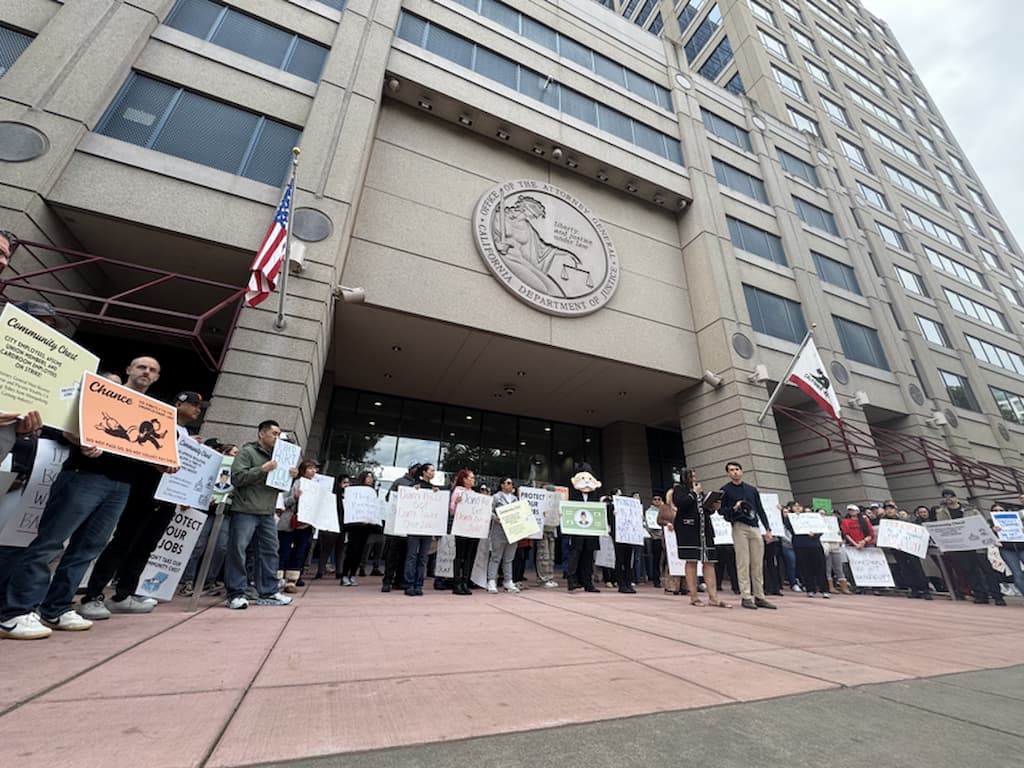
Hundreds of California cardroom employees, customers, city officials, and union members gathered outside Attorney General Rob Bonta’s Sacramento office this week to protest a regulatory proposal they say would devastate local economies and cost thousands of jobs.
Demonstrations took place across multiple days, on Monday, October 20, and Wednesday, October 22. Participants included the California Cities for Self-Reliance Joint Powers Authority, American Federation of State, County and Municipal Employees (AFSCME) union members, city workers, and cardroom workers.
Protesters Warn of Devastating Effects
Protesters rallied against Bonta’s proposed changes to the state’s cardroom gaming laws. At the center of the proposed changes is the restriction of blackjack-style games. That, protesters argue, threatens the livelihoods of thousands of employees and millions of dollars in tax revenue to local municipalities.
On Monday, Juan Garza, the executive director for the California Cities for Self-Reliance, told KNX News that Bonta’s proposal would “essentially devastate our card rooms and by extension, our local cities that depend on those card room revenues.” He estimated that as many as 8,000 jobs could be at risk.
During the Wednesday protest, Shavon Moore-Cage, the Political Advocate and past Vice President of AFSCME Local 36, likened the effects of job loss and city funding cuts to those of the COVID-19 pandemic.
“We can’t survive another hit like that, and this time, it’s not a pandemic; it’s an attack by policy that can be avoided,” Moore-Cage said.
Union and municipal representatives warned that the fallout could be catastrophic.
In a joint letter to the Attorney General’s office, several local governments and labor groups, including the California Teamsters Public Affairs Council, California School Employees Association, and AFSCME Council 57, wrote that the regulations “will cause cardroom closures which will devastate some cities who may have to file for municipal bankruptcy or disincorporate.”
Cities Move to Protect Local Revenue
Some cities have begun taking defensive steps to protect their cardroom revenue streams.
In August, San Jose reduced its annual regulatory fees for Bay 101 and Casino M8trix, resulting in a loss of roughly $440,000 for the city. To offset the costs, the city eliminated two positions from the Police Department. City officials stated that the change would help operators remain competitive amid increasing legal and regulatory uncertainty.
In smaller municipalities such as Hawaiian Gardens and Bell Gardens, local leaders warned that proposed restrictions could cripple their budgets. In a public meeting regarding the changes, Hawaiian Gardens Mayor Dandy De Paula said the proposal will “devastate—and worst yet—potentially bankrupt our city.” She noted that cardrooms contribute 78% of the city’s general fund.
Other municipalities, like Bell Gardens, where cardrooms account for 50% of their general fund, also face economic uncertainty under the new rules.
The mayors of Compton, Commerce, and Gardena have issued similar warnings. They emphasize that their cities rely on cardroom tax and license revenues to fund essential services. Those include police, fire, and youth programs.
Bonta’s Proposal Sparks Industry Backlash
Bonta’s draft regulations would implement changes to some cardroom laws and game rules.
The proposal calls for eliminating third-party proposition player services (TPPPS). Currently, cardrooms hire third-party providers rather than casino employees to serve as dealers. This structure enables cardrooms to comply with laws that reserve house-banked games for tribal casinos.
Under Bonta’s proposed rules, only players seated at the table can act as TPPPS. They must rotate every 40 minutes. Also, TPPPS would not be allowed to settle wagers unless they were occupying the player-dealer seat.
For blackjack-style games, the proposal would prohibit the use of “21” as a target number. It also eliminates the “bust” mechanic and bans the use of the term “blackjack.” In a tie, the player would automatically win instead of splitting the hand with the dealer.
The Attorney General’s office argues the changes are necessary to clarify state law and uphold tribal gaming compacts.
This week’s protesters and critics of Bonta’s proposal refer to the Standard Regulatory Impact Assessment, commissioned by his office.
The report estimates that cardrooms would lose $464 million in revenue and 3,600 full-time jobs over the next decade. Meanwhile, tribal casinos would gain about $232 million.
Cardrooms Gain Momentum in Court
The protests come as California cardrooms celebrate a series of legal victories over tribal gaming interests.
Two weeks ago, Sacramento County Superior Court Judge Lauri Damrell tentatively dismissed a lawsuit filed by several tribes under Senate Bill 549. The bill grants tribes standing to sue cardrooms for alleged violations of gaming exclusivity rights. Damrell ruled the lawsuit was preempted by federal law under the Indian Gaming Regulatory Act. She stated that the court “lacks jurisdiction to resolve this dispute.”
That decision followed Damrell’s August ruling in which tribal casinos failed to persuade the court to halt the use of banked games at cardrooms. Together, the judgments have strengthened cardrooms’ legal position to continue offering their existing formats.
Cardroom attorneys and the California Gaming Association, the cardrooms’ trade association, welcomed the rulings. They argue that tribes want to negotiate compacts under federal law but sue under state law. Meanwhile, they are protected from similar lawsuits under sovereign immunity.