


As Pennsylvania lawmakers discuss ways to fill budget gaps, rumors are swirling that this could include a potential tax hike on sports betting operators.
This scenario has led some of the top operators to quietly prepare for the increase. However, they’ve also warned that they might pass the costs on to customers, similar to what Illinois has done. There, the state introduced a new per-bet tax, which led operators to introduce surcharges and minimum bet requirements.
Currently, Pennsylvania levies a 36% tax on online sportsbook revenue. Online casino operators pay 54% on slots and 16% on table games. All these rates already exceed those in most US states.
According to the latest annual report from the Pennsylvania Gaming Control Board, bettors in the state wagered $8.7 billion, representing a 6.8% increase from the previous year. That generated $487 million in operator revenue and $175 million in state tax revenue, a 0.22% increase.
Political Money Enters the Game
According to Legal Sports Report, a group of “major” sports betting and iGaming operators in the state is forming a super-PAC. It will launch with roughly $10 million in initial funding to influence next year’s elections and any tax-related legislation.
The proposed super-PAC would represent a significant escalation in political activity for the state’s gaming sector. Under federal law, super-PACs can spend unlimited funds on advertising and advocacy, provided they do not coordinate directly with candidates.
The initiative suggests that operators are prepared to defend their margins aggressively, not just through lobbying, but also through electoral influence. The Pennsylvania effort would be one of the first state-specific super-PACs devoted exclusively to gaming tax policy.
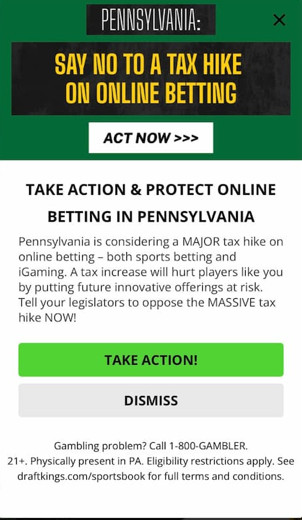
Last week, DraftKings sent a message to Pennsylvania customers, urging them to take action. It urged them to encourage lawmakers to vote against a tax hike.
If lawmakers do agree to raise the levy, operators are prepared to respond. One source told LSR that if rates climb higher, operators “will have no choice” but to pass the cost on to bettors, as they did in Illinois.
Growing List of States Raising the Stakes
Pennsylvania lawmakers are not alone in debating a tax increase for sportsbooks. In addition to Illinois, this summer, New Jersey and Louisiana passed bills to raise the levy.
New Jersey implemented a 19.75% rate on online gambling, up from the previous 13% for mobile sportsbooks and 15% for online casinos. Meanwhile, Louisiana raised the rate on sportsbooks from 15% to 21.5%.
Elsewhere, a legislative committee in Wyoming has proposed to double the state’s sports betting tax from 10% to 20%. Ohio’s Governor Mike DeWine attempted to double the levy for a second straight year, this time from 20% to 40%. However, lawmakers rejected his idea.
In Chicago, Mayor Brandon Johnson proposed a 10.25% city-level sports-betting tax as part of his 2026 budget. In addition to operators, he faces opposition from state lawmakers, who quickly introduced a bill to block the measure.
Pennsylvania’s Crowded Budget Picture
Discussions about new gambling taxes are underway as Pennsylvania lawmakers scramble to adopt the 2025-2026 state budget. The deadline to adopt it was June 30, but that did not happen. The current delay is over 100 days. Still, that’s not unusual, as lawmakers haven’t finished the budget by the deadline in the past five years.
According to the state’s Independent Fiscal Office, the budget is projected to face a shortfall of up to $6 billion. In the last fiscal year, that gap was $3.6 billion. The Office’s projections suggest that by 2027-2028, the budget deficit could grow to $7.6 billion.
Another option to raise funds is regulating skill game machines. The state is home to tens of thousands of these slot-like terminals, but there’s no regulatory framework to tax them.
Governor Josh Shapiro included a provision to tax skill games at a rate of 52%, similar to the tax on slots. Various estimates show that it could generate between $200 and $400 million annually for the state.
However, many lawmakers, small business owners, and manufacturers oppose the rate, as they believe it is too high. In the spring, there were three bills with rates ranging from zero levy to 35%.
A recently introduced bipartisan bill proposed a fee-based system. It calls for a $500 monthly tax per machine, which sponsors Sen. Gene Yaw and Sen. Anthony H. Williams believe would raise $300 million annually for the state.
What To Watch For
As of early November, no formal bill detailing a new rate structure has been filed in the Pennsylvania legislature. While legislative discussions are reportedly ongoing, operators’ rapid mobilization suggests they view a proposal as imminent.
With gambling revenue now a central pillar of many state budgets, Pennsylvania’s looming debate underscores a national tension between maximizing tax receipts and maintaining a competitive, consumer-friendly market.
If lawmakers proceed, operators warn: bettors could soon find themselves paying the price — one wager at a time.