

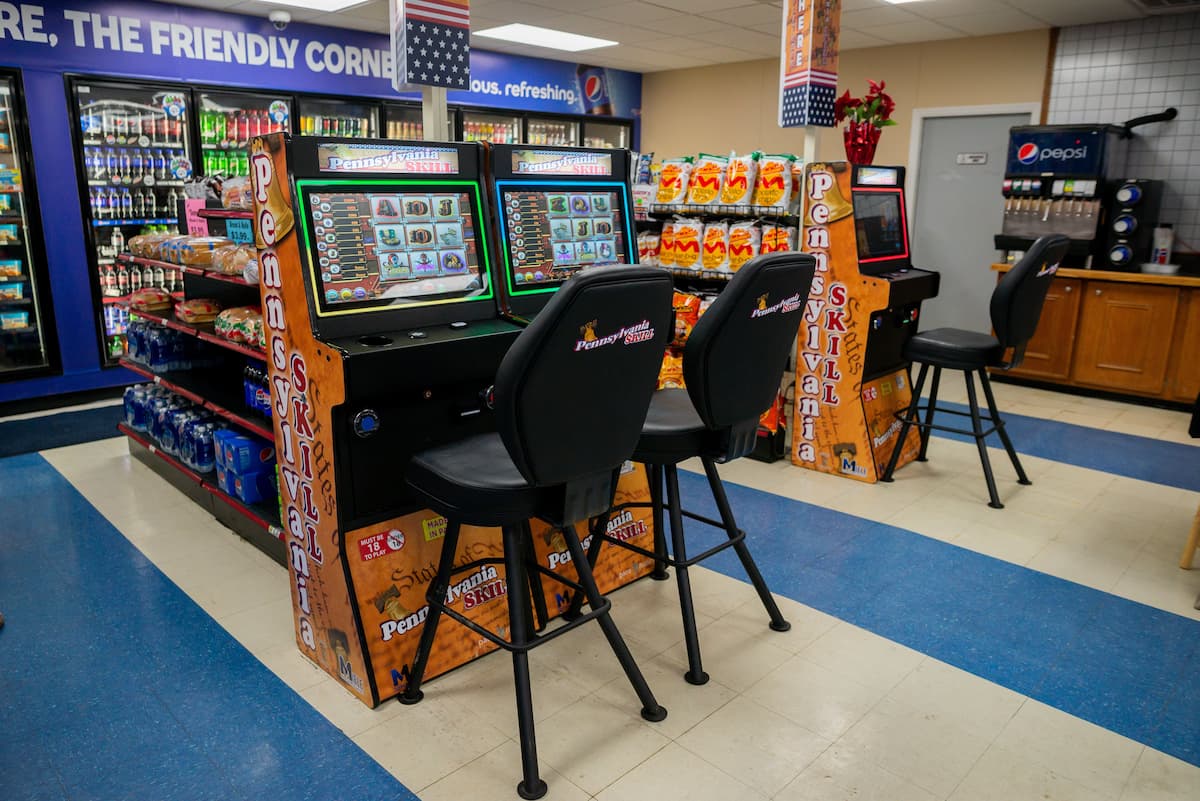
The Pennsylvania Supreme Court heard arguments last week on whether the state’s thousands of “skill game” machines are illegal gambling devices. The court’s decision could finally define the machines, which operate widely in bars, convenience stores, and gas stations but remain outside any regulatory oversight.
Skill game machines resemble slots, but manufacturers argue they don’t qualify as “gambling” because they include a skill element. These games usually require a small memory-based or pattern-recognition step that manufacturers claim allows a player’s ability—not just chance—to determine the outcome.
Defining Legal Moment for State’s Gray-Market Machines
The high court agreed in June 2024 to hear state authorities’ request to appeal a 2023 decision by a county court and a confirmation by an appellate court that the leading maker Pace-O-Matic’s Pennsylvania Skill games don’t meet the definition of illegal gambling devices.
The justices are now weighing arguments by the state’s attorney general’s office and the Department of Revenue against the terminals. During oral arguments, Senior Deputy Attorney General Susan Affronti sharply challenged the assertion that skill games differ from slot machines.
She told the court: “This court has been very clear. Gambling is the hope of gaining something beyond the amount played, and that’s what creates the dangers associated with gambling.”
Affronti further argued that the manufacturer’s games fail the legal test for skill-based exemptions. She said: “The game’s maker must show that skill is a predominant aspect of the game, and in Pennsylvania Skill Games, the skill element is difficult, tedious, and completely optional.”.
She also added that, unlike casino slot machines, which the state oversees, skill games “cannot be audited.” Therefore, they fall outside the scope of regulatory oversight.
Attorney Matthew Haverstick, representing Pace-O-Matic and another distributor of the machines, argued that the statutory definition of a slot machine does not accurately fit the products at issue. He emphasized payout rules as a distinguishing factor, saying:
“When you look at the regs the Gaming Control Board sets what a slot machine … has to pay out,” he said, noting that the requirement is a return of between 85% and 100%. Pennsylvania Skill games allow players to win back up to 105%. “It can never be a game or slot machine rather, as defined under that statute.”
Casinos, Player Behavior & Court’s Questions
The justices questioned how players interact with the machines. Justice Christine Donohue asked whether a patron could ignore the skill feature entirely and simply “pull it and pull it and pull it … with the hope that their gamble will pay off.”
Jason Levine, representing most of the state’s casinos, warned that the machines cut into revenue that supports public programs. He told the court that all parties can agree that “clarity is needed from the Supreme Court as to what is a slot machine and what is a gambling device.”
His comments echo concerns from casinos and the state lottery, which argue the machines divert players from regulated gambling.
Affronti expanded on how the machines function. She argued that they “deliver a win 8% of the time.” The rest of the time, players can reach the skill step if they touch a button labeled “follow me,” adding: “It’s not explained.”
She said that the court must identify the predominant aspect of the game.
“What is the game really about? … This is a slot machine,” Affronti claimed.
Legislature Revisits Regulation After Years of False Starts
As the Supreme Court deliberates, Pennsylvania lawmakers are weighing on whether and how to regulate the machines, a debate that has intensified as lawmakers face budget pressures.
Earlier this year, Governor Josh Shapiro proposed taxing the machines at a rate of 52%. That’s similar to the 54% rate on slot machines. Lawmakers introduced three additional bills in the legislature. They proposed a levy ranging from 35% to 0%.
None of the proposals made it to the state’s budget. However, as lawmakers failed to pass it on time, a new bill appeared in October. The bipartisan measure calls for a $500 monthly fee per machine, rather than a revenue tax.
While lawmakers cannot agree on how to tax the terminals, manufacturers and businesses that host them call for regulation. In October, 100 small business owners rallied in defense of skill games in Hershey. They argued that the machines are “helping keep the lights on.”
The Supreme Court’s ruling will likely reshape the debate, regardless of which tax approach lawmakers pursue.