


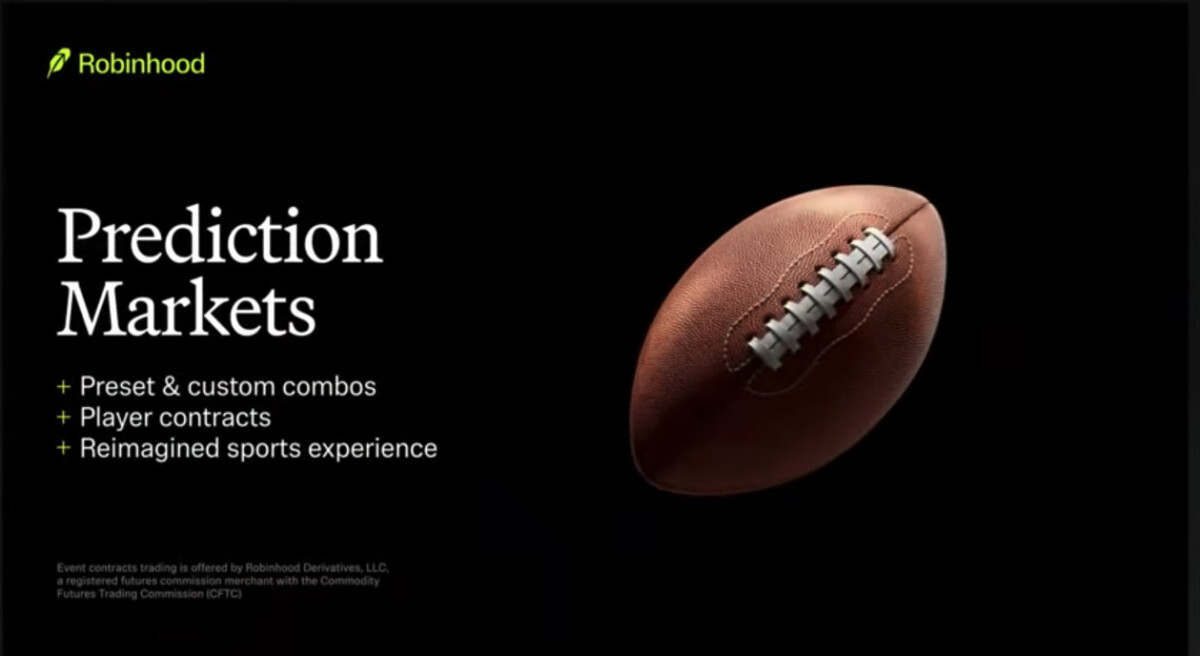
Robinhood is expanding its prediction market offerings to include features that work in much the same way as parlays and prop bets. The new parlay and prop bet sports contracts began rolling out for NFL games on December 17; the company didn’t say when they’d be available for other sports.
The announcement came during the company’s “Robinhood Presents: YES/NO” event at Summit Skywalker Ranch outside San Francisco, California. Company officials didn’t use the terms prop bet or parlay during the presentation; instead, they referred to the new features as “player markets” and “preset combos.” However, listening to the descriptions made it clear that these features operate similarly to the player prop bets and parlays found on sportsbooks.
Talking about the new player markets feature, a Robinhood employee described them this way: “Now you can trade event contracts based on individual player performance, not just the result of the game. That means you can trade whether a player is going to score a touchdown, how many passing yards, receiving yards, or rushing yards they’ll have for a specific game.”
They had this to say about preset combos: “Combos involve combining multiple events into one contract that allows you to get in at a lower entry price for a higher potential payout. Preset combos are curated, ready-made combinations that involve trading the winner and the total for the specific game.”
In a statement to CNBC, JB Mackenzie, vice president and general manager of futures and international at Robinhood, confirmed that preset combos would have “a structural look or feel as a parlay.” While the launch begins with preset combos, the company states that custom combos will be available in time for the playoffs in January 2026, allowing users to determine how to combine outcomes across players, teams, spreads, and totals into a single trade.
Robinhood isn’t limiting these parlay-style mechanics to sports event contracts; eventually, users will be able to combine their predictions across several categories, including sports, culture, and politics, into a single trade.
Kalshi & Polymarket Already Have Prop-Style Sports Markets
Robinhood’s move into the parlay and prop bet space comes as prediction markets have been increasingly experimenting with these familiar betting formats. In September, Kalshi introduced player-level NFL contracts and later took steps toward bundled, multi-outcome trades that resemble traditional prop bets and parlays.
Crypto-based Polymarket has also made its way into the parlay and prop bet territory, offering explicitly labeled parlays on its platform while listing player- and outcome-based markets that are similar to traditional sportsbook props.
Robinhood bringing parlay and prop-bet style sports contracts to prediction markets isn’t unprecedented, as evidenced by the Kalshi and Polymarket examples. However, while Kalshi and Polymarket operate as standalone prediction markets, bringing those mechanics to a retail brokerage with millions of users further normalizes betting inside mainstream investing platforms, packaging multi-outcome contracts in a way that is virtually indistinguishable from traditional parlays.
Prediction Markets Keep Pushing Into Sports as State Pressure Intensifies
Robinhood’s decision to offer parlays and prop bets arrives as prediction markets are under increased pressure, with state regulators arguing that sports event contracts are a gambling loophole that amounts to nothing more than unlicensed sports wagering.
On December 3, the Connecticut Department of Consumer Protection issued a cease-and-desist order against multiple platforms, including Robinhood, for offering sports wagers without a license, in violation of the state’s laws.
The company has also been tied up in litigation over sports contracts, with its derivatives arm, Robinhood Derivatives LLC, suing gaming regulators in Nevada and New Jersey to block state enforcement actions against its prediction markets.
In September, Robinhood sued the Massachusetts Attorney General and Gaming Commission in federal court to prevent enforcement against its sports event contracts, arguing that oversight by the Commodity Futures Trading Commission preempts state law.
In response to the growing scrutiny from states, prediction markets have joined forces against what they’ve described as a patchwork of state enforcement actions across 50 states, with Kalshi and other platforms forming a lobbying group to protect their interests.
If the message Robinhood delivered at its YES/NO event is any indication, the company isn’t treating sports as a temporary experiment but as an integral part of the future of its app, an approach that continues to move forward even as the legal fight over sports contracts intensifies.