

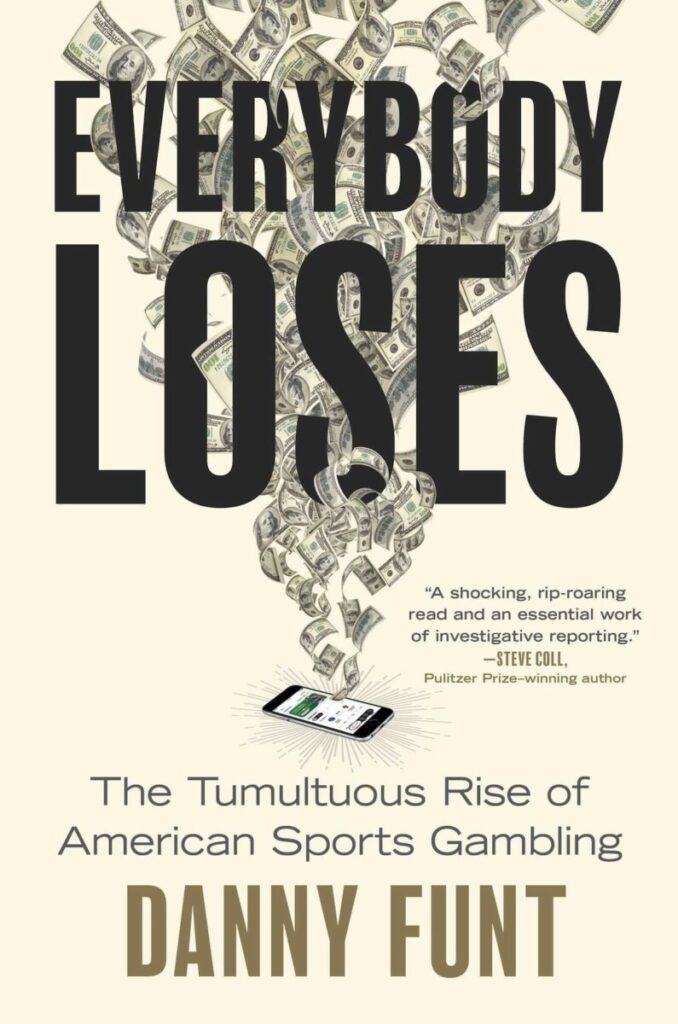
After a few years covering the sports betting industry for the Washington Post, Danny Funt decided to write a book about it. The fruits of that labor are now available with “Everybody Loses: The Tumultuous Rise of American Sports Gambling.”
Funt provides an unflinching portrait of the industry, based on interviews with problem gamblers, sportsbook employees, academics, and many more stakeholders, including a former MLB commissioner.
“I really devoted a full year to the book,” Funt told CasinoBeats in an exclusive interview on Thursday. “Luckily, I was able to do that for a variety of reasons, but it was just a lot of legwork, particularly to cultivate sources in the industry, and there’s just a lot of sides of the story that I felt belonged in the book. But I also wanted to be punctual, because it’s an evolving story, and you don’t want to let that slip away.”
After reading an excerpt from Vanity Fair, you might come away with the impression that the book focuses solely on folks in the throes of gambling addiction. Funt quickly dispelled that notion.
“I was glad they chose that, but at the same time, I was a little worried, because the whole problem gambling side of this is definitely important, and I would not have omitted that by any means,” Funt said. “But there’s a lot more to the book than that, and there’s a lot more types of customers I try to understand beyond people with problems.”
Read below for the full interview, which was edited for brevity and clarity.
Does Everybody Really Lose?
CasinoBeats: The title of your book is counterintuitive on some level. Who did you initially think was losing, and who surprised you the most after writing the book?
Danny Funt: Obviously, customers. And I had written about how hard it is to win, how aggressive limiting policies are if you do start winning or even show signs of competence, and how a lot of these European-backed companies are especially aggressive with limiting. But I think that title came into my head once I realized how many operators are struggling to turn a profit.
I used to live in Colorado. I started writing the book while I was still out there. And as you might know, Colorado was very liberal with its licensing, with nearly 30 operators at the outset. Most of them went out of business or left Colorado because they just couldn’t cut it. So, that was eye-opening.
CB: This goes beyond money, too?
FUNT: Yes, there’s a huge amount of losing, in a financial sense, happening, but a lot of other losing too. If you think in broader terms, whether it’s the integrity of leagues, the independence of sports media from the health side, those losses are pretty alarming. The list goes on, but everybody loses. I do genuinely believe everybody, but it’s bigger than just money.
Sports Betting Industry & Cringe-Worthy Tactics
CB: One of the blurbs promoting the book came from an exec who said, ‘We’re selling that you can win, but you can’t.’ Do you see that as central to the contradiction across the whole industry?
FUNT: Oh, yeah, that was Nigel Eccles, the founding FanDuel CEO. You know, people say, ‘Well, they’re running a business. If they let professional gamblers bet an unlimited amount of money, the bookmakers wouldn’t stand a chance.’ I understand that’s what aggravates people, including the former CEO of FanDuel, how contradictory that is to how they market.
I drove by this billboard from FanDuel that was up until recently and said, ‘Turns out watching football can really pay off.’ They went so far as to underline those words, pay off, and what could be more on the nose than suggesting that gambling is a real way to win money. It really just feels like they’re saying two very different messages. One, we have the right to cut down winners, and the other is come bet with us, and you have a real shot at winning. That definitely aggravates a lot of customers.
CB: I really appreciate the candor, especially from the former PointsBet employee who told you she was the company’s Responsible Gambling department. Did you come away with the sense that RG is largely window dressing?
FUNT: To a large extent, and that was the culmination of not just interviewing a lot of people in other departments at sportsbooks who say they feel like there’s an unspoken rule that you don’t want to intervene, from an RG standpoint, unless a customer does something explicitly worrisome. Like saying, ‘You know, I have a problem.’ Otherwise, there’s just a lot of pressure to look the other way, especially when you’re talking about VIP customers.
CB: VIP hosts offering luxury perks to their biggest losers feel especially predatory. How pervasive is that strategy?
FUNT: It’s a huge side of the business. I think that ended up being my favorite chapter, and it was one that I hadn’t outlined when I started the book, because I didn’t realize just how crucial the VIP side is to the betting business, and also how the online business opens the doors to just such a phenomenal level of perks for those customers, even beyond what was normal in casinos.
CB: What are some examples?
FUNT: These companies partner with sports leagues and teams, and a big reason for those partnerships is to cater to VIPs. So, I was just blown away hearing about VIPs getting to throw out the first pitch at a Major League Baseball game, having their kids take batting practice on the field beforehand, or playing pickup on an NBA court. The list goes on and on.
CB: These VIP host-customer relationships can get personal at times, too?
FUNT: One example that sticks out to me was a VIP host who’d worked at FanDuel remembered a colleague hearing that a customer’s dog had passed away. They sent this condolence gift basket that included a blanket with the dog’s picture printed on it. Wow. And their point was, like, ‘We want you to be loyal, not just to FanDuel and not just to the perks that we offer you, but to your host, so that if you’re ever thinking of reconsidering your betting or taking a break, know that you’ll lose all these perks, but also a friend in your VIP host.’ And that is so dicey.
CB: What was the most startling admission someone made to you on the record?
FUNT: The former head of product at FanDuel, Nik Bonaddio, was talking about parlays, which are FanDuel’s biggest moneymaker. Obviously, you know two things about that. One was that he thinks the vast majority of customers don’t understand that parlays are a bad bet and that the house edge is substantially bigger than for conventional bets against the spread or the OVER/UNDER on the point total. He said that maybe 5% of customers understand that. I’ve always been curious about customers who realize that these are widely considered sucker bets, and that this idea that you’ll hit one parlay and it’ll pay for all your losses. It doesn’t work that way, and to hear him own that was interesting.
U.S. Sports Reach Danger Zone With Integrity & Credibility
CB: We’ve seen scandal after scandal over the past year, with the NBA, NCAA, MLB, UFC, and more. Have we reached a tipping point where the credibility of U.S. sports leagues is in serious jeopardy?
Yes, I was struck by a survey right after those NBA and Major League Baseball arrests last fall. YouGov found that 65% of Americans think some athletes influence their play to swing the outcome of bets. So, hearing that a majority of Americans feel that way is not like some fringe conspiracy theory. Now that’s pretty pervasive. It also seems like the thing that gets lawmakers to take action. I don’t know that it will be a moral concern about gambling or even a health concern or economic concern, but when you saw the integrity of sports being undermined, the House and Senate sent letters to Adam Silver. I think Major League Baseball also faced some scrutiny from lawmakers in light of that, and that seems like the most likely thing to be a tipping point.
CB: Yes, MLB also agreed to provide documents to the Senate involving the Guardians’ scandal.
FUNT: I interviewed former Major League Baseball Commissioner Fay Vincent a little bit before he passed away last year, and he was the commissioner at the past hearings who spoke very emphatically that baseball would never get into business with gambling. As he put it, ‘It would make a mockery of his office.’ Obviously, times have changed, and he was very bitter about that. But he said that he didn’t think those other factors would cause lawmakers to reconsider gambling, but he did think match-fixing and the inevitability of more of that because of legal gambling, would change their minds.
CB: If you could force just one group to read your book, who would it be and why?
FUNT: I think all sports fans, because one takeaway from it is you definitely don’t have to be gambling to be influenced by what’s happening with sports. Not only would you potentially be bothered by all the ads and worried about your neighbors developing gambling problems, but the integrity of sports is being undermined, and that’s bad for everyone who cares about sports.
CB: Anybody else?
FUNT: I would love it if the reaction to the book is substantial enough that the operators have to weigh in. As I mentioned, I spoke with dozens of people who work for sportsbooks, but the executives themselves didn’t cooperate. I wish they would engage in this conversation, defend some of their policies, and address some of these concerns. And if the book helps make that something they can’t ignore, I’d be proud of that.
CB: What’s your take on prediction markets and the possibility of America going through all of this again on an even larger scale?
FUNT: It’s definitely significant if it’s bringing sports betting to all 50 states. We’ll see how that goes, because there are such aggressive battles in court with states saying, ‘We’ve made all this effort to license operators and tax them, or we’ve been reluctant to legalize, you can’t just offer sports betting by a different name in our states and circumvent those rules.’ I don’t have a prediction, but it seems in play that at least in some parts of the country, you won’t be allowed to offer sports betting via prediction markets.