











Adam Roarty Editor
Adam Roarty is a journalist covering sports betting, regulation, and industry innovation for CasinoBeats. His coverage includes tax increases in the UK, covering breaking stories in the ever-evolving landscape of US betting such as the...
Read Full BioPolymarket recently claimed that it is “the most accurate way to forecast the future that humanity has ever invented.” However, following the wisdom of the crowd is often not so wise. Alan Cole, a tax economist, wagered his life savings against the crowd and won.
The market at Kalshi was titled, “How much government spending will Trump cut in 2025?”
Users commenting on the market revealed the lack of wisdom. One user stated, “This whole thing was a scam. No one won. All positions were no.”
Another added, “This was a straight up scam bet to take money from the ignorant…me included.”
Not everyone lost, however. Cole wagered his life savings of $342,195.63 against users betting that Trump could cut spending at all.
“The virtue of the matching market is that you can take the good side of a bad bet—someone else’s bad bet,” Cole said. He spread risk across several bets, so his only liability was if spending declined by more than $50 billion.
Spending increased every quarter. The government published the final 2025 figures last week. The lowest spending quarter in 2025 was $66 billion above the bet’s target level. Cole collected $470,300, resulting in a profit of more than $128,000, or 37%.
Users Didn’t Understand Market Rules
The lowest value in the market was spending to be cut by $1 billion. That opened at 59¢, giving it a 59% chance.
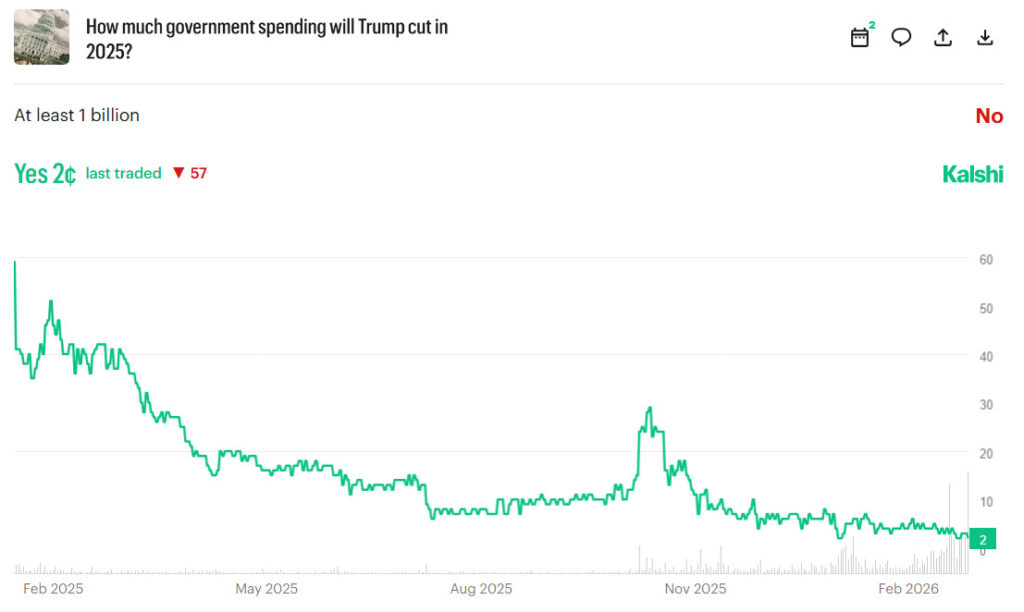
A user who backed that option revealed they believed they were betting against the higher options, stating, “The other options looked too exaggerated, that’s why. I was trying to play it safe. But, guess what? Every option was wrong, so no one got anything right.”
To others, it was obvious that those betting Trump to cut spending would lose money. Cole credits Jessica Riedl, a former Senate Republican aide, for alerting him to the market.
Riedl was wary of gambling her own money but said that she believed taking no options was a sure thing. In comments to the Wall Street Journal, she said, “It should have been completely obvious to anyone who knows anything about the government, the budget and public administration.”
Read the Fine Print
In some cases, those profiting from prediction markets have been accused of having insider knowledge that aided their wagers. In one example, a user made huge profits betting on Google search terms. Google workers with access to that data would have an edge on anyone gambling on the markets.
In the federal spending case, however, Cole did not need access to insider data. Users who did not understand the market rules or wagered based on blind faith in Trump or Elon Musk lost their money.
Cole’s wife said his only edge was in reading the market conditions. She said, “Alan is the type of person who is going to read the terms and conditions when enough money is on the line.”
She was amenable to his wagering their life savings on the bet, particularly after reading comments from other Kalshi users who clearly did not understand what they were betting on.
Markets Open to Manipulation
In other cases, it serves to have some additional context for markets. Earlier this month, users on Polymarket may have noticed that the chance of Jesus Christ returning to earth by 2027 had started to rise. It jumped from a 2.5% chance to a 4.7% chance at the start of February.
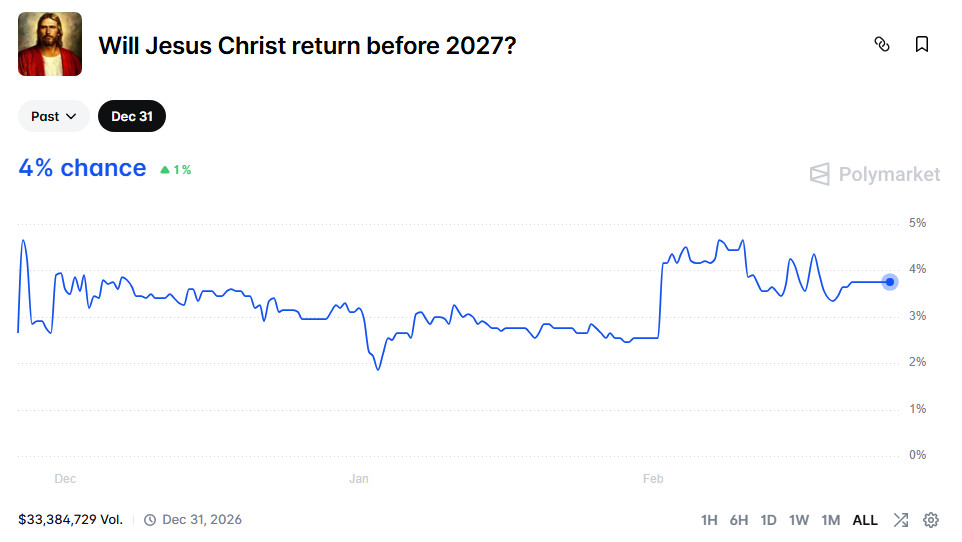
Users following the wisdom of crowds may have thought this indicated that Jesus is more likely to make a triumphant return. However, the only revelation is that there is another sub-market at Polymarket where users are wagering on whether the original market would have odds greater than 5% before February 17.
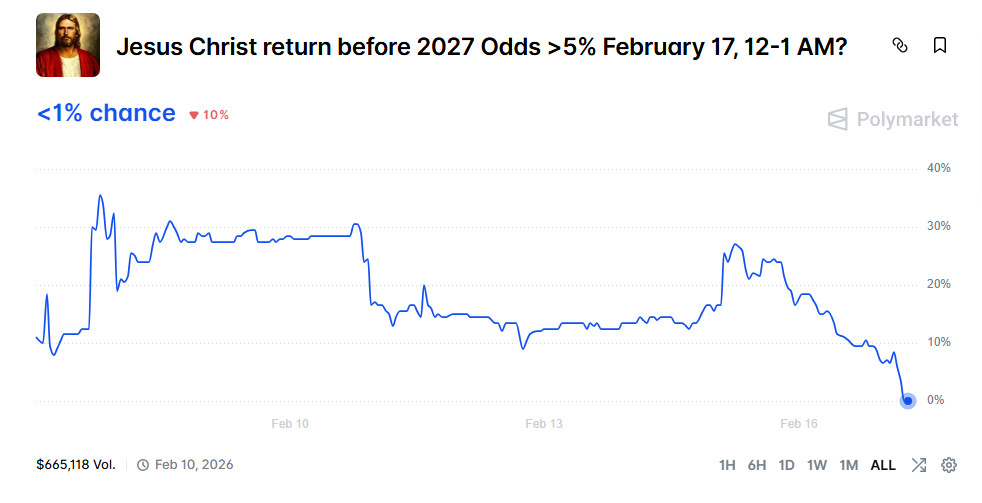
Other users have also pointed out that investing money in something that will pay out in almost a year’s time means the odds should never drop below a certain level. If the odds fall below 3.5%, it falls below the Treasury yield and therefore becomes a riskier investment.
So while Polymarket may claim to be “the most accurate way to forecast the future that humanity has ever invented,” there are several caveats to consider when looking at prediction markets.
Riedl said she refrained from gambling on the federal spending market despite having high confidence that spending would increase. She pointed to other risks, stating, “I would have been nervous about liquidity, administrative loopholes, legality, making sure that I got paid.”