



New York Attorney General Letitia James is targeting some of gaming’s biggest franchises in a lawsuit that accuses Valve Corporation of illegally promoting gambling through the loot boxes found in its most popular titles.
In the complaint, filed in Manhattan on February 25, the state claims Valve’s monetization model for Counter-Strike 2, Team Fortress 2, and Dota 2 mimics traditional casino mechanics, arguing that the system the video games use amounts to “quintessential gambling” under New York’s Constitution and Penal Law.
According to the lawsuit, Valve has made billions of dollars selling the virtual “keys” gamers use to unlock containers for a chance to win rare virtual items that can be exchanged for real money. The lawsuit centers on the state’s claim that users spend real money, in New York, the cost is usually $2.49 plus tax, to open loot boxes or buy keys that unlock them. After doing so, they receive a randomly selected cosmetic item.
The state argues that this setup functions like gambling because gamers are paying for the chance to win something more valuable than the amount of money they staked.
The attorney general framed the case as a consumer protection and youth safety issue. “Illegal gambling can be harmful and lead to serious addiction problems, especially for our young people,” James said in the Office of the Attorney General’s press release. She added that Valve “has made billions of dollars by letting children and adults alike illegally gamble for the chance to win valuable virtual prizes.”
New York Says Valve’s Loot Boxes are a Slot Machine
In the lawsuit, the state zeroes in on the mechanics of Valve’s loot boxes, which it alleges use the same “psychological lures” as traditional casino games.
The complaint says the company “has designed and developed software that enables users to risk or stake something of value in exchange for the opportunity to activate a loot box and win a virtual item, the identity of which is determined entirely by chance.”
The filing also highlights how loot boxes are presented to users in these titles. For example, in Counter-Strike, the state says the process for opening a weapons case is a lot like playing a slot machine. The complaint says the loot boxes feature an animated spinning wheel that stops on a prize while frequently displaying a “near miss,” where it lands right next to a rare, high-value item, a mechanic that encourages players to keep spending.
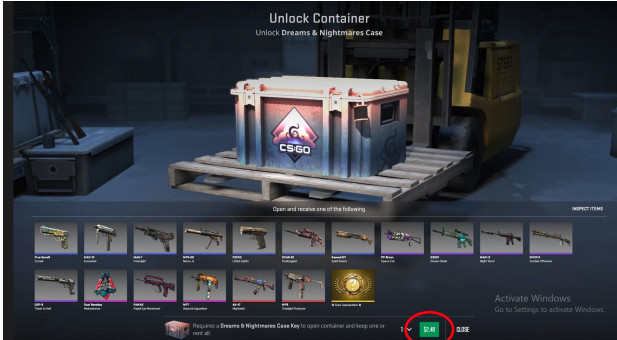
The Office of the Attorney General outlines its case by pointing out the disparity between how much it costs for players to participate versus the value of the rewards:
- Cost of Entry: Users typically pay $2.49 (plus tax) for a key to open just one loot box.
- Common Rewards: Approximately 96% of items awarded are worth only “pennies,” meaning they’re worth much less than the cost of the key.
- High-Value Prizes: Rare items, such as the “Gamma Doppler Emerald Butterfly Knife,” can bring in more than $10,000 on secondary markets.
- Monetization: Valve reportedly takes a 15% commission on sales made through its Steam Community Market.
The complaint says Valve publicly bans off-platform sales in its Steam Subscriber Agreement while still “consistently foster[ing] third-party marketplaces that allow the purchase and sale of virtual items for cash.” In one example cited by the state, an AK-47 skin sold for more than $1 million in June 2024.
The Valve Case Adds to Growing Loot Box Scrutiny
There’s a growing consensus among regulators and researchers that loot boxes are a form of gambling that video game developers have masked as gameplay.
The New York case may feel like an unusually aggressive move for a state attorney general, but video game microtransactions have been under the microscope for quite a while now. A recent example came in January 2025, when the Federal Trade Commission fined Cognosphere, the developer of Genshin Impact, $20 million for misleading children about loot box odds.
The New York lawsuit isn’t the first time Valve has had to answer for its loot box game mechanic, either. In January 2022, Valve successfully defended a similar case in Washington state, when the court granted summary judgment in the company’s favor, finding that the plaintiffs failed to provide sufficient evidence that Valve’s actions, specifically the lack of “loot box” disclosures, directly caused the parents to lose money.
However, the New York case differs from the Washington case in an important way. While the Washington case (G.G. v. Valve) failed because private plaintiffs couldn’t prove personal financial loss resulting from a lack of disclosure, the New York lawsuit is a law-enforcement action brought by the state to protect the public interest and uphold criminal statutes.
International research backs up the New York Attorney General’s claim that video game loot boxes serve as a “gateway” to gambling. A 2025 study from Norway’s SPILLFORSK found that young people who purchase loot boxes are more likely to participate in traditional gambling and experience higher rates of gambling problems.
Spain has also highlighted the problematic nature of video game loot boxes, launching a national campaign in late 2025 called “Fewer Loot Boxes, More Real Gamers.” As part of the push to increase public awareness of the risks of loot boxes, officials in Spain cited data showing players who purchase loot boxes are 4.5 times more likely to develop gambling problems than those who don’t.
New York is now seeking permanent injunctive relief, restitution for consumers, and fines totaling three times Valve’s alleged illegal gains.