

Before DraftKings and FanDuel, before Kalshi and Polymarket, there was Jay Cohen and World Sports Exchange.
When the gambling industry looks back on its modern roots, the conversation often begins with the Supreme Court striking down the Professional and Amateur Sports Protection Act in 2018, opening the door for states to legalize sports betting.
From there, it often turns to the rise of DraftKings and FanDuel, the normalization of sportsbook advertising, and the legal fights that will ultimately determine the future of prediction markets.
Cohen sees it differently.
Back in 1996, Cohen, Steve Schillinger, and Haden Ware launched World Sports Exchange, better known as WSEX, from the small Eastern Caribbean island of Antigua.
The company did something that was considered revolutionary at the time: it took ideas from the trading floor and applied them to sports betting, years before live betting, exchange-style markets, election wagering, and fully online sportsbooks became standard parts of the industry.
Had Cohen built WSEX today, he might be called a gambling-tech visionary. In the 1990s, building it made him a federal target.
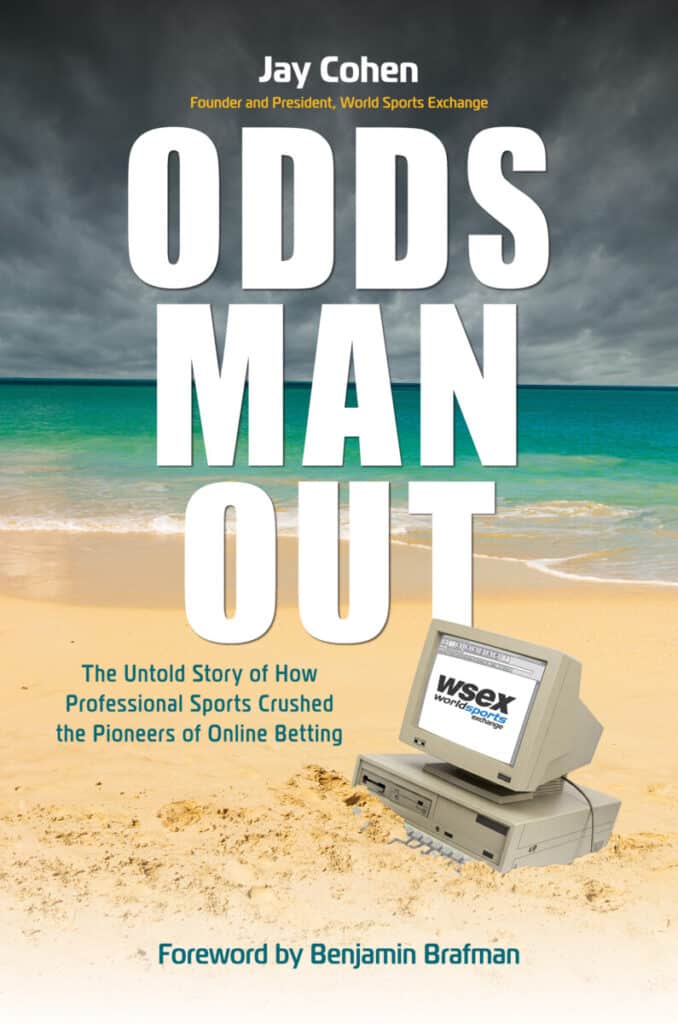
Ahead of the July 7 release of his memoir, “Odds Man Out: The Untold Story of How Professional Sports Crushed the Pioneers of Online Betting,” Cohen spoke with CasinoBeats about WSEX’s early years, his federal prosecution, the company’s eventual collapse, and the personal fallout that followed.
Cohen views his story as a missing chapter in the modern sports betting narrative, one that helps explain where parts of today’s sportsbook and prediction-market playbook came from.
As he put it, “We were doing this in 1997, all this stuff that people think is so revolutionary today.”
WSEX Didn’t Just Take Bets Online, It Made Them Tradable
WSEX wasn’t just an early offshore sportsbook with a website, and from Cohen’s point of view, that’s a distinction worth making.
At a time when many online gambling operations were little more than web pages displaying sports betting lines and phone numbers, Cohen said WSEX was fully transactional.
With the WSEX setup, customers could place bets, parlays, teasers, and exotics online. They could even buy points and check account balances without speaking to an operator.
“People couldn’t believe what we were doing,” Cohen said. “You could do everything online.”
Cohen says the difference between WSEX and other operators came down to structure. While much of the early internet economy was focused on traffic, page views, and banner ads, WSEX was already processing real-money transactions.
“They had a web page, and at best they had their lines up,” Cohen said of the company’s competitors at the time. “Maybe they were stale, they might not have been updated, and they had a phone number. That’s what it was.”
WSEX worked differently. The website wasn’t just a storefront that pointed customers back to a phone number. It was the sportsbook.
The even bigger breakthrough was live betting. Cohen described WSEX’s version as “real-time betting throughout the game to the last second” and, more importantly, tradable.
“You could trade in and out,” he explained. “You didn’t have to bet the other side to get out. You just got out of your bet.”
That was the trading-floor logic behind WSEX. A bettor wasn’t just picking an outcome and waiting for the game to end. They were holding a position they could exit as the market moved.
Golf became one of the most interesting examples of how WSEX’s live markets worked.
Cohen described WSEX markets in which players’ prices moved up and down during tournaments. In what he called the “era of Tiger Woods, when he was coming up,” Woods could start at a much higher price than the rest of the field.
Then, a bogey, birdie, or Sunday charge could shift the entire market.
“It really was some of the most exciting stuff,” Cohen said. “Golf was big.”
WSEX also experimented with markets that look familiar in today’s micro-betting environment. Schillinger priced baseball “at-bat” markets, where customers could bet on whether a player would single, double, triple, strike out, or hit a home run. In football, WSEX listed markets on the next score.
“That was layered on top of the game wagering itself,” Cohen said. “I guess they call it today, they’ll call it sticky, keep them around because now they’re betting the game, and now they’ve got something to bet every play.”
WSEX Tested Prediction Markets Before Kalshi & Polymarket
Reading Cohen’s account of WSEX’s story, the connection to today’s prediction markets is hard to miss.
When CasinoBeats asked Cohen whether Kalshi and Polymarket represent something fundamentally new or are building on ideas WSEX had already tested decades earlier, he was blunt.
“It’s nothing new,” he said. “It’s everything we did back in the 90s. There’s nothing new about it at all, nothing.”
While sports were a major part of WSEX’s business model, the company also offered markets on political events, awards, entertainment outcomes, and other non-sports events.
Cohen said WSEX was initially set up as “what you would call a market maker,” where the company was “the other side of every trade.” Later, WSEX launched Matchbook, a player-to-player exchange model.
“We had that too,” Cohen said.
However, Cohen is skeptical about wagering on politics. And he said Schillinger wasn’t especially enthusiastic about posting those markets because large political bettors could know more than the oddsmaker.
“No one’s going to bet any real money on those things unless they have much better knowledge than us,” Cohen said, describing Schillinger’s concern.
Sports can attract wealthy recreational bettors willing to put serious money on a game. In Cohen’s view, political markets are different.
“They’re interesting, but in many ways they’re still a novelty,” he told us.
The danger, he said, is not the five-, ten-, or fifty-dollar political bettor. It’s the person willing to place a much larger wager because they may know something the market does not.
“You don’t want to be on the other side of that,” he said.
The Leagues That Fought WSEX Now Profit From Its Model
One of the biggest ironies in Cohen’s story is that the leagues that were once opposed to WSEX now operate in an American sports industry that’s completely saturated with betting.
You can’t turn on a sports broadcast in the United States without seeing sportsbook odds displayed prominently on the screen. Betting integrations sit inside sports media. Teams and leagues have commercial partnerships with operators.
Watching sports on TV today, it’s hard to believe that sports betting, which was once described as a threat to the integrity of sporting events, is now part of the business model.
When we asked Cohen what he would say if NFL Commissioner Roger Goodell were sitting in front of him, the message was simple:
“They’re using our business model, they drove us out,” he said.
He also referenced something he said during an interview with Sports Illustrated a couple of years ago.
“You crushed my business and stole my idea,” Cohen said. “Please do one or the other. You shouldn’t do both.”
During the interview, Cohen recounted how league opposition to sports betting helped create the environment that led to his prosecution. Now, he sees those same leagues profiting from a legal market built around the very ideas WSEX was punished for pursuing decades earlier.
“All of a sudden, all their moral hang-ups have disappeared,” he said.
Asked whether any of the leagues have ever acknowledged what happened to him, or called, emailed, or tried to reach out, Cohen’s answer was short and to the point.
“No,” he said.
He also questioned whether the early fight came directly from the leagues themselves or from the law firm representing them.
“I often wonder if it wasn’t even the leagues to begin with, or if it was just that law firm,” he said, pointing to early press coverage and the firm’s recognition that the leagues had deep pockets.
Either way, the result was the same. WSEX became a target, and the industry later moved on.
WSEX Followed the Rules & Still Became a Target
“We were licensed and regulated, we did everything right, and they didn’t care,” Cohen told us.
Speaking to him, it’s clear that his frustration about what happened to WSEX isn’t just about being punished for ideas that are now part of the industry’s playbook. His view is that the company was operating legally from the very start.
Cohen pointed to WSEX’s private placement memorandum, or PPM, which was used when the company sold shares, as one detail he wishes had been emphasized more forcefully in his defense.
According to Cohen, a law firm signed off on the document.
“You can’t have a PPM for an illegal business,” he said.
That PPM is one of the reasons Cohen believed that WSEX had been structured as a legitimate Antigua-based business with lawyers involved.
However, the government saw things differently. Prosecutors charged Cohen with one count of conspiracy to violate the Wire Wager Act and seven related Wire Act violations.
Cohen voluntarily returned to the U.S. to fight the charges because he believed he was innocent.
He remembers thinking at the time, “I’m going to go fight this. This is ridiculous.”
His view hasn’t changed. “I still maintain to this day I did nothing wrong,” he told us.
In his absence, WSEX’s third co-founder, Haden Ware, stepped up. In the book, Cohen recalls patting Ware on the shoulder before leaving Antigua and telling him, “You can take over for me, buddy. Keep it plugged in. I’ll be back in six months.”
Six months would come and go without Cohen’s return as the case dragged on and WSEX came under increased scrutiny. Even with all that was going on, and even as others left, Ware kept the business running.
Cohen wrote that Ware didn’t just keep things “plugged in;” he eventually “would run the show.”
On Feb. 28, 2000, Cohen was convicted on all eight counts in what his representatives describe as the first conviction of an internet sportsbook operator.
He was sentenced to 21 months in prison and served 18 months in North Las Vegas, not far from the casinos where Nevada sportsbooks had long operated legally.
Losing WSEX Hurt Cohen More Than Going to Prison
Stories about WSEX often focus on Cohen’s prosecution and prison sentence. But when asked about what hurt most, going to prison, losing the company, or watching sports betting become legal without him, he pointed to the company.
“To me, the biggest blow was losing the company,” Cohen said. “When the company folded, that killed.”
While he was in prison, WSEX had given him hope. He always believed it would do well and that some legal avenue, whether an appeal, habeas petition, or the World Trade Organization case Antigua brought against the U.S., might eventually vindicate him.
“I always felt that I would be exonerated in the end,” Cohen told us.
The WTO fight is still one of the stranger chapters in the WSEX story. Antigua challenged the U.S. over online gambling and won, but the U.S. never complied in any meaningful way.
Cohen credits Ware with leading the WTO fight and securing support from other sportsbooks in Antigua for the case against the U.S.
“They lost outright,” he said. “They said under the GATS [General Agreement on Trade in Services], Antigua has a right to offer gaming services to customers in the United States. You signed the treaty. That’s it.”
Cohen said the U.S. Trade Representative should have shifted to advocating for compliance after the WTO ruling. Instead, he said, the U.S. kept fighting.
“They weren’t lying,” Cohen said, referring to warnings that the U.S. wouldn’t comply even if it lost.
Years later, he renounced his U.S. citizenship, a decision he said was driven partly by anger over what had happened to him and partly by frustration that the U.S. did not honor the WTO outcome.
“It wasn’t self-preservation,” Cohen said. “It was probably the worst thing I could do.”
Still, Cohen said he believes it was what he needed to do.
“It was the right decision, but it made my life more difficult,” he told us.
Steve Schillinger & Glen McIntyre Built the Markets History Forgot
WSEX’s history cannot be told without Steve Schillinger.
“Without him, there’d be no WSEX,” Cohen said. “He was a brilliant, brilliant oddsmaker. There’d be no live betting without him.”
Cohen credits Schillinger with turning the idea of live betting into a product. Cohen could build the platform, but it was Schillinger who could move the odds.
Schillinger had been thinking that way even before WSEX. Cohen remembers him taking bets on the trading floor “on movies, on everything,” and later bringing that market-making instinct into sports.
“He had a vision that we would be bigger than Vegas,” Cohen said.
Schillinger believed WSEX gave bettors a “fairer shake,” especially in futures markets where traditional sportsbook customers had to wait until the end of a season or event.
That was much different from the Vegas model, where customers were locked into a bet until the final whistle.
“You had a way to get out, you know, or take a profit, or cut your losses before the end. So we thought what we were doing was egalitarian, I guess,” Cohen explained.
Schillinger committed suicide in 2013, after WSEX shut down. When we asked about a line from the book in which he says Schillinger’s decision made sense on a “purely business and gambling level,” Cohen explained that this was how Schillinger saw the world.
“He didn’t want to start over,” Cohen said. “He didn’t want to be a regular guy. He didn’t believe in God.”
Cohen didn’t know Schillinger was planning to take his life, but he believes WSEX’s demise left Schillinger feeling like he didn’t have very many options.
“I mean, that, that was Steve. You know, what’s the point of living if you have to take the bus? Maybe if he were younger, and he could have started over, it would have been different, but I think he felt trapped, like there was no opportunity for him.”
Glen McIntyre, another person behind WSEX’s live betting operation, died in 2022. Cohen described him as one of the best live traders who made the product work.
“He was a machine,” Cohen told us.
McIntyre could handle multiple games at once, making markets on live events as WSEX required. Cohen believes McIntyre’s life would have turned out differently if WSEX had survived.
“If we were still open, he’d still be cranking away, making markets, making a decent living,” Cohen said.
That’s the part Cohen believes gets lost when betting history glosses over WSEX and treats it as a footnote instead of the main event.
He sees the company as much more than just an early website or offshore operator.
For Cohen, WSEX was a group of people who built products that the industry later turned into its own, and some of them didn’t live to see that history acknowledged.
Cohen’s WSEX Conviction Keeps Him From Visiting the U.S.
“Now I have to, like, beg for visas,” Cohen said.
He was speaking about why he hasn’t returned to the U.S. since renouncing his citizenship in 2012.
Cohen said his decision to renounce his citizenship was motivated by anger over his case and frustration that the U.S. didn’t honor the WTO ruling that sided with Antigua in its online gambling dispute with the U.S.
His wife and son have been granted visas, but Cohen said the government has denied his application because it views his conviction as a crime of moral turpitude.
However, he says the Department of State’s guidance says gambling shouldn’t be treated this way.
“In this manual, which I have, it says these are crimes of moral turpitude, and then it says these are not crimes of moral turpitude,” Cohen said. “Gambling is under the not list.”
Cohen said he spent nearly a year gathering criminal records from the places he has lived, including notarizations and translations, only to be denied a visa. When he reapplied, he said he was rejected on the spot.
He suspects officials may be misreading his conviction by seeing references to “wire” and assuming wire fraud.
“There was no fraud,” Cohen said. “The government didn’t even allege any fraud.”
The visa issue has made it impossible for him to see his father, who is now in his 90s.
“I’m not asking for favors,” Cohen said. “Just get a letter clarifying that my crime is not a crime of moral turpitude.”
He now says he would accept a pardon, even though he didn’t always feel that way.
“I’d love a pardon. I’d take a pardon,” Cohen said. “I used to not want a pardon,” he added, explaining that he once viewed accepting one as an admission of guilt.
If he were granted a pardon, Cohen knows it wouldn’t undo the years he’s already lost, the company’s collapse, or the fact that the betting industry has now moved on without him.
But he said it would represent “some small victory of sorts.”
WSEX may be gone, and sports betting may have become mainstream, but Cohen says the consequences of the original case still follow him.
“It’s been a life sentence,” Cohen told us. “Whatever the crime, the sentence, the probation, you do your time, and that should be it.”
Betting Companies Reject the Man Who Helped Build Their Playbook
The consequences of Cohen’s WSEX conviction have followed him in other ways, too.
And that’s one of the bitter ironies of this story. Sports betting is now legal in much of the U.S., and the industry now values trading, market making, live betting, and exchange-style products, but Cohen said that experience has not opened doors for him.
“You would think it’d be good for something,” Cohen said. “I’ve applied to basic jobs in some of these places, and I get the standard rejection letter.”
When that happens, he sometimes thinks to himself, “Oh, you’ve gone with someone more experienced, okay.”
Cohen compared the experience to “turning down Tesla for a job at the electric company.”
In one case, Cohen said he was told the company had found someone with more experience who was a better fit for the role.
“Really?” Cohen said. “Guess they brought Steve back to life.”
It was a reference to Schillinger, his late co-founder and the oddsmaker he credits with making WSEX possible.
In Cohen’s view, if anyone had more directly relevant experience than him in live betting and exchange-style sports markets, it would’ve been Schillinger.
It’s one of the biggest contradictions running through this story.
The industry has moved towards the ideas that WSEX helped prove were possible, but Cohen’s conviction has kept him on the outside, unable to break into the industry built on many of his ideas.
Cohen Wants WSEX Written Back Into Betting History
Early in our conversation, Cohen used a sports analogy to explain how he sees his place in the history of sports betting.
He brought up Curt Flood, the Major League Baseball player who challenged the reserve clause and helped pave the way for free agency, only to see his own career upended in the process.
“He stood up and took on the fight, and it ruined his career,” Cohen said. “He ends up a footnote in history, and everyone else…”
He didn’t finish the sentence, and he didn’t need to. The comparison was clear. Flood helped change baseball, but others reaped the rewards.
Cohen doesn’t pretend that revisiting this story is easy. Before the formal interview began, he said he hates reliving parts of it. Later, when asked what goes through his mind when he sees the modern industry, he said he tries not to dwell on it.
“You can drive yourself mad,” as he put it.
Today’s sports betting industry is built around products, behaviors, and assumptions that WSEX was experimenting with back in the 1990s.
Live betting is now mainstream. Online account management is standard. Prediction markets and event contracts are an ongoing part of the regulatory conversation. The sports leagues that were once opposed to betting are now operating comfortably within the commercial ecosystem built around it.
Cohen isn’t asking the industry to stop moving forward. He’s asking it to remember who moved first.
With “Odds Man Out,” Cohen said he hopes to set the record straight.
“I’d like people to recognize that it was unjust, what happened to me,” he told us.
The memoir gives Cohen a way to put the full legal and personal history on the record. But his message to the betting industry is simpler than the book’s long legal arc.
WSEX wasn’t a footnote in modern sports betting history. In Cohen’s telling, it was one of the places where the future first appeared.
“If they leave me and Steve out,” Cohen said, “they’re leaving out the origin.”