



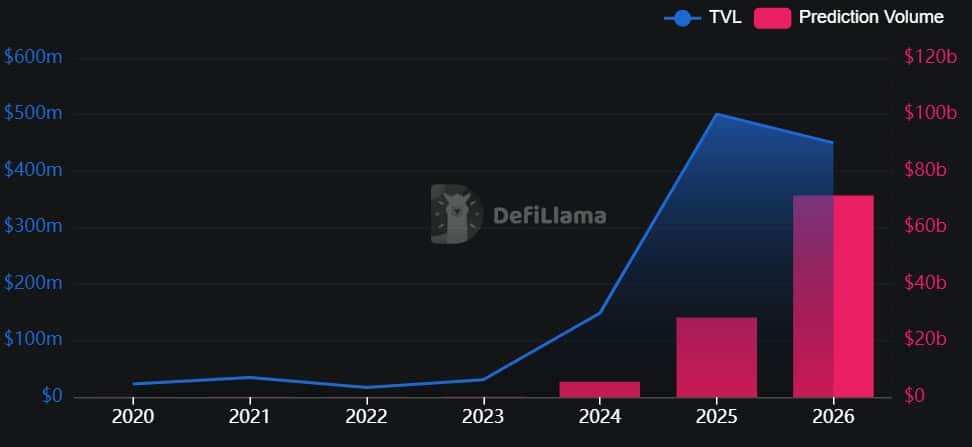
More traditional financial (TradFi) firms will enter the $44 billion prediction market sector in the months ahead, say industry insiders.
Traditional financial firms have already begun taking their first tentative steps. The $26 billion options trading behemoth Cboe launched the Cboe Predicts platform in late June.
The platform offers binary outcome contracts on movements of the benchmark S&P 500 index.
The wealth management titan Charles Schwab is reportedly set to follow suit with its own index-related offerings. Schwab holds $13.14 trillion in client assets and provides brokerage accounts to almost 40 million individuals and companies.
“This is a fast-growing area. And traditional financial intermediaries and institutional investors are paying close attention,” Peter Sanchez Guarda, the former Acting Associate Director and Special Counsel at the Commodity Futures Trading Commission, told CasinoBeats.
“Once a stable regulatory framework is decided on and the legality is settled, traditional Wall Street players will look to integrate event contracts into established trading structures to profit from this new market,” Sanchez Guarda added.
Big-money players appear determined to break Kalshi and Polymarket’s de facto duopoly.
But the experts say there may be enough space for everyone to play in a market with a current daily volume of up to $4.8 billion a day.
TradFi Prediction Markets: More Firms to Follow
The TradFi pivot to prediction markets is “already happening,” Adam Bjorn, the CEO of the iGaming firm Plannatech and the operator of the Prime Sportsbook and Betcris platforms, told CasinoBeats.
But TradFi firms are being careful to build their offerings using regulated exchange infrastructure. They are also using Office of the Comptroller of the Currency (OCC)-compliant clearing features, Bjorn noted.
The likes of Kalshi, meanwhile, use crypto as a settlement tool. That, industry insiders say, is a no-go area for bigger financial firms.
Staying away from crypto rails is “a template every major brokerage can follow without touching the regulatory fire,” said Bjorn.
The expert said “multiple major institutions” will move into the space in the next 12-18 months.
But he said the companies will “stay firmly in the financial contracts lane” pending Supreme Court clarification on legal matters.
Lawyers concur. William Walsh, a partner at Benesch Law, said recent TradFi product launches “show prediction-market-style products are moving from a niche, startup-led category into the mainstream financial market infrastructure.”
‘It’s Not a Death Sentence’
TradFi’s entry into the prediction market space does not necessarily sound the death knell for the Kalshi and Polymarket duopoly. Even with big tech giants like Meta circling the waters, experts agree there is room for more to jump on the prediction market bandwagon.
“Existing prediction market operators will emphasize their broader product offerings, and their ability to be more nimble as they offer new products and features,” Walsh told CasinoBeats. “The more traditional financial institutions are likely to remain somewhat cautious in how they proceed in these markets.”
Bjorn said the likes of Cboe “won’t touch” sports or political markets. But he warned that structural problems may await operators if they all end “chasing up the same retail dollar.”
“Exchanges operate on razor-thin margins in the middle,” he said. “You need scale, and you need velocity. What likely happens is that the financial contracts segment consolidates around the TradFi infrastructure, while the events, sports, and politics segment consolidates around two or three incumbents with the liquidity and brand.”
Failing to identify a lane or stay in it will lead operators to struggle, the experts said. Bjorn concluded: “It’s not a death sentence for the pioneers: It’s a maturation.”