



The Roundhill Sports Betting & iGaming ETF, which invests in a basket of gaming companies, rose 2.3% last week, which was ahead of the S&P 500 Index.
Playtech Plc and Betr Entertainment were among the major gainers last week, while Bally’s Corporation and Penn Entertainment were among the major losers.
Major Gainers
Playtech Plc (LSE: PTEC) +17.44%
Playtech Plc shares soared over 17% last week and are up 32% for the year. Last week’s gains were primarily attributable to a stellar H1 trading update that significantly beat market expectations.
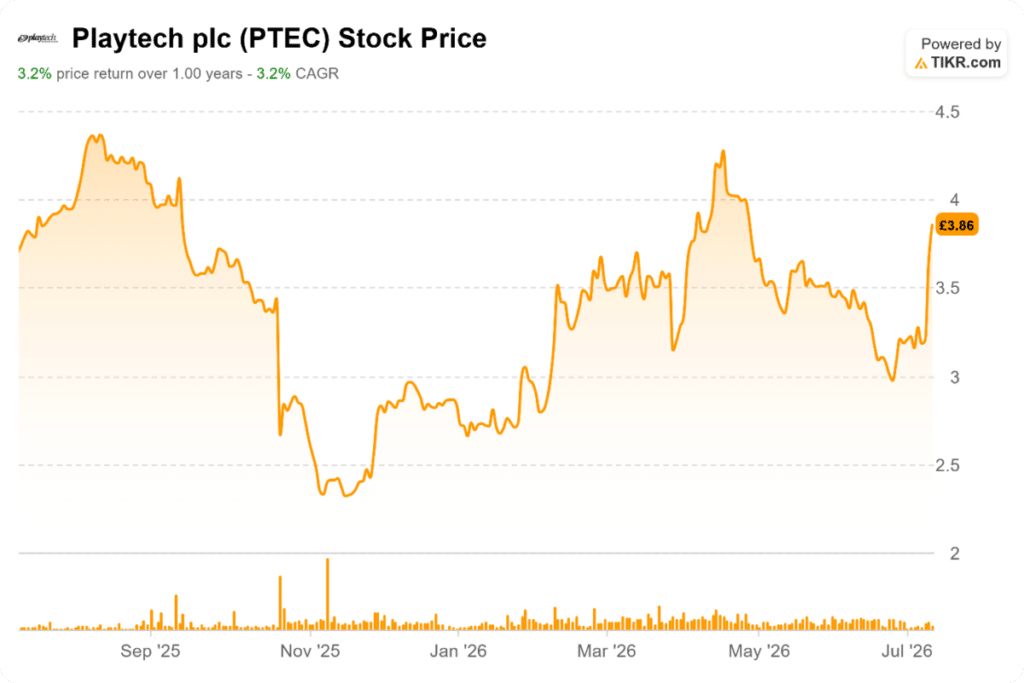
Playtech announced that it expects its full-year 2026 adjusted EBITDA to reach at least €270 million (a 37% increase year-on-year from 2025). This target blew past the prevailing analyst consensus, which had estimated earnings to sit between €205 million and €225 million.
The company’s performance in the first half was spearheaded by “excellent performance in the US and continued strength in Mexico, Colombia and certain European markets.” The U.S. market has been particularly strong for Playtech, thanks to its partnership with Hard Rock Digital.
In its trading update, the company said, “Hard Rock Digital has become one of Playtech’s largest customers and is expected to remain so going forward. It, however, cautioned, “Playtech’s revenue with the operator is likely to continue at a lower but more sustainable level in H2 2026 and into 2027.”
Betr Entertainment (ASX: BBT) +15.15%
Betr Entertainment stock rose over 15% last week, which helped it bridge its year-to-date (YTD) losses to just about 5%. On July 6, Betr announced it was shifting its core corporate and operational headquarters from the Northern Territory to Tasmania after securing a new five-year gaming license. The relocation is highly favorable for the company’s cost structure and regulatory flexibility.
The move has, however, been a political slugfest and has prompted calls for a national regulator to level the regulatory environment. Mark Kempster of the Alliance for Gambling Reform said: “A lot of questions have to be asked about this deal, because it’s very light on detail at the moment in terms of how they’re actually going to be able to properly regulate this company in the industry.”
Gambling industry body Responsible Wagering Australia, meanwhile, welcomed the move and, chief executive Kai Cantwell said, “Jurisdictions that combine strong consumer protections with competitive tax and regulatory settings will be best placed to attract investment, create jobs and deliver the best outcomes for punters.”
Bragg Gaming (NYSE: BRAG) +14.86%
Bragg Gaming also rose nearly 15% last week and made it to the list of biggest gainers. On July 9, Bragg announced a comprehensive set of operational and organizational measures, which included reducing its global workforce by approximately 19%.
The company expects these measures to lead to annualized cost savings of €6 million, which is incremental to an earlier restructuring effort announced in January, which already targeted €4.5 million in annualized savings. In his prepared remarks, Bragg’s CEO Matevž Mazij said, “These measures are designed to deliver focus, discipline, execution, and cash generation.”
Notably, there has been a flurry of layoffs in the gaming industry over the last couple of months. The market’s reaction to these has been mixed: while names like Gambling.com fell after announcing layoffs, Bragg and Robinhood saw price action to the upside.
Biggest Losers
Bally’s Corporation (NYSE: BALY) -12.31%
With a double-digit decline last week, Bally’s Corporation was the biggest loser in our coverage of gaming stocks. There wasn’t any major company-specific news, but investors are increasingly anxious about Bally’s aggressive, capital-intensive expansion timeline. The company is simultaneously funding massive long-term developments, including:
- The $1.7 billion permanent riverfront casino in Chicago (slated for 2027).
- The $4 billion Bally’s Bronx resort in New York required a hefty $500 million statutory gaming license fee earlier this year.
These investments would put strain on Bally’s balance sheet in the near term, and last month, Fitch lowered its outlook on the company from “stable” to “negative” while affirming its credit rating. “The rating reflects the elevated leverage ratios of the restricted group, projected near-term free cash flow (FCF) deficits, and uncertainty around funding new developments,” said Fitch in its report.

Penn Entertainment (NYSE: PENN) -7.52%
Penn Entertainment, which was otherwise having a good run this year, fell by over 7% last week. There wasn’t any company-specific news last week, and the decline appears to be profit-taking following stellar gains over the previous few weeks. While casino stocks were under pressure at the beginning of the year, a flurry of merger and acquisition (M&A) activity across the casino space helped trigger a rally. However, the euphoria has cooled, and names like Penn have come off their 2026 highs as investors book profits after the sharp rally.
Churchill Downs (NYSE: CHDN) -5.93%
Churchill Downs fell nearly 6% last week and has now lost a quarter of its market capitalization this year. There wasn’t any specific development last week, and the stock continued its dismal 2026 run. Wall Street analysts are meanwhile upbeat on the stock, and its mean target price of $139.75 represents a potential upside of more than 63% over the next year.
Major Gaming Market Developments Last Week
Last week, Ohio regulators advanced a proposal to officially ban credit card use for sports betting, aiming to align with nine other states that are targeting credit-based gambling risks.
In a major bid to match traditional financial derivative structures, Polymarket filed an application for a Futures Commission Merchant (FCM) license via an affiliate. The license will allow eligible U.S. traders to leverage their bets rather than fully collateralizing positions with upfront cash.
According to reports, major Wall Street banks, including Goldman Sachs, Bank of America, JPMorgan Chase, and Morgan Stanley, have added rules related to prediction markets to their code of conduct. These bar employees from placing bets on political and financial events. However, there are no restrictions on betting on entertainment and sports activities.
The prediction market has been battling allegations of insider trading. Last week, Arizona Governor Katie Hobbs signed a first-of-its-kind bill banning insider trading on prediction markets. Simultaneously, Arizona regulators issued sweeping cease-and-desist orders against social online gambling platforms.
There is also a turf war between states and the CFTC over the regulation of prediction markets. The CFTC is aggressively doubling down on the view that sports “event contracts” fall strictly under its federal jurisdiction, drawing sharp anger from state regulators and tribal governments who argue this is illegal gambling that bypasses state laws.
Last week, North Carolina Governor Josh Stein signed a $34 billion budget that immediately raised the state’s online sports betting tax from 18% to 23%. It also introduces a 6% tax on the net trading fee revenue of federally regulated prediction markets, making NC the first state to legitimize its operations by officially recognizing the CFTC’s jurisdiction.
Given the ongoing legal tussle between states, the CFTC, and prediction market platforms, the battle might eventually head to the Supreme Court, where many lawyers believe the CFTC may have the upper hand over states.
Last week, U.S. District Judge Analisa Torres denied Kalshi’s request for a preliminary injunction that aimed to block New York state from enforcing its local gambling laws against Kalshi’s sports contracts.
Regulatory resistance continues to grow abroad. The Netherlands officially rejected an appeal from Polymarket, and Italy has re-added the platform to its unauthorized gambling blacklist, following recent bans in Spain, Portugal, and Brazil.
Last week, Michael Burry, who rose to fame with his bet against the U.S. housing market prior to the 2008 crash, disclosed that he has taken positions in DraftKings and Flutter Entertainment. Meanwhile, more than a bet on these companies, Burry is betting against prediction markets which have taken away business from traditional gambling companies.

In his Substack post, the “Big Short” investor said, “I believe that the political climate will not tolerate this (prediction markets).” He added, “Prediction markets exist in a loophole adjacent to a heavily regulated and taxed industry. In time, prediction markets will be subsumed into regulation and taxation.”
What Should Gaming Investors Watch This Week?
We are now in the Q2 earnings season, and while there aren’t any major gaming earnings lined up for this week, investors should keep an eye on the earnings calls of major banks this week as they provide crucial insights into the health of the U.S. consumer.