


Blackjack insurance is one of the most common yet misunderstood side bets in the game of blackjack. So, what is insurance in blackjack? It’s an optional wager offered when the dealer shows an Ace, allowing players to hedge against a potential blackjack.
Its real value has always been open to debate. In this guide, we’ll break down what blackjack insurance is, when it might make sense to use it, and whether it’s worth it – based on statistics, strategy, and probability.
Key Beats
- Blackjack insurance is an optional side bet offered when the dealer shows an Ace.
- Insurance blackjack feels like protection, but most of the time it costs you more money.
- Best advice for casual players: skip blackjack insurance and stick to basic blackjack strategy.
What Does Insurance Mean in Blackjack Online?
Blackjack insurance is a side bet that’s offered to players when the dealer’s upcard is an Ace. Rather than protecting your hand itself, insurance in blackjack is designed to hedge against the possibility that the dealer has a natural blackjack.
If you take blackjack insurance, you place an additional bet – usually half your original stake – that pays out 2:1 against the dealer’s facedown card being a 10-value (10, J, Q, K). If the dealer does have blackjack, your insurance blackjack bet wins.
How Does Insurance Work in Blackjack
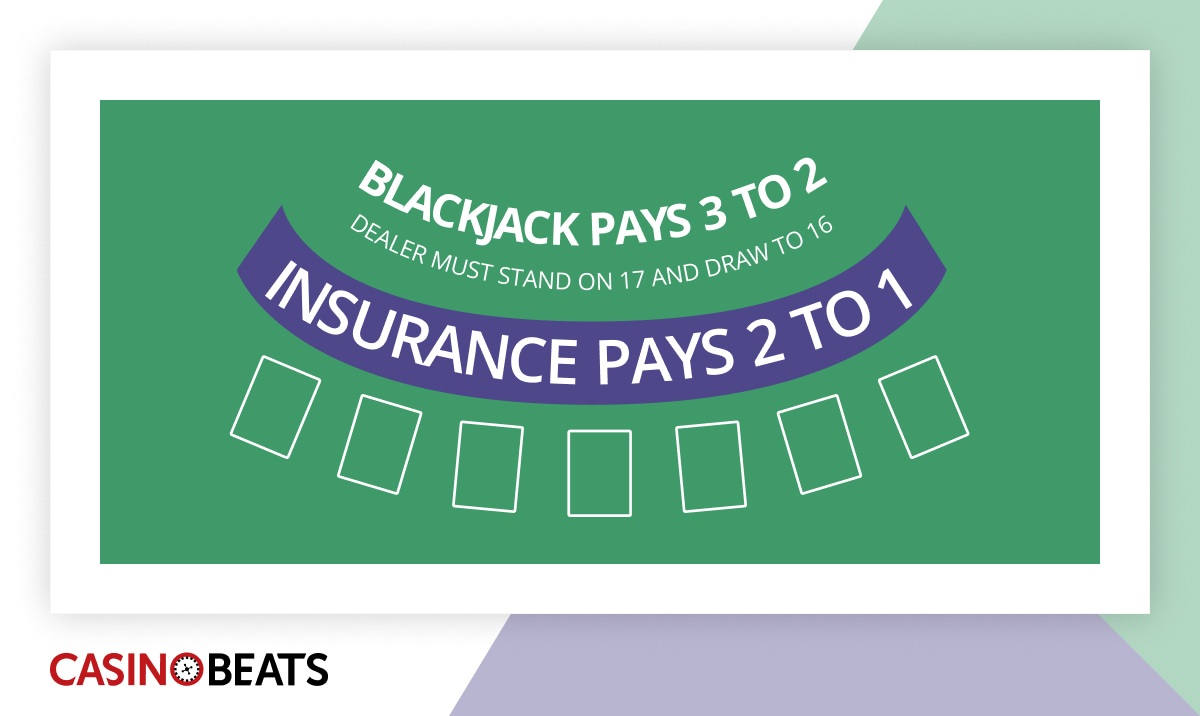
The blackjack insurance rules are straightforward once you see them in action. The example below shows how blackjack insurance works from the moment the dealer reveals an Ace to the final outcome of the bet.
Here’s a step-by-step example:
- You bet $10 on your main hand.
- The dealer shows an Ace.
- You’re offered insurance and choose to place a $5 insurance bet.
- If the dealer has a 10, they have blackjack. You lose your main $10 bet but win $10 from insurance (2:1 payout on $5), breaking even overall.
- If the dealer doesn’t have blackjack, your $5 insurance bet is lost, and you continue playing the round with your original hand.
This option gives the illusion of protection, but in reality, it’s a separate gamble with different odds – and they’re not great, as we will reveal.
Blackjack Insurance Odds
Due to its name, blackjack insurance sounds like protection, but it’s one of the most misunderstood bets at the table, because it doesn’t work the way it sounds. Let’s walk through how it really works:
- When is insurance offered? You’ll be offered an insurance bet only when the dealer’s upcard is an Ace. The insurance is a side bet on whether the dealer has blackjack.
- What are you betting on? You’re betting that the dealer’s hidden card is a 10-value card (10, J, Q, or K), which will total 21 combined with the previous Ace card.
- What’s the actual chance of happening? In a standard deck, 16 out of 52 cards are worth 10 points. That’s about a 30.8% chance the dealer has blackjack.
- What’s the payout? Insurance pays 2:1 if the dealer has blackjack.
- Why is it risky? The 2:1 payout doesn’t match a 30.8% probability very well. Over time, you’re paying more for the insurance bet than it’s statistically worth.
In essence, insurance bets sound like total safety, but they actually benefit the casino more than the player, especially if you’re not counting cards.
Probability & House Edge of Blackjack Insurance Bet
As mentioned earlier, insurance bets are a bad match between probability and payout numbers. Now, let’s look at why blackjack insurance bet is such a bad deal mathematically. Here’s how the mismatch happens:
- You can only win the insurance bet if the dealer’s hidden card is a 10-value card.
- The dealer having a 10-value card happens only about 30.8% of the time in a fresh deck.
- However, insurance pays 2:1, which would only be fair if the probability of happening were 33.3% (1 in 3) instead of 30.8%.
- That gap between 30.8% vs 33.3% is where the casino’s advantage lives.
It doesn’t end there. In multi-deck games, the house edge on insurance is about 7.5%. But in single-deck games, it can climb as high as 8.75%. That’s a lot when compared to normal blackjack play, which can offer a house edge of under 1% with perfect basic strategy.
You can express it in terms of expected value:
Formula: EV = (Win % × Win Amount) – (Loss % × Bet)
In essence,
- You win 30.8% of the time and get paid 2 units
- You lose 69.2% of the time and lose 1 unit
Over many bets, that imbalance slowly drains your bankroll.
Blackjack Insurance Example
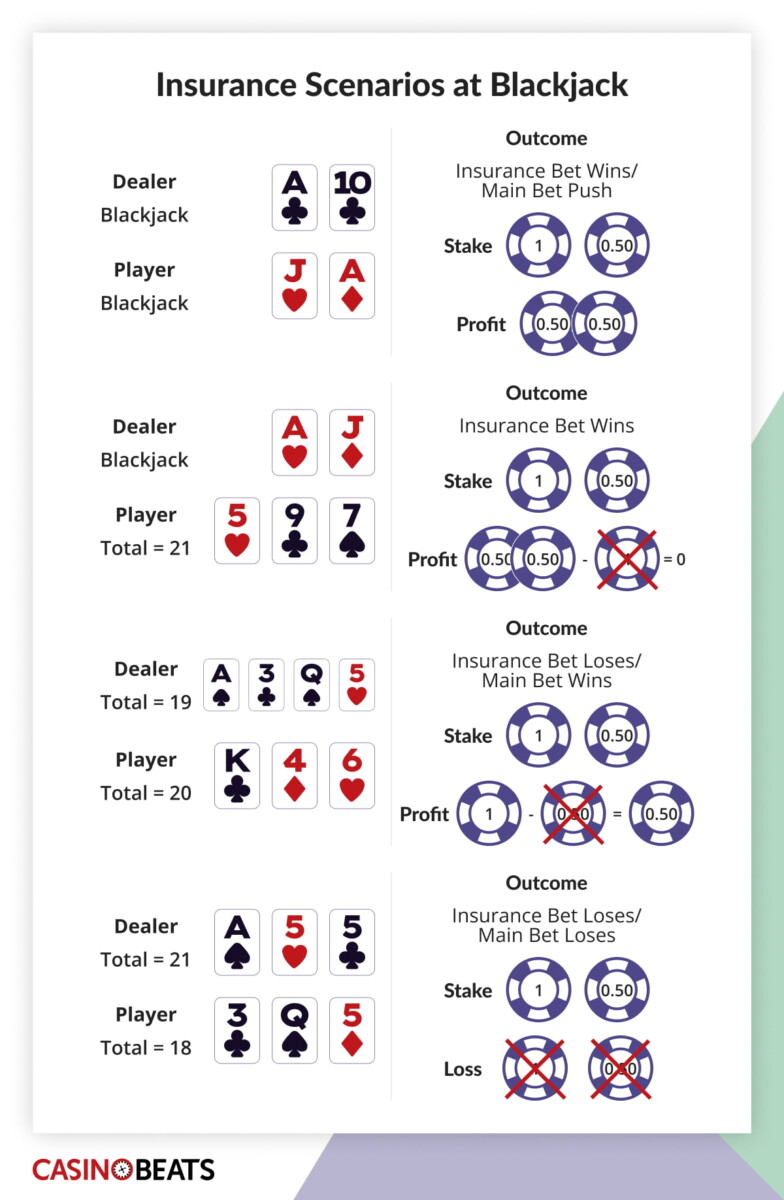
Below, we’ve curated a simple and educational example to illustrate how blackjack insurance works. This is just a clear way to understand why the standard 2:1 payout favors the house.
Background Assumptions:
- The player is at the table, and the dealer shows an Ace, so insurance is offered
- The dealer has blackjack about 30.8% of the time
- Insurance bet size = 1 unit
- Expected Value (EV) = (Win % × Win Amount) – (Loss % × Bet)
The EV compares like this:
| Payout Odds | Dealer Has Blackjack (30.8%) | Dealer Doesn’t (69.2%) | Net Expected Value (EV) | House Edge / Player Edge |
|---|---|---|---|---|
| 2:1 (standard) | Win +2.00 units | Lose −1.00 unit | −0.076 | House edge ≈ 7.6% |
| 2.2:1 | Win +2.20 units | Lose −1.00 unit | −0.014 | House edge ≈ 1.4% |
| 2.23:1 (fair) | Win +2.23 units | Lose −1.00 unit | ≈ 0.005 | Break-even |
| 2.5:1 | Win +2.50 units | Lose −1.00 unit | +0.078 | Player edge ≈ 7.8% |
How the EV is calculated (example for 2:1):
EV = (0.308 × 2.00) − (0.692 × 1.00)
EV = 0.616 − 0.692 = −0.076
That means:
- The standard 2:1 insurance payout clearly favors the house
- Insurance only becomes fair at about 2.23:1, which casinos never offer
- By capping insurance at 2:1, casinos lock in a guaranteed long-term advantage
- Unless you’re counting cards and know the deck is rich in tens, insurance is a losing bet
When Should You Take Insurance in Blackjack
While most experienced players skip blackjack insurance, there are limited cases where it could be useful. An insurance blackjack bet is a side wager meant to guard against the dealer having a natural blackjack.
Insurance in blackjack should only be considered when the probability of the dealer holding a ten-value card is unusually high. By knowing when to place a blackjack insurance bet, you can make smarter choices and avoid taking unnecessary risks in every round.
✔️ 1. You’re Counting Cards
If you’re an advanced player, using a card counting system like Hi-Lo, and you know the deck is rich in 10-value cards, a blackjack insurance bet can be a profitable move.
For example: You’ve counted a high number of 10s remaining in the deck – the dealer shows an Ace. You take insurance because the probability of the dealer having blackjack is now greater than 33.3%.
✔️ 2. You’re Playing Single-Deck Blackjack
In a single-deck game, you have better information about the remaining cards. Therefore, card counting is more effective. That makes insurance in blackjack slightly more viable, but only if you’re using a strategy.
The game uses a single deck. You’ve seen a lot of low cards drawn. You estimate a high chance that the next card is a 10, making insurance slightly more favorable.
✔️ 3. You’re in a Tournament Situation
In rare cases, like blackjack tournaments, insurance might help preserve your position if losing your hand would knock you out of contention.
Let’s say you’re in the final hand of a tournament. You’re ahead by a narrow margin. Taking blackjack insurance would lock in a win or keep you in the game even if the dealer has blackjack.
When Not to Take A Blackjack Insurance Bet
Most of the time, blackjack insurance bet is a bad bet, particularly for casual players. The odds simply don’t justify the payout. The house edge makes it a long-term drain on your bankroll.Here are three clear-cut situations when you should skip the insurance blackjack option:
❌ 1. You’re Not Counting Cards
Without counting cards, you’re essentially guessing whether the dealer has blackjack. Since the odds are against you, insurance in blackjack is a sucker’s bet.
Let’s use this example: The dealer shows an Ace. You’re playing for fun and have no clue how many 10s remain. You take blackjack insurance, and you lose it 70% of the time. Why bother?
❌ 2. You Have a Strong Hand
Players often want to ‘protect’ a good hand like 20 by taking insurance in blackjack. But this is a psychological trap – insurance is a separate bet. Your strong hand doesn’t affect the dealer’s odds of blackjack.
If you’re holding a 10 and a Queen (20), and the dealer shows an Ace. You insure your bet, only to lose the insurance because the dealer didn’t have blackjack. Now you’ve thrown away half a bet for no reason.
❌ 3. You’re on a Budget
Blackjack insurance rules eat into your bankroll with no real long-term benefit. If you’re playing conservatively or trying to make your money last, you’re better off declining the bet every time.
If you bet $10 per hand, and insurance asks for $5 more. Over 20 hands, that’s $100 in extra bets that are statistically stacked against you.
4 Tips for Using Blackjack Insurance Bet
While insurance in blackjack is rarely the optimal move, it helps to know how to approach it like a pro, especially if you’re tempted to click that button in a live online game. Here are some quick-fire tips to help you handle blackjack insurance wisely.
Know what you’re betting
Insurance bet blackjack isn’t about your hand – it’s a side bet on whether the dealer has a 10 underneath their Ace. Don’t let a strong hand (like a 20) emotionally trick you into thinking you need to protect it.
Avoid it, unless you’re counting cards
If you’re not using a card counting strategy, the odds are simply not in your favor. The house edge is too high for casual bets.
Don’t confuse it with ‘even money’
When you have blackjack and the dealer shows an Ace, you might be offered ‘even money’. That’s just insurance in blackjack by another name. And yes, it’s still a bad bet mathematically, unless you’re a card counter.
Stick to basic strategy first
Before diving into side bets like insurance, master basic blackjack strategy, which is proven to reduce the house edge on the main game, unlike blackjack insurance, which increases your risk.
Should You Take Insurance in Blackjack?
To be honest, in most cases,blackjack insurance bet is not worth it for the average player. Although it sounds like a smart safety net, the math simply doesn’t back it up.
Whether you’re playing at land-based tables or trying live dealer games at trusted online casinos, insurance is always presented when the dealer shows an Ace.
Statistically, when the dealer shows an Ace, they’ll only have a blackjack around 30% of the time. That means you’re losing your blackjack insurance bet nearly 70% of the time.
Given that the payout is only 2:1, the odds don’t reflect the risk. The house edge on insurance in blackjack is steep, about 7.5% in multi-deck games. This makes it one of the least player-friendly options at the table.
Conclusion
Blackjack insurance might sound like a smart way to protect your hand, but – for most players – it’s a costly distraction. Yes: it pays 2:1. Unfortunately, the odds of the dealer having blackjack don’t justify the bet. It gives the house a significant edge.
Unless you’re counting cards or playing in a particular scenario like a single-deck tournament, insurance in blackjack is best avoided. It doesn’t depend on your hand; it’s not a safeguard, it’s a side bet with poor value over the long run.
Stick to a solid basic strategy, manage your bankroll wisely, play responsibly, and if you’re serious about improving, learn how card counting affects the math behind bets like blackjack insurance. Otherwise, your safest bet is to simply say “no, thanks” when the insurance offer pops up.
FAQs
-
What does insurance mean in blackjack?
Insurance in blackjack is a side bet that protects you if the dealer has blackjack. You place it when the dealer shows an Ace. If their hidden card is a 10-value, the bet pays 2:1.
-
Is insurance in blackjack worth it?
For most players, no. The payout doesn’t match the true odds and gives the casino an edge.
-
How much is insurance in blackjack?
Insurance costs half of your original bet and is offered when the dealer shows an Ace.
-
Does insurance matter if I hit blackjack?
Not really. Insurance is a separate bet and doesn’t improve your blackjack payout.
-
Is insurance in blackjack good for beginners?
Not really. For beginners, insurance is usually a losing bet over time. It’s better to focus on basic strategy and avoid side bets unless you understand the odds.
-
Should you ever take insurance in blackjack?
It depends. The only time you should take blackjack insurance is if you’re counting cards and know the deck is rich in 10s. Otherwise, the odds don’t justify the 2:1 payout, making it a poor value bet in most cases.
-
When to take insurance in blackjack?
You take blackjack insurance when the dealer shows an Ace. But taking it is only advised in rare scenarios – like card counting or in a specific tournament strategy.