










Paul started his career in newspaper journalism before exploring the emerging world of online gaming in 1998, joining Intertops in Antigua - the pioneering force behind the first online sportsbook. Since then, Cullen has enjoyed...
Read Full Bio
Dina has over three years of experience in the iGaming industry as a Content Writer before moving into SEO Content Writing and later Editorial Project Management. Her work centers on online casino topics, including commercial...
Read Full BioExpected Value in casino games is the go-to statistic for players and strategists, showing the mathematically expected outcome of a bet. On paper, it’s flawless: it calculates risk, reward, and potential results with precision. In reality, however, short-term swings, human decisions, and game design quirks mean the numbers rarely play out as predicted.
This guide explains what expected value in casinos is, why it works best in theory, and how variance, psychology, and casino mechanics can skew outcomes.
Whether you’re a casual player curious about why your ‘positive EV’ strategy doesn’t always pay off, or a professional gambler looking to understand the nuances behind the math, this article will give you a clear, practical reality check.
Key Beats
- EV in casinos shows long-term averages, not short-term results. Variance and volatility can make actual outcomes unpredictable.
- Player behavior affects results. Biases like chasing losses or hot streaks can turn positive EV into losses.
- Game design matters. Bonuses, RTP variations, and casino rules can reduce practical EV in casinos.
What Is Expected Value in a Casino
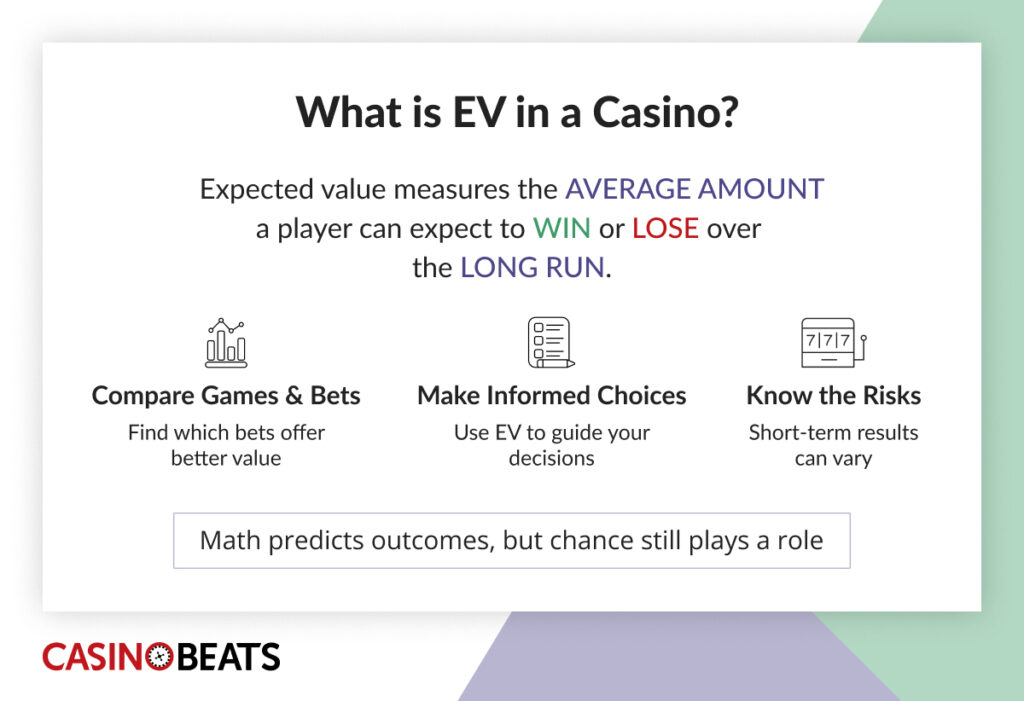
Expected value in a casino measures the average amount a player can expect to win or lose on a bet over the long run. It’s a statistical tool used to compare different games, bets, and strategies, helping players make more informed decisions. While EV predicts outcomes mathematically, short-term results can still vary due to chance and game mechanics.
The Math Behind Expected Value in Gambling
Expected value in gambling shows the average amount you can expect to win or lose on a bet over time. It’s a simple way to compare games and make informed decisions, even though short-term results can vary.
The formula is simple enough:
EV = (Probability of Win × Amount Won) − (Probability of Loss × Amount Lost)
If the result is positive, the bet is theoretically profitable. If negative, it’s a losing proposition over time, and the house is happy.
A more general formula for how to calculate expected value is EV = Σ (Probability of each outcome × Value of that outcome). This covers situations with multiple possible results.
Let’s consider some examples:
- Blackjack: Perfect strategy fine-tunes the house edge to 0.5%, meaning an EV of −$0.50 for every $100 wagered.
- Roulette: A single-number bet on a European wheel has a 1 in 37 chance of winning, paying 35:1. The EV works out to around −2.7%.
- Poker: Skilled players can push EV into positive territory by consistently making better decisions than their opponents.
- Slots: With fixed RTPs and high volatility, most have an EV of −5% or worse.
For strategists, EV is a cornerstone metric. It allows players to compare games, bets, and strategies objectively. However, keep in mind that expected value in casino games
is not a prediction of what will happen in a single session. Instead, it’s a statistical calculation – an average – meant to guide long-term decision-making.
It’s not a guarantee against the waves of short-term variance. It occurs in all of the most popular casino games you will ever come across.
Reasons Why Expected Value in Casino Games Doesn’t Always Meet Reality
Below is a quick overview of the main reasons why expected value in casino games often differs from reality — each of these topics is explored in detail throughout this guide:
- Short-term variance – Results can swing far from EV in the short term.
- Behavioral biases – Psychology, like chasing losses or believing in streaks, affects outcomes.
- House edge and game rules – Built-in casino advantage alters practical EV.
- Game design and volatility – Slots, bonuses, and mechanics can make losses less noticeable.
- Regulatory differences – RTP rules, multiple versions of games, and operational factors can change what players actually experience.
House Edge vs Expected Value: What Players Really Face in Casino Games
The house edge is the casino’s built-in advantage: the percentage of every bet it expects to keep over the long haul. It’s the mirror image of EV: if your EV is −1%, the house edge is +1%. It’s also the reason why the lights stay on in Vegas, and you’re drinking a comped margarita.
House edge is baked into the rules. Blackjack’s payouts, roulette’s extra zero, and baccarat’s commission on banker bets. They are all designed to tilt the math in the casino’s favour.
Players often confuse house edge with Return to Player (RTP), especially in slots. RTP is the theoretical percentage a game pays back over millions of spins. A 96% RTP sounds excellent, but it still means the game is keeping 4% in the long run – and that’s before we throw volatility, bonus conditions, and players’ decisions.
But here’s the kicker: the house edge tells you nothing about short-term swings. Hit a streak at the roulette table, and you could blow the 2.7% edge out of the water – at least for a while.
House edge is the casino’s average. Your reality depends on variance, timing, and whether you can play without handingan extra edge back through bad decisions.
Variance: Why Short-Term Results Can Differ from EV
Even if expected value in casinos predicts long-term averages, variance is the “chaos” that makes short-term results unpredictable. You can play the same game with the same bets and win big one night, lose the next.
But is it all just down to luck?
Real-world Nevada gaming data shows exactly how far reality can stray from the averages:
| Game | Average (%) | Low (%) | High (%) |
|---|---|---|---|
| Blackjack Twenty-One | 12.76 | 8.23 | 18.12 |
| Craps | 14.33 | 8.03 | 20.23 |
| Roulette | 18.83 | 9.17 | 25.70 |
| Baccarat | 12.89 | 2.91 | 26.47 |
These figures cover two decades of monthly state-wide hold percentages (2004–2025). Even skill-heavy blackjack can swing from 8.23% to 18.12% in a month. Roulette’s volatility pushes it from 9.17% to 25.70%, and baccarat – the most extreme – has ranged from 2.91% to 26.47%.
For bankroll management, this matters.
High-variance games can produce thrilling short-term wins. The problem is, they also require deeper pockets and stricter discipline to survive the inevitable losing runs. Without understanding variance, even a positive expected value in games won’t save you from going broke before the math has a chance to even out. This is where a responsible gambling strategy also comes in handy.
How Behavioral Biases Impact Expected Value
Even when players understand expected value in gambling and variance, human psychology often gets in the way, leading to costly mistakes. Our brains are wired to spot patterns – even when none exist. This can lead to costly mistakes at the tables.
Three classic examples:
- Gambler’s Fallacy: Believing that past results influence future ones best sums up what the Gambler’s Fallacy is (red has come up five times in a row, so black is due next). In reality, each spin of the roulette wheel is independent.
- Hot Hand bias: Assuming a winning streak will continue because you’re ‘in the zone’. This can lead to overbetting before the inevitable correction.
- Loss aversion: Feeling the pain of a loss, more strongly than the pleasure of an equivalent win, can often drive players to chase losses with bigger, riskier bets.
In real life, these biases cause players to abandon mathematically sound strategies. A blackjack player might deviate from basic blackjack strategy after a run of bad hands. A poker player might loosen up and bluff more after a big win. The danger is that behavioural mistakes stack on top of the house edge, turning an already negative EV into a bankroll killer.
Understanding the numbers is essential. However, staying disciplined and aware of these biases is just as important as understanding the math.
Game Design and Bonuses Can Change Your Expected Value
Casinos and game developers understand expected value in casino games, variance, and psychology better than most. Modern games are engineered to make the math less noticeable and the experience more compelling, keeping players engaged for longer.
Volatility as a feature
Slot designers often lean on high volatility to create an emotional rollercoaster: long stretches of nothing, punctuated by big, noisy wins. The average expected value remains negative, but the occasional adrenaline spikes make the losses feel less significant in the moment.
Bonuses and perceived value
Welcome offers, free spins, and progressive jackpot slots are all marketed as ‘extra value’. The reality is in the fine print: wagering requirements, game restrictions, and expiry dates all drag the practical EV down.
For example, a ‘100% bonus up to $100 with a 40x rollover’ means you will need to wager $4,000 before you can withdraw – and that’s assuming you don’t go broke first.
Aggregators and game libraries
Online casinos often source their games from aggregators, who set the available RTP versions. A 96% RTP slot might also exist in 94% and 92% configurations. Operators can choose the one that suits their market or profit goals. Players rarely see this choice, further distancing the advertised EV from what they experience.
In short, the design isn’t about hiding the edge; it’s about making it irrelevant in the heat of the game.
Game Rules, Regulators, and Your Expected Value
Game fairness isn’t left entirely to casino goodwill – regulators set the standards. But those standards vary wildly from one jurisdiction to another. The way they intersect with EV in casinos isn’t always apparent to players.
- Jurisdictional differences: In the UK, the Gambling Commission mandates that slot RTP be clearly disclosed and that the figures reflect long-term theoretical performance. In parts of the US, casinos can offer multiple RTP versions of the same game without revealing which one is in play. In some markets, there’s no public RTP data at all.
- The payment and withdrawal factor: Even when the game math is fixed, your effective EV can be eroded by operational rules. Withdrawal minimums, transaction fees, and processing delays can all impact how much you actually keep. Bonuses with time limits can force you into higher-volatility play, increasing the risk of busting out before the wagering requirement is met.
- Implications for operators and aggregators: For reputable operators, transparent RTP reporting and consistent configurations build trust. However, they can also squeeze margins. While aggregators supply the games, they have to balance regulatory compliance with operator demands for house edge flexibility.
In other words, regulators can keep the expected value in casino games honest in theory. But practical reality still leaves room for wide variation in what players experience.
Expected Value: Myths vs. Reality
Players often treat expected value in casinos like a magic key – master the maths and the winnings will follow. The truth is messier. EV is a compass, not a guarantee. Without discipline, it’s useless. You have to stick to the strategy through both the highs and lows.
- Use EV to compare bets, games, and strategies.
- Track your play with spreadsheets or bankroll management apps to understand variance.
- Avoid chasing losses; that’s where the biggest EV mistakes happen.
- If you take bonuses, calculate their real EV after wagering requirements and restrictions.
EV is not your ticket to beating the house; it’s your way of knowing the cost of playing. Use it responsibly, and it becomes a valuable decision-making tool. Ignore variance and psychology, and it’s just another number.
Final Thoughts
Expected value in gambling is the clean, precise maths behind every casino game. Reality ruins the party.
Short-term variance, player psychology, game design, and regulatory quirks can all distort the neat predictions offered by EV.
For players, understanding EV in casinos means seeing past the hype and recognising the cost of playing over time. It’s a tool for more thoughtful decisions, not a promise of profit. Even with a positive EV, short-term results can vary widely — the key is discipline, smart bankroll management, and patience to let the numbers work in your favor.
Bottom line: Expected value in casino games works as advertised in the long run, but in the real world, swings, streaks, and human factors mean results will often differ from the math. Knowing this helps you play smarter, not just hope for a win.
FAQs
Expected value in gambling (EV) is a statistical measure that shows the average amount you can expect to win or lose on a bet over the long term. It helps players compare games and strategies objectively, but it does not guarantee short-term results. EV is a guide, not a promise of profit.
To calculate EV, multiply the probability of each possible outcome by its payout, then subtract the probability of losing multiplied by your loss. The basic formula is:
EV = (Probability of Win × Amount Won) − (Probability of Loss × Amount Lost)
A positive result means a theoretically profitable bet over time, while a negative result indicates an expected loss. For games with multiple outcomes, sum the EV of each possible result.
Because variance rules the short term, you can win big in a −EV game or lose heavily in a +EV situation simply due to luck. EV only plays out as predicted over a very large number of trials.
Technically, by comparing RTPs and volatility, you can identify slots with a smaller house edge. However, remember that high volatility can make results swing far from the average for long periods.
Bonuses can improve EV if the wagering requirements and restrictions are reasonable. However, high rollovers, game limitations, or short expiry times often reduce or eliminate any real advantage. Always calculate the practical EV before committing.
EV benefits everyone. Casual players can use it to stretch their bankroll by picking games with lower house edges, while pros use it to shape long-term strategy and investment decisions.
References
- Nevada Table Games: Historical Hold Percentage Variations (Gaming Library)