


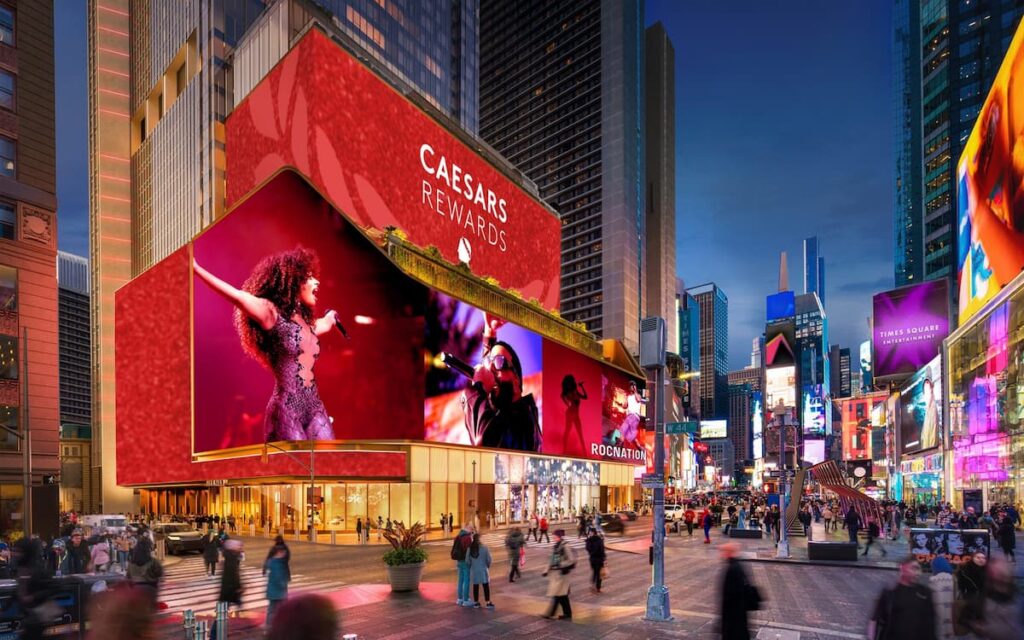
While SL Green Realty‘s bid to open a Manhattan casino is over, CEO Marc Holliday signaled the company isn’t giving up on the idea of bringing a casino to Times Square.
During the company’s third-quarter 2025 earnings call, Holliday described the failed Caesars Palace Times Square proposal as both a “disappointment” and a testament to the company’s ambitions.
“I’d be remiss if I didn’t mention the disappointment we felt in not advancing in the state process for a gaming license,” Holliday said.
“You know we put our heart and soul into Caesars Palace Times Square, and it was an enormous loss for New York City and for the large coalition of community stakeholders that stood to gain so much from this project.”
He added that the company “could not be prouder of the enormous effort that the entire company put behind this proposal.” Holliday called it an example of SL Green at its best: “bold, community-minded, and rooted in New York.”
Refusing to Fold
Holliday said the project “would have improved Times Square, created thousands of good jobs, and served as an economic engine for every business in the area for generations to come.”
He criticized the licensing process that, in his view, “put so much power in the hands of so few.” He argued that “there should be at least one casino in Manhattan.”
Analysts raised questions about the fate of 1515 Broadway, the proposed site for the casino. Holliday made clear that the idea remains alive.
“I don’t think by any means it’s… completely dead,” he said. “The whole process and the outcome is still unknown … and whether, if any [licenses] are held back, there’ll be another shot … for casinos in Manhattan or otherwise to come into play.”
He noted the company is “keeping alive a hope for the future of a possible casino if a license remains available.” At the same time, it’s “evaluating all options” for the property, which it has fully leased through 2031.
Community Opposition & Tough Manhattan Market
SL Green developed the Caesars Palace Times Square casino proposal in collaboration with Caesars Entertainment and Roc Nation. The proposal emerged as one of the most contentious among the eight casino applicants.
While the developers claimed they had the backing of over 200 businesses and organizations, they faced considerable pushback.
Local business owners, theater operators, and neighborhood groups—including the Broadway League and the No Times Square Casino Coalition—warned that the development would disrupt tourism patterns and the area’s cultural fabric.
Proponents argued it would drive economic revitalization, fund safety improvements, and generate union jobs. Despite those promises, the Community Advisory Committee (CAC) voted down the Times Square bid.
All Manhattan Bids Fail to Convince CACs
The Times Square proposal was one of three in Manhattan. The others were The Avenir in Hell’s Kitchen and Freedom Plaza near the United Nations. All of them faced the same fate, with each proposal’s CAC rejecting them amid similar community divisions. That left the borough without a casino contender.
Four other bids advanced outside Manhattan. That left potential downstate licenses concentrated in Queens, Brooklyn, the Bronx, and Yonkers. Many industry observers considered the existing racinos, Resorts World New York City and Empire City in Yonkers, to be frontrunners from the beginning of the process. Still, in a shocking move, MGM Resorts withdrew Empire City’s application a few days ago.
Holliday’s comments echo the frustration of developers who felt the process favored outer-borough projects. “Times Square was the exact right location,” he said on the call. He added that the process “was designed to make that impossible, at least for the time being.”
Looking Ahead
For now, Holliday said SL Green is in no rush to decide the long-term fate of 1515 Broadway. The company’s debt position provides “complete financial flexibility.” Also, the property’s current tenant—recently strengthened through a Skydance acquisition—offers stable cash flow until 2031.
“We’re going to evaluate all options,” Holliday said. “The beautiful thing is right now, we’ve got so much flexibility … and obviously, you know, keeping alive a hope for the future of a possible casino if a license remains available.”
Whether that optimism will result in another bid will depend on the New York State Gaming Commission reopening the Manhattan conversation. However, that’s a scenario industry observers consider unlikely, at least in the near term.
Still, SL Green’s persistence keeps the dream of a Times Square casino alive, long after others have folded.