



There was a relief rally in gaming stocks last week, and the Roundhill Sports Betting & iGaming ETF (NYSE: BETZ), which invests in a basket of gaming companies, rose 1.4%, which was slightly ahead of the S&P 500 Index. Importantly, it was the first time in 10 weeks that BETZ outperformed the broad-based index.
Rush Street Interactive and Super Group were among the major gainers last week, while Huya and DouYu were among the major losers.
Major Gainers
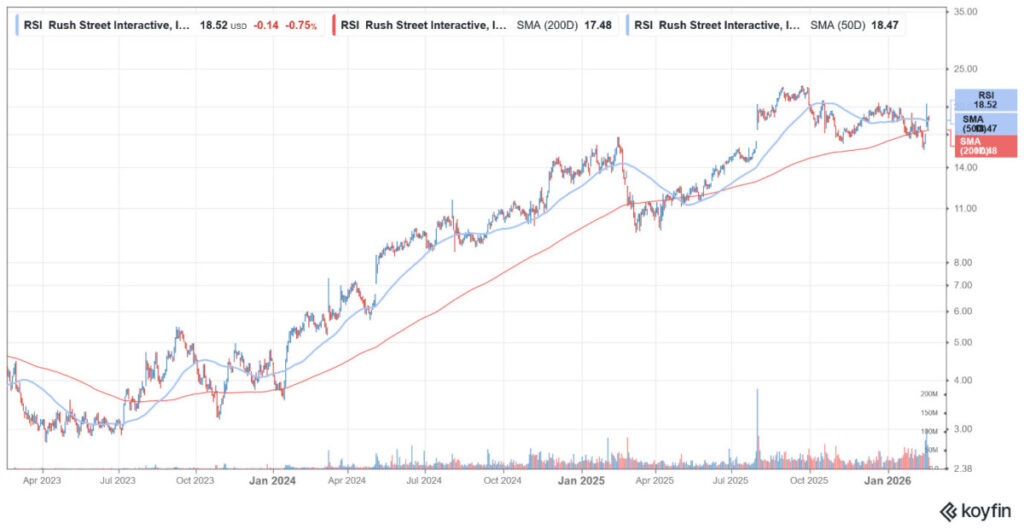
Rush Street Interactive (NYSE: RSI) +16.5%
With a rise of 16.5% last week, Rush Street Interactive was the biggest gainer in our coverage of gaming stocks. Last week’s rally could be attributed to the Q4 2025 earnings release, when the company beat both the top and bottom lines.
RSI’s Q4 revenues rose 28% to a record high of $324.9 million, beating estimates by nearly $20 million. Its adjusted EBITDA also rose 44% over the period to a record high of $44.1 million. Along with the stellar Q4 performance, Rush Street also provided upbeat guidance for 2026, forecasting revenues between $1.375 billion and $1.425 billion. It expects to generate adjusted EBITDA of $210 million to $230 million, with the top end of the guidance implying a 50% year-over-year increase.
Looking at the other metrics, RSI’s Monthly Active Users (MAUs) in the U.S and Canada rose 37% YoY to 278,000, while Latin America MAUs rose 47% to 493,000.
The earnings were received well by Wall Street analysts, and Needham and Oppenheimer raised their target prices. Citizens went a step further, upgrading the stock by one notch to “Outperform” while assigning a target price of $24.
Supergroup (NYSE: SGHC) +14.32%
Supergroup rose by more than 14% last week, helping it narrow its YTD losses to 17%. While there wasn’t any major company-specific news, the rally could be in anticipation of upcoming earnings.
Notably, Super Group, the parent company of Betway, announced an exit from the US market in 2024. Its European operations have, however, done well, which helped the stock rally last year despite jitters over the U.K. gambling tax hike.
Melco Resorts & Entertainment (NYSE: MLCO) +9.58%
Melco Resorts, which was among the major losers in the preceding week as markets gave a thumbs down to its Q4 earnings, saw nearly double-digit gains last week. Along with bottom fishing in the beaten-down name, third-party reports suggesting the company is gaining market share in Macau helped propel the shares higher.
Analysts also see the MLCO sell-off as overdone, and last week UBS upgraded the stock to a “Buy” from “Neutral” while assigning a target price of $9.50. The stock’s mean target price is $8.67, which is 43% higher than last week’s closing price.
Biggest Losers
Huya (NYSE: HUYA) -11.68%
Huya was the biggest loser in our coverage of gaming stocks last week, shedding nearly 12% of its market capitalization, roughly half of which came on Friday. There was a sell-off in Chinese shares last week, which seems to have put pressure on Huya shares.
Also, the fall looks like a profit book exercise after Huya rose to a multi-year high earlier this month.
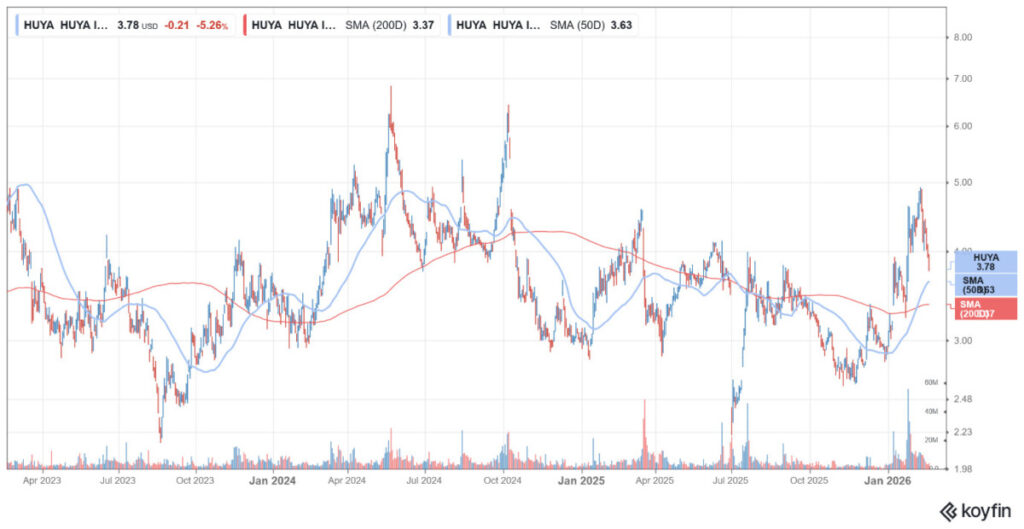
Notably, Huya stock rallied in January after the company reported that the mobile version of the popular social deduction game Goose Goose Duck (which it co-published with Kingsoft Shiyou) reached No. 1 on the Apple App Store’s free games chart in mainland China.
On February 2, it said that Jian “Uzi” Zihao, a popular former professional League of Legends player, will return to its platform and host a special live stream the next day.
Both announcements helped HUYA stock move higher. However, the rally may have gotten ahead of fundamentals, and the stock is now down over 23% from its earlier this month peak, even as it is still up over 31% for the year.
DouYu International Holdings (NYSE: DOYU) -9.29%
DouYu was among the major losers last week, falling by over 9%. The stock is now down 22.5% this year and hit a 52-week low last week. It has been underperforming for quite some time now and has lost two-thirds of its 52-week high.
The sell-off in Chinese shares only added to DOYU’s woes last week. The stock has been looking weak on the charts, which is further adding to the selling pressure.
Meanwhile, Douyu is a microcap company with a market cap below $200 million and scant trading volume, making it susceptible to wild price movements.
Light & Wonder (ASX: LNW) -3.1%
Light & Wonder, which had otherwise had a strong start to the year, fell by more than 3% last week and is now down 14% for the year. The stock was among the major losers in the preceding week, also where it saw a double-digit dip. Recent losses look like a profit-taking exercise following sharp gains in January, when the stock soared after the announcement that it would settle all global legal disputes with Aristocrat Leisure.
The dispute centered on allegations that Light & Wonder used Aristocrat’s trade secrets and copyrighted work to develop its popular Dragon Train and Jewel of the Dragon game.
The resolution removed a legal uncertainty, but it came at a high cost, as Light & Wonder agreed to pay US$127.5 million (approx. AU$190 million) to Aristocrat to settle the case. Also, after the relief rally faded, investors’ attention shifted to the company’s fundamentals, particularly its bloated debt pile, which triggered the correction.
Major Gaming Industry Developments
Looking at developments in the gaming industry, prediction markets, which have been reeling under regulatory uncertainty, received a shot in the arm last week after CFTC Chairman Michael Selig backed the growing segment while lashing out at states looking to regulate the sector.
In his op-ed, he said that CFTC-registered exchanges, including Kalshi and Polymarket, “face an onslaught of state-driven litigation across the country, with nearly 50 active cases presenting a range of legal challenges.”
He added, “The CFTC will no longer sit idly by while overzealous state governments undermine the agency’s exclusive jurisdiction over these markets by seeking to establish statewide prohibitions on these exciting products.”
Last week, Polymarket announced that it had acquired Dome. The acquisition would help Polymarket improve developer access and expand API capabilities. While the exact financial details of the deal aren’t public yet, Dome raised $500,000 from Y Combinator and $4.7 million in seed funding.
What Should Investors Watch This Week?
Investors should keep an eye on tariff uncertainty after the U.S. Supreme Court ruled that President Donald Trump’s tariffs were illegal. After the ruling, Trump announced a 10% global tariff, which he later raised to 15%, sparking fears of tensions with trading partners.
As a high-beta sector, gaming stocks tend to be more volatile than the broader market, and any market sell-off in response to trade uncertainty could amplify that volatility.