



Gaming stocks had yet another lackluster week in aggregate, and while the Roundhill Sports Betting & iGaming ETF closed in the green, its returns trailed those of the S&P 500 Index.
Corsair Gaming and Robinhood were among the major gainers last week, while Super Group and Rush Street were among the biggest losers.
Major Gainers
Corsair Gaming (NYSE: CRSR) +75.18%
Corsair Gaming was by far the biggest gainer in our coverage of gaming stocks as it soared over 75% last week. CRSR also made it to the list of the best-performing gaming stocks in the preceding week and has more than doubled this year.

The gains could be attributed to the company’s pivot towards artificial intelligence (AI). In the preceding week, Corsair announced a portfolio of AI-powered workstations and servers named Corsair PRO. Given the massive market appetite for anything related to AI hardware, this strategic expansion beyond consumer gaming peripherals and into enterprise-grade AI infrastructure helped buoy sentiments.
Commenting on the AI pivot, Corsair CEO Thi La said, “This expansion moves CORSAIR into professional AI infrastructure, broadens our customer base, and positions us to capture higher-value system opportunities in AI compute.”
The rally in CRSR gained further momentum last week after the company’s creator brand, Elgato, announced Model Context Protocol (MCP) support for its popular Stream Deck. This allows the device to act as a physical controller for AI agents like NVIDIA G-Assist, letting users trigger complex, multi-step AI tasks with voice commands or a single keypress.
Commenting on the move, La said, “Paired with our strategy of embedding the Stream Deck platform across a growing range of peripherals, Corsair offers one of the most valuable action layers for AI on the market today.”
Notably, while AI euphoria has fueled a rally in chipmakers, tech companies, and even utilities that would supply power to the electricity-guzzling data centers, the gaming industry also seems to be having its AI moment.
We’ll hear next from Corsair Gaming on Thursday at Baird’s 2026 Global Consumer, Technology & Services Conference, where the management might offer more insights into its AI initiatives.
Robinhood (NYSE: HOOD) +24.21%
Robinhood stock made it to the list of the week’s top gainers after a long break. The stock is still down over 16% for the year despite adding a quarter to its market cap last week. There were three key drivers for last week’s surge. The first was the broad-based rally in tech stocks. Second, the company announced that the official Trump Account App that the Treasury Department developed in partnership with Robinhood and Bank of New York Mellon is now available for download.
The app is intended to help eligible children start their investing journey early. Children born between 2025 and 2028 receive an immediate $1,000 initial seed contribution from the U.S. Treasury, and families can contribute up to $5,000 annually.
Robinhood Securities LLC will physically hold these assets in a fiduciary capacity. Through the government-sponsored app, Robinhood could capture millions of new, younger households. Investors view this as a massive, low-cost asset gathering machine that locks in long-term customer relationships.
Finally, last week Robinhood unveiled an agentic credit card and agentic trading, enabling AI agents to trade and make purchases on behalf of its customers. “Bring your agents from anywhere and simply connect them to Robinhood’s AI-native Model Context Protocol (MCP) servers for fast, seamless integration into the Robinhood experience,” said the company in its release.
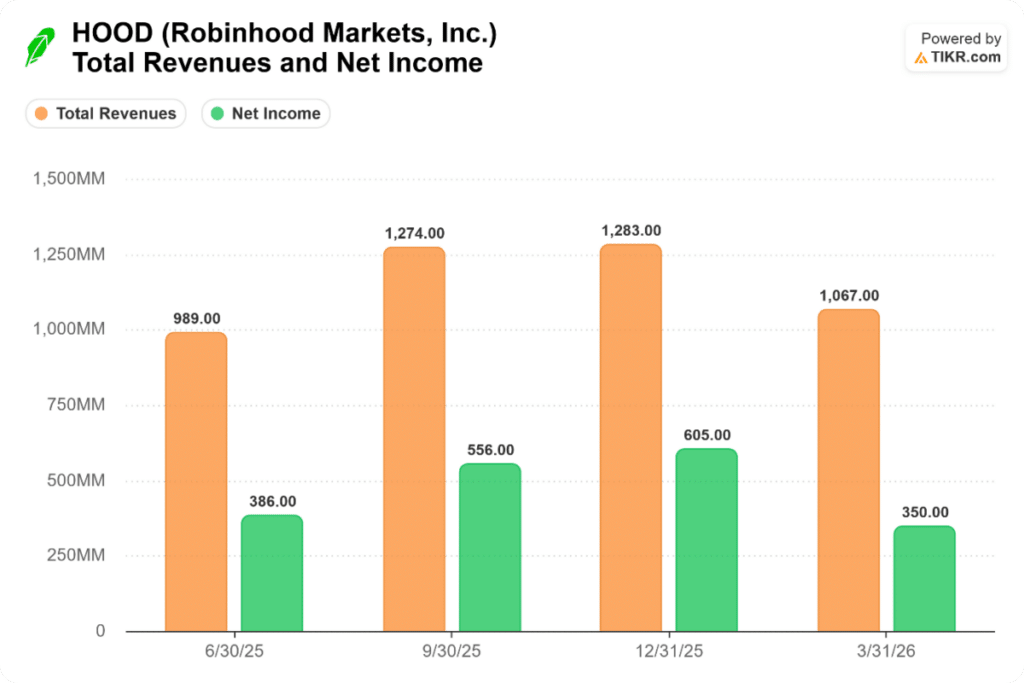
Notably, while Robinhood’s cryptocurrency trading business sagged in Q1 2026, its prediction market business continues to flourish. The company saw record prediction market volumes in the quarter and is gearing up for the joint venture with Susquehanna to launch its CFTC-regulated prediction market exchange and clearinghouse.
Genius Sports (NYSE: GENI) +19.84%
Genius Sports added almost a fifth to its market cap last week, which helped it bridge its year-to-date loss to around 47%. The stock was among the major gainers in the preceding week as well, despite there being no major market-moving announcement.
Earlier in May, the company released its Q1 2026 earnings and also completed the acquisition of Legend. While some analysts have been apprehensive about the deal and have lowered Skillz’s target price due to the acquisition, Genius Sports has been quite upbeat on the deal and believes that it would be immediately accretive to its group-adjusted EBITDA margins and free cash flow conversion.
During their Q1 earnings call, Genius raised its annual group adjusted EBITDA margin guidance to 28% versus the previous guidance of 23% to account for the Legend acquisition.
The recent rise looks like bottom fishing in this beaten down name and a delayed recognition that its outlook is perhaps not as pessimistic as perceived.

Biggest Losers
Super Group Limited (NYSE: SGHC) -7.78%
Super Group stock fell nearly 8% last week. The stock hit its 52-week high earlier in May, but sentiments were dampened after regulatory filings revealed that the company’s CFO, Alinda Van Wyk, sold shares worth over $1 million. Insider selling is generally seen as a negative for stocks, with the vice versa also holding true.
Rush Street Interactive (NYSE: RSI) -7.52%
Rush Street Interactive fell by over 7% last week. It is still among the major gaming gainers for the year, though with a rise of more than 30%. Moreover, the stock has more than doubled over the last year. With no fresh catalysts dropping last week, shorter-term institutional traders likely began locking in profits, letting the stock cool off from overbought territory.
Huya Inc (NYSE: HUYA) -7.41%
Huya also lost over 7% last week and extended its YTD loss to 13%. The stock was among the biggest losers in the preceding week as well. In May, the company released its Q1 2026 earnings and missed on both the topline and the bottomline. Subsequently, it provided an update on its $50 million share buyback program, which would run until March 18, 2028.
The company’s acting CEO, Junhong Huang, expressed confidence in its outlook and said, “We believe the Company’s current market valuation does not fully reflect the progress we have made in expanding our game-related services ecosystem, improving our revenue structure and driving operational efficiency.” However, that assertion failed to cut ice with investors, and Huya has the stock has continued to slide.
Major Gaming Industry Developments
Last week, Fertitta Entertainment agreed to acquire Caesars Entertainment in a $17.6 billion deal. As part of the deal, Caesars shareholders will receive $31 per share in cash, and Fertitta will assume $11.9 billion of Caesars’ outstanding debt. There wasn’t much movement in CZR after the announcement, as the stock had rallied previously in the year on reports of a bidding war for the company.

Looking at prediction markets, last week, the FBI and the US Attorney’s Office for the District of New York unsealed an indictment against Google employee Michele Spagnuolo for using non-public company data to game Polymarket.
The employee allegedly accessed confidential data regarding Google’s highly anticipated Year in Search rankings ahead of time, using that information to place highly profitable, zero-risk bets on the platform.
This is one of the most prominent insider trading actions involving a prediction market. Regulators have long warned that these platforms are vulnerable to asymmetric information and, by extension, insider trading.
Notably, there has been a turf war between states and the Commodity Futures Trading Commission (CFTC) over the regulation of prediction markets. Last week, CFTC formally submitted its highly anticipated prediction markets proposal to the White House for review, officially starting the federal rulemaking process.
Simultaneously, state-level resistance reached a boiling point, and Tennessee signed a bill targeting prediction market manipulation. Minnesota enacted a sweeping ban on prediction markets, and Kalshi immediately retaliated by filing a lawsuit against Minnesota. Incidentally, last month, Kalshi launched an advocacy group named American for Fair Markets to defend against what it called ‘gambling industry lies.’
“The new organization will take on the sportsbook and casino interests that are focused on protecting their monopolies and seeding lies about prediction markets to policymakers,” it said in its release.
The prediction market industry is witnessing explosive growth, and according to Pew Research, combined monthly volumes surged to $24 billion in April, which, for context, is nearly five times what it was in September 2025. The volumes are rivaling legal sportsbooks, which recorded wagers of $14 billion per month on average in 2025, even though the two numbers are not strictly comparable.
Legacy sportsbooks have also been pivoting to prediction markets, and DraftKings is set to launch microbetting on its prediction platform. Notably, instead of fighting through the agonizing, state-by-state approval process required for standard sports betting, DraftKings is leaning into the federal derivatives model. If approved by the CFTC, DKeX could theoretically offer sports-indexed event contracts nationally under a single federal framework.