



After outperforming the S&P 500 Index for two consecutive weeks, the Roundhill Sports Betting & iGaming ETF underperformed last week, falling 3.8% versus the 1.4% rise in the broad-based index.
Robinhood and Take-Two Interactive were among the major gainers last week, while Genius Sports and DraftKings were among the major losers.
Biggest Gainers
Robinhood (NYSE: HOOD) +17.26%
Robinhood stock has been quite volatile this month and alternated between the week’s top gainers and losers. Last week, it gained over 17%, helping it reduce its year-to-date (YTD) losses to just about 4%.
Last week, Robinhood said in an SEC filing that it was laying off about 10% of its full-time workforce and eliminating some open positions. In its filing, Robinhood said it will incur employee severance and benefits costs of around $20 million, plus another $8 million in share-based compensation, due to the restructuring. While the company did not provide the run-rate savings from these actions, analysts estimate that it would be $120 million annually.
There have been several layoffs in the gaming space over the last two months, which the markets saw as a desperate survival effort. However, in its release, Robinhood said that it “is taking this action from a position of business strength, including June month-to-date average daily trading volumes at record levels across equities, options, and prediction markets.”
Notably, Robinhood’s May metrics previously showed that event contracts traded reached an Average Daily Volume (ADV) of 126 million contracts, an 18% jump from April. The event contract trading volumes soared 22% month-on-month to $3.9 billion.
Robinhood’s prediction market volumes have been rising at a stellar pace, and the company is gearing up for the joint venture with Susquehanna to launch its Commodity Futures Trading Commission (CFTC)-regulated prediction market exchange and clearinghouse in the current quarter.
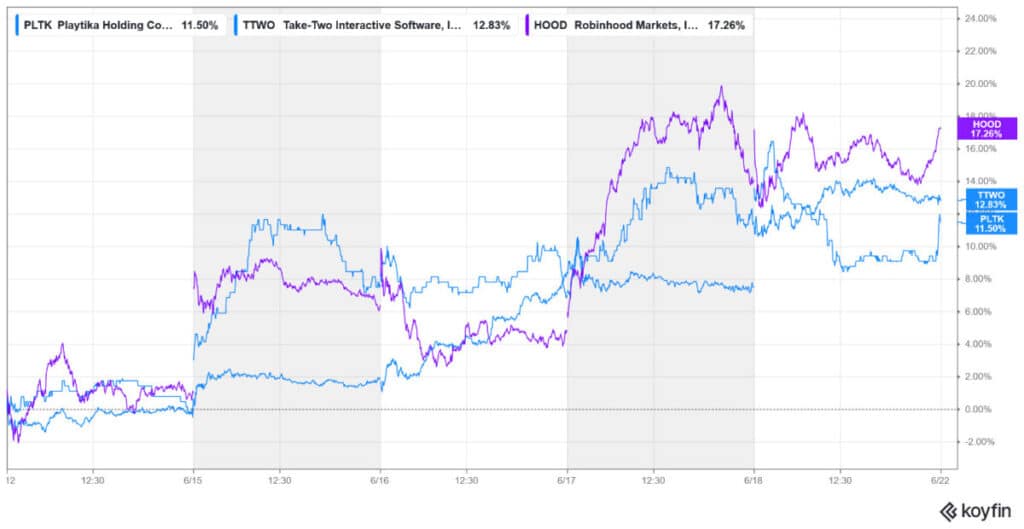
Take-Two Interactive (NYSE: TTWO) +12.83%
Take-Two Interactive stock rose nearly 13% last week. The biggest catalyst came from Rockstar Games, which officially announced that pre-sales for Grand Theft Auto (GTA) VI will begin next week on June 25.
Take-Two has previously guided for record-breaking fiscal year 2027 net bookings of $8.0 billion to $8.2 billion (up from $6.72 billion in FY26). The GTA VI is expected to be a key driver of the company’s financial performance this year. Markets have therefore been eagerly waiting for the pre-sales to open.
Analyst action towards TTWO was also favorable last week, and Piper Sandler, which initiated the stock with an “overweight” rating and $280 target price earlier this month, reiterated its bullish stance. The brokerage expects GTA VI to sell 45 million units at launch, which would potentially make it one of the biggest releases ever.
Playtika Holdings (NYSE: PLTK) +11.50%
Playtika also posted double-digit gains last week, helping it narrow its YTD losses to just under 12%. The stock has been quite volatile this year. Notably, in April, Playtika announced a “review of strategic alternatives to maximize shareholder value.”
The company has formed a special committee of independent directors that is tasked with “conducting a comprehensive review and evaluation of strategic alternatives across its portfolio.”
Last week’s rise looks like bottom fishing in this beaten-down name, and there wasn’t any major market-moving announcement related to the company.
Biggest Losers
Genius Sports (NYSE: GENI) -13.23%
Genius Sports continued its wild run, falling by over 13% last week. The decline predominantly looks on account of profit-taking. Notably, from late May through mid-June, GENI staged a powerful 35% rally, surging from roughly $5.30 to an intraday peak above $7.20.
Much of this excitement was fueled by a high-profile, three-way partnership with LIGA MX and Polymarket to power U.S. sports prediction-market contracts using official league data. Once the initial hype was digested, short-term momentum traders likely locked in their profits, sparking a technical pullback.
There are also lingering concerns over the massive $1.2 billion acquisition of Legend, which was predominantly financed by debt – an $825 million term loan and a $220 million revolving credit facility.
Meanwhile, while many analysts have been skeptical of the acquisition, Genius Sports has been quite upbeat on the deal and believes that it would be immediately accretive to its group-adjusted EBITDA margins and free cash-flow conversion.

DraftKings (NYSE: DKNG) -12.09%
DraftKings, which was the biggest gainer in our coverage of gaming stocks in the preceding week, fell over 12% last week. The rally in the preceding week was driven by optimism about DraftKings’ prediction markets business, after a regulatory filing showed a preliminary 24% month-on-month increase in annualized consumer trading volume on DraftKings Predictions.
However, the stock pared gains last week in typical profit-taking. The initial euphoria around the FIFA World Cup has also faded, even though the wagers are expected to be much higher than in the 2022 edition.
For instance, Macquarie analyst Chad Beynon believes global wagers at this year’s FIFA World Cup could rise to a record $50 billion versus the $35 billion in the 2022 event. However, much of the optimism was already priced into the shares heading into the event.
The Star Entertainment Group (ASX: SGR) -11.82%
The Star Entertainment Group continued its dismal run, falling nearly 12% last week and extending its YTD decline to 46%. Last week, the Federal Court handed down massive penalties and bans to former Star top executives following an ASIC civil penalty proceeding. Former CEO Matthias Bekier was ordered to pay a $700,000 penalty and disqualified from managing corporations for six years, while former General Counsel Paula Martin was slapped with a $400,000 penalty and a seven-year management ban.
The court ruled that they significantly breached their duties by failing to properly handle and escalate massive legal, regulatory, and financial crime risks (specifically regarding international junket operations and China UnionPay card transactions).

Moreover, while Star recently finalized a vital $390 million (around AUD 540 million) debt facility with WhiteHawk Capital Partners to avoid a near-term liquidity collapse, the market remains highly cautious about the terms. The agreement imposes strict covenants, increasing liquidity buffers, and heavy future amortization obligations starting in 2027.
Overall, while a corporate structural reset, backed by Bally’s Corporation, saved it from collapse, the ongoing stream of regulatory fines, historic executive penalties, and strict debt covenants makes several investors wary of Star shares.
Major Gaming Industry Developments
Last week, the American Gaming Association (AGA) released the Commercial Gaming Revenue Tracker, revealing that U.S. commercial gaming grew 9.8% YoY in April, with traditional casino gaming up 5.3% and sports betting surging 21.1%.
However, data released by the Mississippi Gaming Commission showed that casino revenues in the state fell 2.6% YoY to $217.9 million in May.
Elsewhere, the billionaire Ilitch family, famous for founding the Little Caesars pizza chain and owning Detroit’s Red Wings and Tigers, has officially launched a new unified division called Ilitch Gaming to dramatically expand its casino portfolio.
They are also buying the remaining 50% stake in Ocean Casino Resort (Atlantic City, NJ) from private equity firm Luxor Capital, thereby taking full ownership and control of the property. The family originally bought their initial 50% stake back in 2021 for $175 million. Apart from Ocean, the family announced the acquisition of Scarlet Pearl Casino Resort in D’Iberville, Mississippi, expanding their footprint into the third gaming market.
Major Prediction Market Developments
While the prediction market industry is witnessing astronomical growth and valuations of players like Kalshi and Polymarket have soared, there is significant regulatory uncertainty over the market.
Last week, Kentucky Attorney General Russell Coleman filed three lawsuits against Kalshi and Polymarket. The state alleges that offering contracts on sports outcomes amounts to running an unlicensed sportsbook that bypasses state tax laws.
There is also a growing clamor to bar lawmakers and government officials from trading in prediction markets due to insider trading concerns. Last week, Representative Bryan Steil (R-Wis.) introduced a draft bill to ban members of Congress and their immediate families from wagering on political outcomes and government policies in prediction markets. Steil said that the bill, named the Stop Lawmakers From Predicting Act, was “critical to restoring public trust” in elected officials.
Such concerns are being voiced globally, and last week, Ukraine approved a proposal to ban soldiers from gambling online, amid claims many armed forces personnel have become addicted to web-based betting.
There is a turf war between states and the CFTC over the regulation of prediction markets. The CFTC is aggressively doubling down on the view that sports “event contracts” fall strictly under its federal jurisdiction, drawing sharp anger from state regulators and tribal governments who argue this is illegal gambling that bypasses state laws.
Last week, New Jersey senators unveiled a bill to regulate prediction markets and impose a tax of up to 30% on sports-related event-contract trades. Earlier this month, the CFTC sued New Mexico in federal court to block state officials from enforcing local gaming laws against federally regulated prediction markets.
What Should Gaming Investors Watch Next Week?
There are no major gaming earnings scheduled this month, but we have plenty of data points investors should watch, including the Personal Consumption Expenditures (PCE) price index, the Fed’s preferred inflation gauge. The U.S. central bank has ruled out a rate cut this year amid sticky inflation, and the possibility of a hike remains on the table. Higher rates could strain monthly budgets for many families and reduce their disposable income, which is negative for the gaming sector.
The CGS Santiago & GAT Brazil are scheduled for next week. Latin America remains one of the fastest-growing frontiers for sports betting and iGaming. These dual conferences will provide critical pipeline updates on Brazil’s massive regulated rollout, directly impacting major international operators seeking a share of the LatAm market.
The evolving data on FIFA wagers would also be crucial to monitor, and the event is a key acquisition tool for sportsbooks and prediction market players.