









Charlon Muscat iGaming Writer
Charlon Muscat is an iGaming writer active since 2019, with early experience at Paddy Power in Malta. He covers online casinos, sports betting, esports, sweepstakes and social casinos, creating player-focused content for leading platforms.
Read Full Bio
Nick Shepherd Contributor
Nick is an ex-casino manager turned PR specialist. He began his career as a croupier in the UK, and went on to work in Europe, Russia, Africa, Asia, and the USA. Previously he has worked...
Read Full BioBill Benter has made himself one of the most legendary and richest gamblers in the world. The Pittsburgh-born mathematician started his career as a blackjack card counter in Las Vegas during the late 1970s before turning his attention to horse racing. By developing statistical models that could calculate probabilities more accurately than bookmakers, he became known as the man who beat the Hong Kong Jockey Club betting system.
Key Beats
- Bill Benter was born in 1957 in Pittsburgh and showed an early talent for numbers before dropping out of Case Western Reserve to pursue gambling.
- In Las Vegas during the late 1970s, he made a living counting cards until casinos banned him. Later, he moved to Hong Kong with Alan Woods to apply statistical models to horse racing using a $150,000 bankroll.
- He founded the Benter Foundation and donated millions, including $3 million for polio immunization and $1 million to the University of Pittsburgh.
Bill Benter Net Worth and Global Recognition
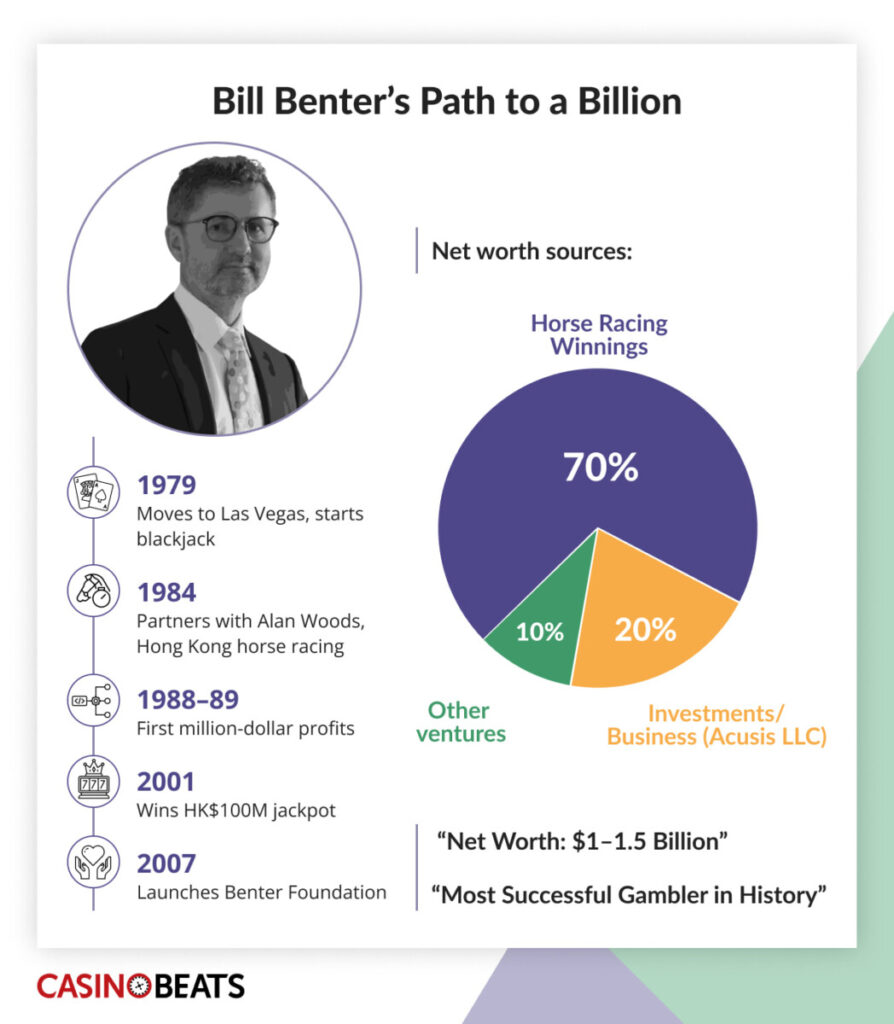
Today, Bill Benter’s net worth is estimated between $1 billion and $1.5 billion. That level of wealth ranks him among the world’s wealthiest gamblers and has earned mentions on outlets ranging from Bloomberg to the Guinness World Records.
Open any Bill Benter biography piece and one point comes through clearly: he altered the way gambling regards mathematics. His success showed that data could strip chance of its mystery and turn betting into something measurable.
The ripple effect is still visible today, not only in Hong Kong horse racing but in sportsbooks, online casinos, and even financial markets, where variations of his methods are now standard practice.
Bill Benter Biography Summary
| Profile | Details |
|---|---|
| Full Name | William “Bill” Benter |
| Date of Birth | 1957 (Pittsburgh, Pennsylvania, USA) |
| Nationality | American |
| Education | Studied Physics and Philosophy at Case Western Reserve University (did not complete degree) |
| Profession | Professional Gambler, Mathematician, Philanthropist, Businessman |
| Known For | Developing statistical horse-racing algorithms that beat the Hong Kong Jockey Club system |
| Major Ventures | Co-founder of an advanced betting syndicate with Alan Woods; Founder of the Benter Foundation; Former CEO of Acusis LLC |
| Philanthropy | Donated millions to education, healthcare, and cultural programs, including $3M to polio immunization and $1M to the University of Pittsburgh |
| Net Worth (2025) | Estimated between $1 billion – $1.5 billion (Bloomberg, various reports) |
Benter’s Early Life and Education
For those who have followed the significant figures of gambling history, Bill Benter’s story begins in 1957 in Pittsburgh, Pennsylvania. Raised in a modest, middle-class household, he quickly showed himself to be a mind apart, marked by a fascination with numbers and logic.
Teachers would later recall how easily he spotted patterns that slipped past others, an early glimpse of the skill set that went on to define the remarkable Bill Benter’s blackjack career.
After graduating from high school, Benter attended Case Western Reserve University, where he studied physics and philosophy. It was during this time that he began to realize how mathematics could be applied to gambling.
The spark came when he discovered Beat the Dealer, Edward O. Thorp’s famous work that laid bare the flaws in blackjack through card-counting strategies. But what lingered most was a memory from his teenage years. As he told Stephen Yafa in 2011, per the Rotary Club of Macau:
I remembered a sign I’d seen as a teenager in an Atlantic City casino: ‘Professional card counters are prohibited from playing at our tables.’ That always stayed with me; it meant that if you learned to count, you could win.
By his junior year at Case Western, curiosity gave way to action. He walked away from university and headed to Las Vegas with friends, determined to test the math at the tables. Reflecting on that decision, Benter later admitted:
I never made a serious career choice to become a gambler. My only real interest has been to beat the system and come out ahead.
His confidence, combined with a lifelong fascination with probability, set him on a path many regarded as unrealistic.
Blackjack Career and Casino Ban
By the late 1970s, Benter arrived in Las Vegas intent on bringing Thorp’s theories to life. The city’s casinos were thriving, their blackjack pits crowded with casual players unaware that mathematics could tilt the odds toward the disciplined few.
Benter linked up with professional card-counting crews, among them teams organized by Alan Woods and other gambling mathematics pioneers. They merged bankrolls and relied on elaborate systems to avoid detection.
The approach paid off, and Benter quickly found himself making a living at the tables. Recalling those early days, he told interviewers:
In our early 20s, we were averaging about $80,000 each per year at blackjack, which was pretty good back then for young kids.
Eventually, though, the house pushed back. His face appeared on internal watch lists, and by the early 1980s, he had been banned from most major establishments in Las Vegas. The move was not tied to any crime.
Even today, neither physical venues nor online blackjack sites outlaw card counting. But Nevada casinos operate as private enterprises, free to bar whoever they regard as a threat to the tables.
For Benter, the setback became a turning point. He shifted focus to a pursuit far more complex than blackjack: horse racing.
Transition to Horse Racing
In 1984, Benter teamed up once more with Alan Woods, but the setting had changed. Instead of blackjack tables, the partnership played out at the Hong Kong Jockey Club. There, horse racing dominated public life and drew enormous betting pools.
Benter and Woods saw promise in a market far less rigid than the blackjack market. Horse racing came with layers of uncertainty — everything from jockey performance to weather could swing an outcome, and most bettors had no way to calculate it all.
I was developing a somewhat complex database program for betting on horse races, based on 70 variables for each horse that enabled me and my colleagues to determine its true odds of winning in any race, once we entered all the data and did our modeling. But we had to key the information into our Kaypro computers – this was way back when, and there were no available online racing databases in the mid-’80s.
Starting with a bankroll of about $150,000, Benter and Woods set out to build statistical models for Hong Kong racing. The early runs were rough, and losses piled up before the formulas began to click.
But a man determined to beat the system as one of the most successful gamblers in history was not about to walk away. He kept refining models by testing variables and running simulations until the numbers finally pointed in his favor.
By 1988, the program had delivered its first significant payoff: approximately $600,000 in winnings. A year later, returns had jumped to $3 million. This was the moment the Bill Benter gambling fortune began to take shape.
The Benter Algorithm and Record Wins
What made Bill Benter’s horse racing algorithm so successful was its complexity. The typical gambler would focus on one or two factors — Benter explains that he wanted to:
Handicap every Hong Kong racehorse based on past performance, track conditions, and so forth, and place strategic bets based on the results.
The system approached horse racing as a data puzzle. Instead of relying on instinct, the gambling mathematics pioneer aimed to identify horses whose real chances of winning, as calculated through his model, were higher than the odds available to the betting public.
A Bill Benter Bloomberg profile by Kit Chellel outlined the approach as follows:
- He taught himself advanced statistics and wrote software on an early IBM PC using race results keyed in by hand.
- The model initially consisted of around 20 measurable factors and later expanded to more than 120 per horse.
- Inputs included speed figures, jockey records, trainer history, rest days, and track conditions.
- He discovered that weather data had no predictive power, but rest days and jockey skill did.
- His breakthrough was starting with the Hong Kong Jockey Club’s public odds and refining them with his own calculations.
- The Kelly criterion dictated how much to stake depending on the strength of the model’s edge.
- By placing tens of thousands of bets per season, small statistical advantages are compounded into multimillion-dollar profits.
The story of Bill Benter, a mathematician-turned-gambler, illustrates how data models can outperform even the toughest markets. By the late 1990s, his success was so overwhelming that rivals suspected his system could not be beaten.
Then came 2001, when he anonymously claimed Hong Kong’s largest racing jackpot. The prize, valued at around HK$100 million — roughly $13 million — made headlines worldwide.
Experts noted the jackpot barely touched the surface of his lifetime haul. Estimates suggested that over the course of decades of betting, Benter’s winnings ran into the hundreds of millions and may have exceeded the $1 billion mark.
Philanthropy and Business Ventures
Bill Benter’s philanthropy began to take form in the early 2000s with the launch of the Benter Foundation in Pittsburgh. The organization, focused on education, medical research, and the arts, has contributed millions of dollars to initiatives ranging from university scholarships to cultural programmes.
Notable Bill Benter charity donations include:
| Year | Donation / Initiative | Beneficiary or Cause |
|---|---|---|
| 2010 | $800,000 | Support for J Street (pro-Israel advocacy group) |
| 2012 | $1 million | University of Pittsburgh (education and research funding) |
| 2013 | Undisclosed (ad spend) | Pro-Hagel ads in Politico during Chuck Hagel’s nomination for U.S. Secretary of Defense |
| 2016 | $100,000 | A New Voice for Maryland — supported Joel Rubin’s congressional campaign |
| Year not specified | $3 million | Polio immunization programs in Afghanistan, Pakistan, and parts of Africa |
Outside of gambling, Benter also pursued business ventures. He has held leadership roles at Acusis LLC, a Pittsburgh-based company that provided outsourced medical transcription services to hospitals and healthcare providers.
Summary
Bill Benter, whose net worth is estimated at up to $1.5 billion, remains a defining figure in the history of gambling. The Pittsburgh-born physicist began at blackjack tables but made his fortune in Hong Kong after building one of the most advanced betting algorithms ever applied to sport.
His model factored in more than 120 variables per horse and relied on the Kelly criterion to size wagers. Small statistical edges turned into hundreds of millions in winnings. For many, his work stands as proof that intellect can turn games of chance into outcomes that can be measured and predicted.
Disclaimer: This article highlights Bill Benter’s career as a case study in gambling history and mathematics, not as a guide to profitable play. Wagering money always carries risk. Prioritize responsible gambling.
FAQs
Bill Benter has spoken publicly about statistics and mathematical probability, but he has not taught formal courses in these subjects. One-off interviews, including with the Rotary Club of Macau, revealed limited details about his horse racing models.
Bill Benter is a member of several organizations. He has been affiliated with the Rotary Club of Macau and has supported universities such as the University of Pittsburgh. Through the Benter Foundation, Benter works closely with education, healthcare, and cultural institutions worldwide.
Yes, Bill Benter married Vivian Fung, a Hong Kong national, in a Tibetan Buddhist ceremony. They welcomed their first child, Henry, in 2015.
Yes, Bill Benter has donated to political causes. He gave at least $800,000 to J Street in 2010, backed Chuck Hagel’s nomination in 2013 with pro-Hagel ads, and supported Joel Rubin’s 2016 congressional campaign in Maryland.
Bill Benter lives in Pittsburgh, Pennsylvania, where his Benter Foundation is based. He also spends time in Hong Kong due to his long involvement in horse racing. His primary residence and business ties, however, remain centered in Pittsburgh.
References
- The Gambler Who Cracked the Horse-Racing Code (Bloomberg)