









Paul started his career in newspaper journalism before exploring the emerging world of online gaming in 1998, joining Intertops in Antigua - the pioneering force behind the first online sportsbook. Since then, Cullen has enjoyed...
Read Full Bio
Nick Shepherd Contributor
Nick is an ex-casino manager turned PR specialist. He began his career as a croupier in the UK, and went on to work in Europe, Russia, Africa, Asia, and the USA. Previously he has worked...
Read Full BioPontoon and Blackjack look almost identical at first glance: the magic number is 21, you start with two cards, and the gameplay options are virtually identical. But details matter; there are quirks between these siblings that make them play very differently. Take a seat, as we deal out another comprehensive CasinoBeats guide to help you master these two classic casino card games.
Key Beats
- In Pontoon, both stay hidden until the end. In Blackjack, one dealer card is face-up.
- Blackjack pays 3:2 on a natural 21, while Pontoon pays 2:1 and adds the five-card trick (five cards ≤ 21).
- Pontoon leans on risk, suspense, and bigger swings—blackjack rewards structure and strategy.
What’s the Difference Between Pontoon and Blackjack?
Is it a case of a different name, but the same game? It’s a common mistake to assume that Pontoon and Blackjack are the same game, separated only by an ocean and a handful of letters. In this case, a rose by any other name does not smell as sweet.
While it’s true that they share the same family tree, they grew up on opposite sides of the Atlantic. These siblings, separated at birth, were raised in different countries: one in the U.S. and the other in the UK.
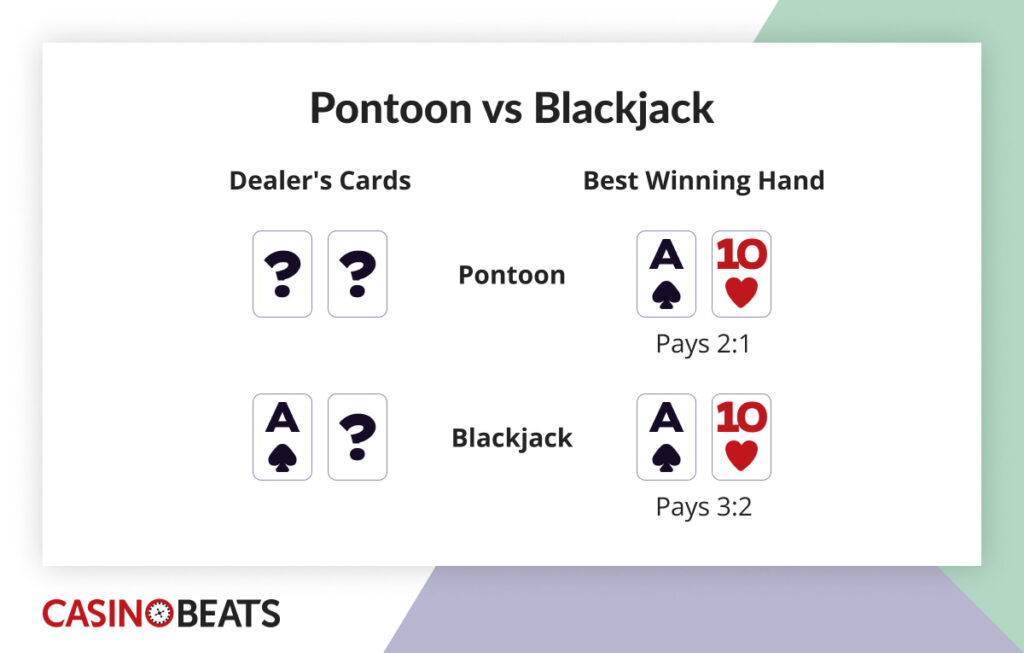
What is true is that both games revolve around hitting 21 without going bust. However, the rules, payouts, and even the terminology diverged as they evolved. In Blackjack, players face an open dealer card. In Pontoon, the dealer keeps things hidden.
Blackjack pays 3:2 on a natural 21. In Pontoon, the same hand pays 2:1. These subtle shifts make each game feel familiar yet distinct, with a personality all its own. Pontoon is Blackjack’s British counterpart: similar but different; same language, but a particular accent.
Understanding how Pontoon differs from Blackjack can help you choose the game that best matches your style: coffee or tea, chips or fries, petrol or gas, candy or sweets.
Origins and Evolution
Blackjack and Pontoon share the same ancestor: a French game called Vingt-et-Un (Twenty-One), which first appeared in the 18th century. Over time, as the game spread, it evolved and adapted.
In the United States, it morphed into Blackjack, gaining its name when casinos offered a bonus payout for a winning hand that contained both the ace of spades and any black jack. The promotion ended, but the name stuck.
Across the Atlantic, however, the British took the same foundations and reshaped them into Pontoon. The game kept the familiar race to 21 but added unique twists like the five-card trick, the ability to buy hidden cards, and the rule that the dealer’s cards remain concealed until the end.
These differences weren’t just cosmetic; they reflected local gaming culture. In the US, online casinos leaned toward fast, open games, where players could build strategies around visible dealer cards. British gambling circles embraced more hidden, high-risk mechanics, creating a game where bluff, betting, and boldness carried extra weight. So, while Pontoon and Blackjack may initially appear the same, they both have distinct personalities.
Core Rule Differences
Although Blackjack and Pontoon share the same DNA, their rules create two very different experiences at the table.
Blackjack is familiar, structured, and strategic, with the dealer showing one card. Players use that information to guide their decisions.
Pontoon, by contrast, thrives on secrecy and surprise. The dealer’s hand is hidden. Players have to make bold choices without knowing what they’re up against.
Here’s a breakdown of the key differences:
| Rule/Feature | Pontoon | Blackjack |
|---|---|---|
| Dealer Cards | Dealer’s cards remain hidden until all players finish their turns. | The dealer shows one card face-up; players act based on it. |
| Best Hand | ‘Pontoon’ (Ace + 10-value card) pays 2:1. | ‘Blackjack’ (Ace + 10-value card) pays 3:2. |
| Special Hands | ‘Five-card trick’ (five cards totalling 21 or less) beats all hands except a Pontoon. | No extra ranking beyond Blackjack. |
| Player Actions | Twist (take a face-up card)Stick (hold)Buy (take a hidden card with an extra bet)Split (only identical-value 10s, Jacks, Queens, or Kings)Players can buy multiple cards in a hand, increasing the stake each time | HitStandDoubleSplitSurrender (in some casinos) |
| Banker’s Role | The banker is chosen from the players and rotates; the banker wins ties. | Dealer plays last and must follow fixed rules (hit until 17). |
| Payouts | Pontoon 2:1; Five-card trick 2:1; standard wins 1:1. | Blackjack 3:2; standard wins 1:1. |
| Table Size | 5–8 players, with rotating banker. | 1 dealer vs 5–7 players. |
These differences have a direct impact on strategy. In Blackjack, players rely heavily on the dealer’s visible card and basic strategy charts to guide decisions.
In Pontoon, the lack of information shifts the balance: players lean into aggression, buying cards or pushing for a five-card trick, knowing the banker always holds a slight edge.
Payouts and House Edge
One of the most striking differences between Pontoon and Blackjack is how winning hands are rewarded. In standard Blackjack, a natural 21 (an Ace plus a 10-value card) pays 3:2, while regular wins pay 1:1.
This is one of the reasons Blackjack remains a staple in casinos worldwide: the payouts are simple, predictable, and tied closely to the house edge. Pontoon flips that formula. A Pontoon hand pays 2:1, which feels more generous than Blackjack’s 3:2 payout. The catch is the banker’s advantage.
Because the dealer’s cards are hidden until the end, and all ties go to the banker, the house edge creeps higher than in traditional Blackjack.
Pontoon also introduces the five-card trick, another hand that pays 2:1, providing players with extra opportunities to double their stake – but only if they are willing to take the risk. Ultimately, these payout structures balance each other out.
- Blackjack tends to offer the lower house edge for disciplined players following basic strategy
- Pontoon offers bigger wins at the cost of more volatility
The choice between them often comes down to whether you value steadier odds or the excitement of chasing a higher-paying hand.
Strategy Adjustments
Switching from Blackjack to Pontoon isn’t just a matter of learning new terminology; it requires a shift in how you play. In Blackjack, decisions are made based on the dealer’s visible upcard. That single piece of information allows players to consult basic strategy charts and make mathematically sound choices.
In Pontoon, the dealer’s hand stays hidden until the end. It forces players to act more aggressively.
The buying mechanic is a good example. Instead of the fixed double down you see in Blackjack, Pontoon allows players to buy extra cards by increasing their stake. These cards are dealt face down. Only the player purchasing the card knows its value. This makes it tricky for the dealer to decide when to stay.
Each buy increases your stake, at least equal to your original bet, but not more than the amount of your last purchase. This creates a sliding scale of risk and reward.
Buying introduces an extra layer of risk management, as you weigh the cost of betting more against the potential payout of a Pontoon or a five-card trick. That five-card trick itself changes the dynamic. In Blackjack, taking four or five cards usually means you’re hovering dangerously close to a bust.
In Pontoon, however, the possibility of being rewarded 2:1 for surviving with five cards encourages players to twist or buy more often.
For Blackjack players making the switch, the key adjustment is psychological. Accept the uncertainty, embrace the risk, and remember that in Pontoon, patience and boldness often go hand in hand.
Regional Popularity and Availability
Blackjack is the undisputed global superstar of the casino floor. You’ll find it in Las Vegas,
Macau, Monte Carlo, and almost every online casino platform. Its broad reach, consistent rules, and relatively low house edge make it a universal favourite, familiar to both casual and serious players alike.
Pontoon, by contrast, has a more regional identity. It remains popular in the UK and Australia, where it is often the go-to version of 21 in clubs and home games. For many British players, Pontoon is the game they grew up with.
The online casino boom has blurred these lines. Today, players may encounter Pontoon as a variant within the Blackjack category, although rule sets can vary depending on the operator. This occasionally creates confusion for new players, making it even more important to understand how Pontoon differs from Blackjack before placing your first bet.
If you’re a new player looking to learn how to play blackjack, it’s worth reading our online guide before venturing into Pontoon. That way, you’ll recognise the shared foundations and be better prepared to adapt to the twists Pontoon introduces.
Which Game Should You Play?
Choosing between Pontoon and Blackjack often comes down to your personality as a player. If you prefer structure, open information, and the comfort of widely available strategy charts, Blackjack is the safer bet. Its rules are consistent across casinos worldwide, and its lower house edge makes it attractive for players seeking steady, long-term value.
Pontoon, however, appeals to players who enjoy risk, suspense, and bigger swings – as well as something a little different! The hidden dealer cards and five-card trick keep every round unpredictable. In addition, the option to buy cards gives you more control over your fate, as well as the chance to increase your bet. It’s risky but potentially rewarding.
Pontoon is a game that rewards boldness and thrives on tension, making it ideal for players who like a faster pace and the thrill of variance.
Accessibility is another factor. Blackjack is available everywhere, from land-based casinos to online. Pontoon, by contrast, is a more niche game, found mainly in UK and Australian casinos, or online as a variant.
If you’re after consistency and widespread availability, Blackjack is your go-to. If you want a game that feels like Blackjack’s more adventurous sibling, Pontoon is worth exploring.
Conclusion
Pontoon and Blackjack may look like two sides of the same coin, but their differences are what make them fascinating. They are pretty diverse.
- Blackjack is the reliable classic: structured, strategic, and available everywhere.
- Pontoon thrives on suspense, hidden information, and the thrill of bigger swings.
Which you prefer comes down to your playing style. If you like consistency and a clear roadmap, Blackjack is your game. If you crave unpredictability and don’t mind higher risk, Pontoon might be the better fit.
Whichever you choose, remember the golden rule: play for fun!
FAQs
Not exactly. Both games share the exact origin in the French game of Vingt-et-Un, but they evolved differently. Blackjack is the American variant, while Pontoon is the British version.
The most significant difference is the dealer’s hand. In Blackjack, one dealer card is visible, helping players guide their decisions. In Pontoon, both dealer cards remain hidden until the end of the round.
No. Blackjack strategies rely heavily on the dealer’s upcard and basic strategy charts. Pontoon demands more flexible play, with added focus on a five-card trick, the option to buy cards, and coping with less information about the dealer’s hand.
Yes: a natural 21 in Blackjack pays 3:2, while a Pontoon (the same hand) pays 2:1. Pontoon also rewards the five-card trick with 2:1 payouts, giving players more ways to double their stake.
Blackjack generally offers a lower house edge, especially when played with basic strategy. Pontoon’s rules – like the banker winning ties and hidden dealer cards – tip the odds slightly more toward the house, though the higher 2:1 payouts can balance the risk.
References
- Safe Gambling Guideline Online Casinos (Google Docs)