










Paul started his career in newspaper journalism before exploring the emerging world of online gaming in 1998, joining Intertops in Antigua - the pioneering force behind the first online sportsbook. Since then, Cullen has enjoyed...
Read Full Bio
Dina has over three years of experience in the iGaming industry as a Content Writer before moving into SEO Content Writing and later Editorial Project Management. Her work centers on online casino topics, including commercial...
Read Full BioKnowing when to double down in blackjack is one of the most important decisions you’ll make at the table. When used at the right moment, this move can significantly increase your winnings. When used incorrectly, it can quickly cost you twice as much. We’ll walk you through the rules, examples, common mistakes, and smart tips to help you make the most of doubling down in blackjack.
Key Beats
- Since 10s, Jacks, Queens, and Kings make up nearly 31% of the deck, doubling on totals of 10 or 11 gives you a massive advantage.
- When you double down in blackjack, you get exactly one more card—you cannot “hit” again if that card is small.
- The best time to double is when the dealer shows a “bust card” (4, 5, or 6).
- Avoid doubling if the dealer has an Ace or a 10 (unless you have a hard 11).
What Is Doubling Down in Blackjack?
It is a move where you double your original bet after seeing your first two cards. In return, the casino gives you exactly one more card. Think of it as a special “bet exchange”
Doubling down in blackjack basically translates to: “I am so confident in this hand that I’ll double my bet for just one more card.” While it sounds like a gamble, it is actually a good blackjack strategy used to lower the house edge and maximize your potential profit.
Blackjack Double Down Rules
You can only double down in blackjack after you get your first two cards. You cannot hit once and then decide to double later.
However, different casinos have different blackjack double down rules. Some only let you double on totals of 9, 10, or 11. Others allow Double After Split (DAS). This means if you split a pair (like two 8s) and then get a 3 to make a total of 11, you can double your bet on that new hand; so always check the table rules before you start playing.
When to Double Down in Blackjack
There are two situations when it is the best time to double down in blackjack. The key to success is to understand when the odds are in your favor.
Doubling Down on Hard Hands
A “hard” hand is any hand that does not have an Ace (or has an Ace that must count as 1). When deciding when to double down in blackjack, these are your best bets:
- Hard 9: Double if the dealer shows a 3, 4, 5, or 6.
- Hard 10: Double if the dealer shows anything from 2 through 9.
- Hard 11: Always double unless the dealer shows an Ace.
Why? Because 10-value cards are the most common in the deck. If you have 11 and draw a 10, you get a perfect 21!
Doubling Down on Soft Hands (Aces)
A “soft” hand has an Ace that can count as 11. Beginners are often scared to double down on blackjack with an Ace, but it is a great way to pressure a weak dealer.
- Soft 13 or 14 (Ace + 2/3): Double if the dealer shows 5 or 6.
- Soft 15 or 16 (Ace + 4/5): Double if the dealer shows 4, 5, or 6.
- Soft 17 or 18 (Ace + 6/7): Double if the dealer shows 3 through 6.
Think of the Ace as your safety net. In a “soft” hand, the Ace is flexible. If you double a Soft 15 (Ace + 4) and draw a 6, your Ace stays as an 11, and you’ve suddenly got a strong 21. But if you draw a 10 instead? In a hard hand, you might have busted. Here, your Ace simply “flips” its value to a 1, and you still have a 15. Here, you aren’t necessarily betting that you’ll hit a 21; you’re betting that the dealer is going to fall off a cliff. When you see that 5 or 6 in the dealer’s hand, don’t be shy. Push those chips out.
Double Down Blackjack Chart (Quick Reference)
Use this chart if you are learning how to play blackjack, to know exactly when you should double down in blackjack.
| Your Hand Total | Dealer’s Upcard | What to Do |
|---|---|---|
| Hard 9 | 3 through 6 | Double |
| Hard 10 | 2 through 9 | Double |
| Hard 11 | 2 through 10 | Double |
| Soft 13 or 14 | 5 or 6 | Double |
| Soft 15 or 16 | 4 through 6 | Double |
| Soft 17 or 18 | 3 through 6 | Double |
How Doubling Down Works in Blackjack
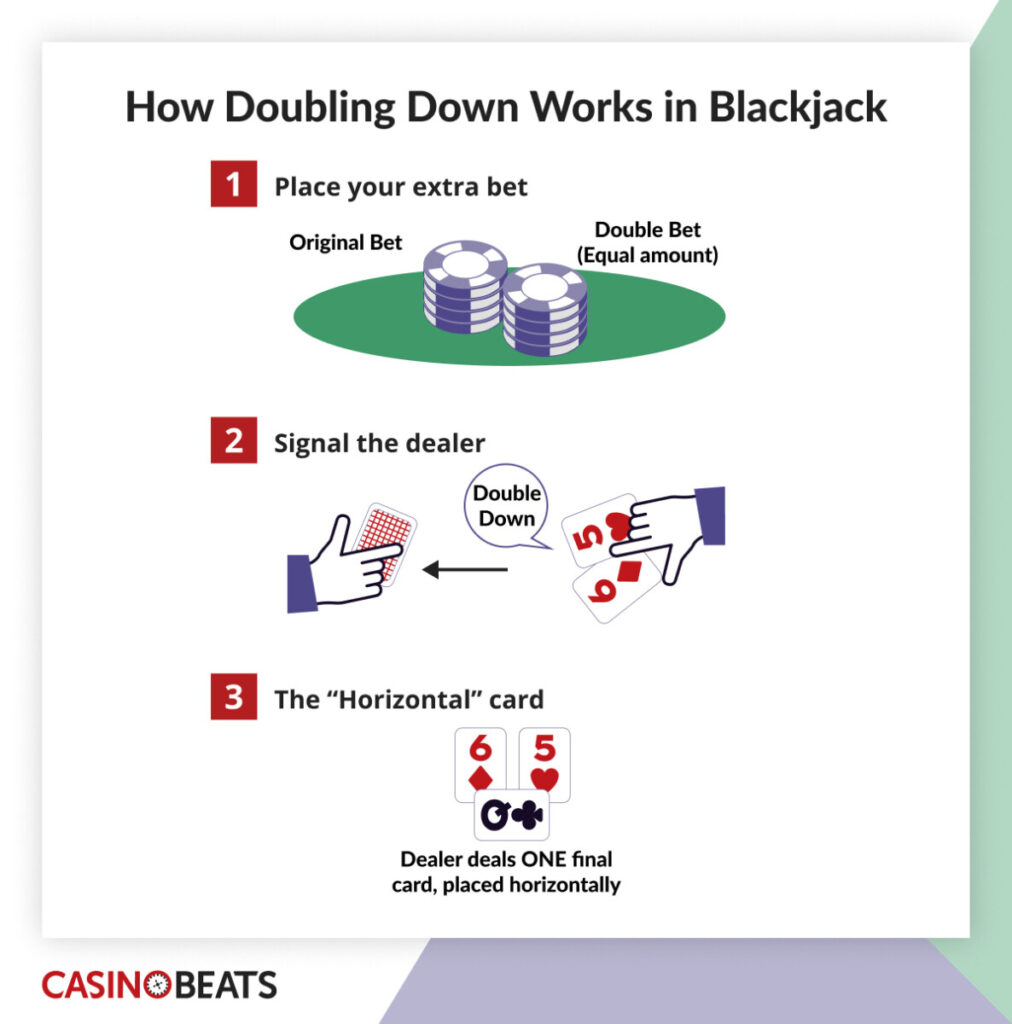
The process of how does double down work in blackjack is very specific, especially at a physical table:
- Place your extra bet: Put a second stack of chips (equal to your first bet) next to your original wager. Do not put them on top, as the dealer needs to see both bets clearly.
- Signal the dealer: You can say “Double Down” out loud or use a blackjack hand signal by pointing with one finger.
- The “horizontal” card: The dealer gives you one card and usually places it sideways (horizontally) across your other cards. This signals that your turn is over.
- The stand: You must stand with whatever total you have. You cannot hit again, even if the card you received was very low.
When Not To Double Down in Blackjack
Many beginners lose money by doubling down blackjack bets in the wrong spots. To protect your bankroll, you should avoid doubling down in these specific scenarios:
- When the dealer shows an Ace or a 10-value card: Unless you have a hard 11, the dealer is in too strong of a position. The mathematical probability of the dealer finishing with a 20 or 21 is too high to justify risking double your money.
- When you have a “Hard” 12 or higher: Never double down if your total is 12 or more. The risk of drawing a 10-value card and “busting” (going over 21) is extremely high. Since you only get one card, you have no chance to recover if that card is high.
- When you are unsure of the table rules: Always check if the dealer Hits on Soft 17 (H17) or Stands on Soft 17 (S17). These house rules slightly change your winning percentages. Doubling down without knowing the specific table setup is a common mistake that increases the house edge.
3 Double Down Strategy Tips for Beginners
To master this blackjack double down strategy:
- Focus on the match: Don’t double because you “feel lucky.” Only double when the chart says the numbers are on your side.
- Watch the dealer: A weak dealer card is your green light to be aggressive.
- Manage your bankroll: Since you are doubling your bet, make sure you have enough chips to handle a few losses in a row.
To win at blackjack, you have to be emotionally ready to lose that double bet. If you hesitate or “chicken out” and only hit when the math says you should have doubled, you are effectively giving the casino an extra 1-2% edge over you. Pros call this “playing scared.” If you can’t afford to double down when the strategy says so, move to a lower-limit table where that extra bet doesn’t scare you.
Real-World Examples of Doubling Down
Below are the examples of how doubling down in blackjack is about the best chance to win, but it isn’t a guaranteed win every time.
Example 1: The winning play (Hard 11 vs. Dealer 6)
- You have: 6 and 5 (Total 11).
- Dealer shows: 6.
- The move: You double your $10 bet to $20.
- Result: You draw a Queen for a total of 21. Even if the dealer gets a 20, you win $20 in profit instead of just $10.
Example 2: The risky play (Hard 9 vs. Dealer 2)
- You have: 7 and 2 (Total 9).
- Dealer shows: 2.
- The move: You double your $10 bet to $20.
- Result: You draw a 3, giving you a total of 12. Because you doubled, you are stuck with 12. The dealer draws to a 20. You lose $20.
Conclusion
Doubling down in blackjack is one of the most powerful moves in your betting arsenal – but choose your moment. When used correctly, especially against weak dealer cards, and with strong starting totals like 10 or 11, doubling down can boost your winnings and give you a real edge in the best online blackjack casinos.
But it also comes with risk. Make sure you understand the house rules, know the math behind each move, and only double when the situation calls for it. With a bit of practice and a cool head, doubling down can turn a solid hand into a winning one; just don’t forget to gamble responsibly.
FAQs
You should always double down when the statistical probability of your hand beating the dealer is at its peak. The best time to do this is when your total is 11 (against almost any dealer card) or 10 (unless the dealer shows an Ace or 10). These situations offer the highest “expected value,” meaning they are mathematically the most profitable moments to increase your wager.
In most blackjack games, doubling on 11 is a mandatory move. Because 10-value cards are the most common in the deck, you have a high chance of hitting 21. The only rare exception is in some multi-deck games where the dealer shows an Ace; in that specific scenario, a simple “hit” is safer, though many pros still double down to maximize potential returns.
You split when you are dealt a pair (like Aces or 8s) to turn one weak hand into two strong ones. You double down when your first two cards total 9, 10, or 11. If your table allows Double After Split (DAS), you can actually do both: split your pair, and if one of your new hands results in a 10 or 11, you then double down on that specific hand for maximum profit.
When you double down, you double your original bet and receive exactly one additional card. After this card is dealt, your hand is automatically “stood,” meaning you cannot take any more hits regardless of the total. If you win, you collect double the profit; if you lose, you lose both your original and additional wager.
The best hands to double down on are Hard 11, Hard 10, and Hard 9, as well as “soft” hands like Soft 16, 17, and 18 (an Ace plus a 5, 6, or 7) when the dealer shows a weak upcard like a 4, 5, or 6. These hands capitalize on either your high chance of hitting a strong total or the dealer’s high probability of busting.
You should not double down if the dealer is showing a strong card like an Ace or a 10, as the risk of them having a high total is too great. Additionally, never double down if your hand total is 12 or higher, as the risk of busting with your one extra card is too high. Finally, avoid doubling if the table rules do not favor the move, such as on a “Soft 17” if you aren’t following a specific strategy chart.