










Sofoluwe Mayowa iGaming Writer
Sofoluwe Mayowa is an iGaming and sports betting specialist with over five years of industry experience and more than 1,000 published articles. He creates authoritative, SEO-driven content across casino gaming, football and sportsbook reviews, combining...
Read Full Bio
Nick Shepherd Contributor
Nick is an ex-casino manager turned PR specialist. He began his career as a croupier in the UK, and went on to work in Europe, Russia, Africa, Asia, and the USA. Previously he has worked...
Read Full BioRachel Reeves’ second Budget as Chancellor of the Exchequer has put the gambling industry firmly in the spotlight. Online casinos and betting companies are staring down the barrel, as significant tax increases designed to raise government revenue loom. Here, we examine how the new changes affect players and operators, as well as what the future holds for the market.
Key Beats
- UK Chancellor of the Exchequer, Rachel Reeves, officially announced new tax rates, which are set to broaden the tax obligations of the UK gambling industry.
- Under the new tax rates, remote gaming duty will be set at 40%, online betting duty at 25%, and general betting duty at 25%.
- In perhaps the most significant development, Rachel Reeves has scrapped the current 10% Bingo duty.
Overview of Rachel Reeves’ 2025 Budget
The commencement of the new 2025 budget will bring significant changes to the gambling industry, especially online operators. It’s a lot to digest, but here’s an overview of what’s changing and when:
- 10% duty on Bingo is scrapped, beginning April 2026.
- Remote Gaming Duty is set to increase from 21% to a staggering 40% in April 2026. It’s a huge increase aimed mainly at online casinos.
- Starting from April 2027, online betting duty will rise from 15% to 25%. High street bookmaker bets and machine gaming Duty are exempted from this increase.
- Horse racing gets a full exemption from all tax increases.
- Casino gaming Duty is frozen for 2026-2027 and will then rise in line with inflation (RPI).
- A new General betting duty is introduced for online betting, which will sit at 25%.
The Abolition of Bingo Duty
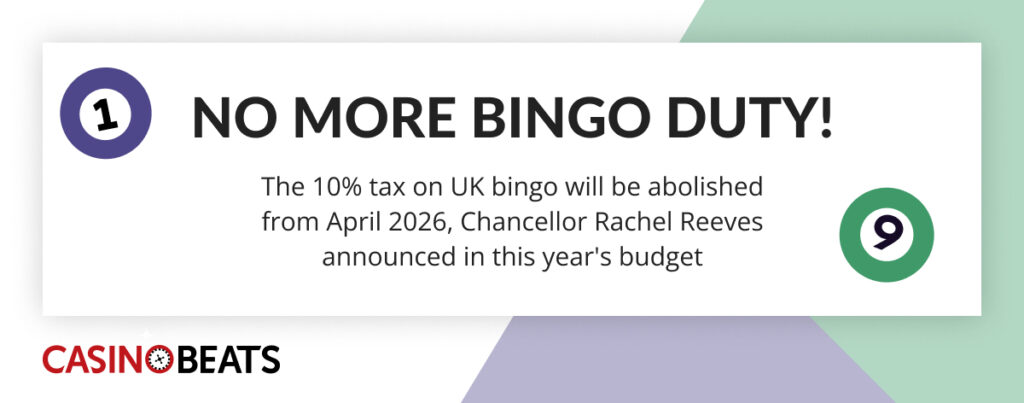
One of the brightest sparks in Rachel Reeves’ 2025 budget is the removal of the 10% duty on Bingo. Unlike casinos and betting, which are facing fire and brimstone, Bingo players and venue owners get a break.
For years, Bingo operators have struggled with rising costs and fierce competition from casino gaming. Abolishing the duty means they get to keep more of their revenue and keep the doors open in communities where Bingo is more than just gambling. As Meg Hillier, the chair of the Treasury select committee, terms it, “Bingo halls make a cultural contribution to our country.”
Players can expect friendlier promos, mesmerizing prize pools, and even better offline hosting. Operators like Rank have already reacted positively to the change, viewing it as an opportunity to stabilize their operations.
In a budget full of tax hikes, Bingo is an unexpected winner, providing relief to community-focused gambling.
Economic Impact on Gambling Operators
Nearly a month ago, the new 2025 budget from Reeves looked likely to bleed the online gambling sector. It has come true; not up to the projected numbers, but enough to unsettle huge moving parts. So, what will the effect of Rachel Reeves’ budget 2025 on UK gambling be? For starters, operators and investors are in for a tougher landscape.
- Massive revenue boost: With a projected £1.1 billion revenue a year by 2031 from higher gambling taxes, the government is sitting on a massive financial boost.
- Stock market turbulence: Shares in major operators, such as Evoke, sank by nearly 19%. Rank increased slightly due to the abolition of Bingo duty.
- Players feel the heat: With skyrocketing taxes, operators are most likely to offset losses by offering reduced promos, increasing minimum bets, reducing payouts, or even widening the odds margin in sports betting.
- Profit reductions: Big players are already projecting major profit downturns.
- Entain predicts a £100m hit next year and up to £150m the year after.
- Evoke (already dealing with financial issues) expects an extra £135m in duty costs.
- Rank forecasts a £40m fall in operating profit.
- Mergers or death: Smaller companies may be forced to merge to meet the financial strains. Failure may lead to exiting the UK or a total shutdown.
Overall, the sector is facing a challenging adjustment period, particularly for online-focused brands and smaller operators. Grainne Hurst, BGC Chief Executive, said the increases were a “devastating hammer blow to tens of thousands of people working in the industry.”
Impact on Horse Racing and Traditional Betting
The new Rachel Reeves gambling tax changes create a ripple effect in the world of horse racing and high-street betting.
Racing relies heavily on levy payments and media rights, and many in the industry fear these revenues could shrink as operators juggle higher costs.
Some bookmakers, including Betfred, may be adversely affected, with the possibility that 1,287 Betfred shops may be at risk of closure.
Furthermore, the pressure sparked campaigns like “Axe the Racing Tax”, with industry groups seeking punters to sign a petition urging the government to reconsider. While this seemed to have worked, everyday gamblers may face fewer racing promos, tighter offers, and less generous odds.
All-in-all, the effect of Rachel Reeves’ budget 2025 on UK gambling may mean a tougher track ahead for the racing scene.
Social Policy and Responsible Gambling
The uproar from certain sections may have been deafening, but not everyone is upset about the UK’s 2025 gambling tax increase. Many advocates for responsible gambling actually view it as an opportunity to tax formats of online gambling (like slots), where players’ bankroll can be drained in minutes, thereby slowing harm and using the funds to support social programs.
Although the Government has passed a narrative that this tax hike strikes a balance between raising revenue and protecting public health, critics warn about side effects.
Some have warned that the hikes could prompt frustrated players to seek out offshore sites. Kevin Harrington of Flutter warned that the changes will give illegal, unlicensed gambling operators a competitive hand overnight.
Industry Concerns, Trade Body Reactions & Global Comparisons
The industry has been quite loud about the potential fallout of the new Rachel Reeves budget gambling duties.
The Betting and Gaming Council warns that the sector’s £6.8bn contribution to the UK economy could shrink as operators juggle higher costs and fewer resources.
Bacta, which represents the amusements and low-stakes gambling industry, fears that higher machine duties could cause the closure of hundreds of small businesses.
Gambling operators are not left out in the fear of the unknown. They argue that safer gambling is essential, but the new taxes risk tipping the balance too far.
Looking abroad, several European markets have introduced significant tax changes over the last decade, and the outcome has been far from ideal, with mixed results at best.
Aggressive taxation drove many players in Sweden and Germany towards offshore sites, which had adverse effects on national revenue and consumer protection.
There is a possibility that the UK may repeat the same pattern if taxes rise faster than the market’s ability to adapt. Industry voices think the goal is to find a sweet spot that protects players and prevents a surge in black-market gambling.
Future Outlook of the UK Gambling Sector
Looking ahead, the UK gambling landscape will undergo significant shifts as the betting duty rates for 2025 come into force. But it’s not all doom and gloom, as usual, operators will adapt, but things will look different in the coming years:
- Operators would focus more on lower-tax products, such as bingo and loyalty-based rewards.
- Casinos would feature fewer high-risk games and emphasize entertainment-themed formats and skill-based games.
- A more stable long-term market is on the horizon, with companies learning to operate with strict tax rules and better responsible gambling measures.
Lastly, this move signals that Reeves is seeking a fair and responsible gambling economy, which is beneficial for her public and political image.
Conclusion
There’s one thing the UK gambling industry budget changes make clear: the Government wants more revenue and stronger protection for players. Although higher taxes create huge challenges for gambling companies, there’s room for adaptation and innovation.
Ultimately, the impact on operators and players depends on how effectively the new rules are enforced and how they respond.
With Rachel Reeves’ gambling reform explained in simple terms, a certainty is certain that the UK gambling sector is entering a new phase. One where responsibility and sustainability are the top priorities.
FAQs
There’s a belief that online gambling causes the highest harm, so more taxes mean more revenue, which helps social healthcare.
Bingo halls are allowed to keep more of their revenue, which helps them stay open longer.
Remote Gaming Duty applies to online casino-style games, while General Betting Duty covers online sports bets.
Yes, that’s a possible scenario. It’s a major concern raised by industry experts.
Around £6–7 billion a year.
References
- Back British Racing (Axetheracingtax)
- BGC response to the Budget (Betting and Gaming Council)