


Mississippi Stud might look complex at first glance. However, with the right approach, it’s one of the most engaging poker-based table games around. This guide covers everything you need to know, from the rules and payouts to the Mississippi Stud basic strategy.
Key Beats
- Mississippi Stud is a poker-based table game where you aim to make the best five-card hand using your two hole cards plus three community cards, with payouts based on a fixed paytable.
- Betting decisions are made after each community card is revealed, and knowing when to fold versus when to raise up to 3x is the foundation of any solid Mississippi Stud strategy.
- The key to success is patience: fold weak hands early, raise with pairs of sixes or better or strong draws, and manage your bankroll to ride out losing streaks until those big winning hands land.
How to Play Mississippi Stud Poker
Before we dive into Mississippi Stud poker strategy, we will give you a brief explanation on how do you play Mississippi Stud. This is a poker-based table game where the goal is to make the best five-card hand using your two hole cards and three community cards. Unlike learning how to play blackjack, where you face the dealer, Mississippi Stud lets you focus entirely on your own betting decisions.
Bets are placed in stages: after each community card is revealed, you can fold or raise. This makes discipline and bankroll management essential, especially when waiting for strong hands like pairs, straights, or flushes.
The game follows standard poker hand rankings, and payouts typically start at pairs of sixes or better. Understanding which hands to play and when to fold or raise is the core of any Mississippi Stud basic strategy.
Mississippi Stud Basic Strategy Explained
A solid Mississippi Stud strategy helps beginners in online casinos make better betting decisions and avoid common mistakes. The game revolves around building the strongest five-card hand using your two hole cards plus the three community cards, with betting occurring in stages: Ante, 3rd Street, 4th Street, and 5th Street.
Your key actions are simple: Raise, Call, or Fold. Knowing when to take each action is the foundation of any winning Mississippi Stud basic strategy:
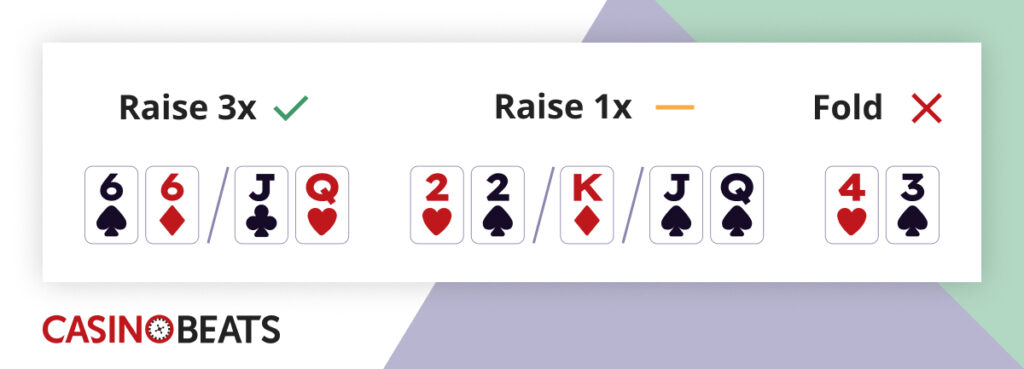
- Raise when you have a strong starting hand or a hand with good potential to improve. This includes pairs of sixes or higher, high cards, or suited connectors that can form straights or flushes.
- Call when your hand has moderate potential and staying in the round gives you a reasonable chance to improve.
- Fold weak hands immediately, such as low, unconnected off-suit cards (2s–5s), to avoid unnecessary losses.
As community cards are revealed, adjust your betting according to how your hand develops. If your hand improves or draws become promising, continue raising or calling. If your chances remain slim, folding early helps preserve your bankroll.
Following a structured Mississippi Stud strategy keeps gameplay disciplined, reduces risky decisions, and maximizes your chances of winning over time—even for beginners.
Mississippi Stud Strategy Chart
To better understand how to play this poker game, here’s a simplified Mississippi Stud strategy cheat sheet showing what to do at each stage of the game.
| Stage | Strong Hands | Moderate Hands | Weak Hands |
|---|---|---|---|
| Hole Cards | Raise 3x: Any pair of 6s or higher, high cards, suited connectors | Call 1x: Small pairs (2s–5s), single high card | Fold: Low, unconnected off-suit cards (2s–5s) |
| After 3rd Street | Raise if hand improves or strong draw | Call if moderate chance to improve | Fold if no realistic draw |
| After 4th Street | Raise with made hand or strong draw | Call with moderate draw | Fold if no hand still weak |
| After 5th Street | Raise with final strong hand | Call/Push with moderate hands | Fold losing hands |
Mississippi Stud Payouts and Hand Thresholds
Understanding the payout table is essential for making smart betting decisions in Mississippi Stud. Since payouts usually start at pairs of sixes, or better, knowing these thresholds helps you decide when raising is worth the risk. The game follows standard poker rankings. Here’s the typical payout table:
| Hand | Payout (per unit bet) |
|---|---|
| Royal Flush | 500 to 1 |
| Straight Flush | 100 to 1 |
| Four of a Kind | 40 to 1 |
| Full House | 10 to 1 |
| Flush | 6 to 1 |
| Straight | 4 to 1 |
| Three of a Kind | 3 to 1 |
| Two Pair | 2 to 1 |
| Pair (Jacks or better) | 1 to 1 (even money) |
| Pair (6s -10s) | Push (no win/loss) |
| Pair (2s – 5s) | Loss |
| Anything else | Loss |
[Note: Payouts can vary slightly between casinos. Always check the specific paytable where you play.]
4 Additional Mississippi Stud Poker Strategies for Beginners
Once you understand the basic betting rules, a few additional Mississippi Stud strategies can help beginners stay disciplined, avoid common mistakes, and make more confident decisions at the table.
- Treat the Ante as a filtering tool, not a commitment
Many beginners feel “locked in” once they place the ante, but in Mississippi Stud, folding early is part of smart play. The ante is simply the cost of seeing your starting hand. If your hole cards don’t justify further betting, folding immediately protects your bankroll and prevents small losses from adding up.
- Think in terms of survival, not big wins
Mississippi Stud has high variance, which means losing streaks are normal. Beginners should focus on the Mississippi Stud basic strategy of staying in the game long enough for strong hands to appear rather than chasing big payouts. Folding often and betting selectively is not a weakness — it’s how you survive long-term and put yourself in position for profitable hands.
- Let hand improvement drive your bets
A common beginner mistake is betting based on hope rather than progress. Each betting round should answer one question: Did my hand improve or gain real potential? If the answer is no, folding is usually the correct decision. This mindset keeps your bets aligned with probability, not emotion.
- Use fixed bet sizes to stay disciplined
New players should avoid switching between aggressive and cautious betting without a clear reason. Stick to simple Mississippi Stud rules: raise small with marginal hands, raise big only with clear strength, and fold everything else. Consistent bet sizing reduces emotional decisions and makes the game easier to control.
Common Mistakes When Playing Mississippi Stud
Many beginner players lose money in Mississippi Stud by making avoidable mistakes, often due to importance or overconfidence:
Treating every hand as playable
Mississippi Stud rewards selective betting. Playing too many starting hands quickly drains your bankroll.
Using maximum raises without clear upside
Large raises on small or marginal pairs often add risk without increasing long-term value.
Misreading drawing potential
Some hands gain value through strong draw possibilities, while others look promising but lack realistic improvement paths.
Letting short-term results affect decisions
Increasing bet sizes after losses or changing strategy mid-session leads to inconsistent and costly play.
Summary
Mississippi Stud is a unique poker-based table game that rewards players who exhibit patience and discipline. This means that by learning when to fold, when to raise, and how to manage your bankroll effectively, you can minimize losses and increase your chances of hitting those big payouts.
By sticking to Mississippi Stud strategy chart and applying Mississippi Stud basic strategy tips, you’ll protect your bankroll while keeping the game fun and exciting.
FAQs
-
What are the betting rounds in Mississippi Stud?
The game has four betting rounds:
1. Ante (start of the hand)
2. 3rd Street (after first community card)
3. 4th Street (after second community card)
4. 5th Street (after final community card)
At each stage, you can fold, call, or raise 1x–3x your ante. -
What pay-table supports Mississippi Stud?
Mississippi Stud uses a fixed paytable based on standard poker hands. Typical payouts include: Royal Flush (500:1), Straight Flush (100:1), Four of a Kind (40:1), Full House (10:1), Flush (6:1), Straight (4:1), Three of a Kind (3:1), Two Pair (2:1), Pair of Jacks or higher (1:1), Pair of 6s–10s (Push), and anything lower loses.
-
When is it correct to fold in Mississippi Stud?
Fold when your hand has low potential to improve, such as weak off-suit low cards or uncoordinated hands with no draw. Folding early preserves your bankroll and avoids unnecessary losses.
-
What is the “point system” used in Mississippi Stud strategy?
The point system is a guideline to evaluate hand strength and drawing potential. It helps players decide when to fold, raise 1x, or raise 3x based on hand quality, draw possibilities, and stage of the game.
-
What are the odds of winning at Mississippi Stud?
The house edge is around 4.9% with optimal play. Odds vary depending on your decisions each round, making disciplined Mississippi Stud strategy essential for long-term success.
-
What is Mississippi Stud?
Mississippi Stud is a poker-based casino table game where you bet against a paytable rather than the dealer. The goal is to make the best five-card poker hand possible using two hole cards and three community cards.