










Paul started his career in newspaper journalism before exploring the emerging world of online gaming in 1998, joining Intertops in Antigua - the pioneering force behind the first online sportsbook. Since then, Cullen has enjoyed...
Read Full Bio
Nick is an ex-casino manager turned PR specialist. He began his career as a croupier in the UK, and went on to work in Europe, Russia, Africa, Asia, and the USA. Previously he has worked...
Read Full BioMississippi Stud might look complex at first glance. However, with the right approach, it’s one of the most engaging poker-based table games around. This guide covers everything you need to know, from the rules and payouts to Mississippi Stud basic strategy.
Key Beats
- Mississippi Stud is a poker-based table game where you aim to make the best five-card hand using your two hole cards plus three community cards, with payouts based on a fixed paytable.
- Betting happens in stages: after each community card is revealed, you can fold or raise to 3x your ante, making bankroll management essential.
- The key to success is patience: fold weak hands early, raise with pairs of sixes or better or strong draws, and manage your bankroll to ride out losing streaks until those big winning hands land.
What Is Mississippi Stud?
It might sound like the kind of game that would end in a gunfight at the O.K. Corral. Still, Mississippi Stud is a relatively modern addition to the casino floor, especially when compared to classics like blackjack or roulette.
The game was first introduced in the early 2000s by Scientific Games (then Shuffle Master), the same company responsible for popular proprietary table games, including Three Card Poker and Let It Ride.
The goal was to create a poker-style game that players could enjoy without going head-to-head against the dealer or other players. Instead, payouts are determined by a fixed paytable.
This format was designed to appeal to both casual casino visitors, who may find traditional poker intimidating, as well as experienced players seeking something different.
The ‘Stud’ in the name is a nod to traditional five-card stud poker. ‘Mississippi’ adds the veneer of old-school Americana and riverboat gambling. Over the years, Mississippi Stud has gained popularity in the U.S., particularly in the South and Midwest. It is also widely available in online casinos. Its combination of big-payout potential, structured betting rounds, and strategic depth has made it a firm favorite among players seeking something different from standard table games.
How to Play the Game of Mississippi Stud Poker
Mississippi Stud is a casino table game based on five-card poker hands. However, unlike blackjack, you’re not playing against the dealer or other players.
The goal is simple: make the strongest hand possible from your two hole cards, combined with the three community cards.
Here’s the twist: you place bets in stages, as each community card is revealed. You start with an ante, receive two hole cards, and then have the choice to fold or raise as each of the three community cards comes out. By the end, you’ll have wagered anywhere from 1x to 10x your ante, depending on your decisions.
The key attraction of Mississippi Stud is the potential for big wins. These happen when you hit strong poker hands like straights, flushes, or full houses. The downside is that you’ll spend a lot of time folding weak starting cards and losing the ante.
It’s a game that requires patience, discipline, and a solid strategy.
Set-Up and Objective
Mississippi Stud is typically played on a table similar to Three-Card Poker. The dealer manages the community cards but doesn’t compete against you directly.
- Ante: You begin by placing a mandatory ante bet.
- Hole Cards: You receive two face-down cards.
- Betting Rounds: There are three rounds of betting: third street, fourth street, and fifth street—one for each of the three community cards. You can either fold or raise. Raises can be 1x, 2x, or 3x your ante.
- Final Hand: Your two cards, plus the three community cards, form the final five-card poker hand.
- Payouts: Your hand is paid according to the paytable, usually starting with a pair of sixes or better. Hands lower than that are losing hands.
The objective is simple: manage your bets across the streets to maximize your return when you have a strong hand. Minimize losses when you don’t.
Mississippi Stud Hand Rankings
The game follows standard poker rankings. Here’s the typical payout table:
| Hand | Payout (per unit bet) |
|---|---|
| Royal Flush | 500 to 1 |
| Straight Flush | 100 to 1 |
| Four of a Kind | 40 to 1 |
| Full House | 10 to 1 |
| Flush | 6 to 1 |
| Straight | 4 to 1 |
| Three of a Kind | 3 to 1 |
| Two Pair | 2 to 1 |
| Pair (Jacks or better) | 1 to 1 (even money) |
| Pair (6s -10s) | Push (no win/loss) |
| Pair (2s – 5s) | Loss |
| Anything else | Loss |
[Note: Payouts can vary slightly between casinos. Always check the specific paytable where you play.]
Mississippi Stud Basic Strategy
Mississippi Stud rewards patience and discipline. Since you must decide to fold or bet before any community cards are revealed, the strength of your two hole cards is critical.
Weak off-suit junk hands should be folded immediately, while strong starting cards should be played aggressively.
General rules of thumb:
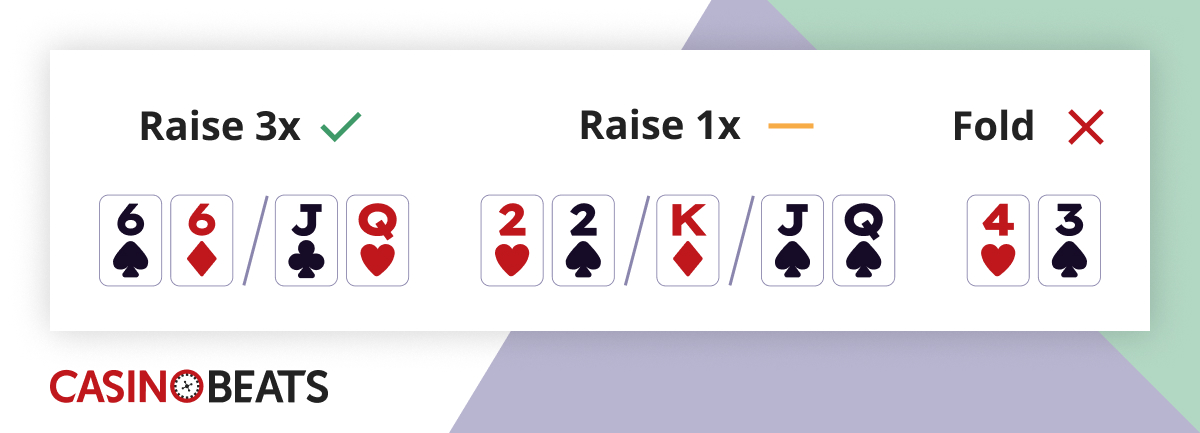
- Raise 3x with premium hands: any pair of 6s or higher, or two high cards (J or better).
- Raise 1x with marginal hands: small pairs (2s-5s), one high card, or suited connectors that could build straights/flushes/trips.
- Fold immediately with weak, unconnected, low offsuit cards.
- As community cards are revealed (third, fourth, and fifth streets), adjust your bets:
- Keep betting if your hand develops draws or improves.
- Stay disciplined. Fold when your chances remain slim.
This approach minimizes unnecessary losses and keeps you in the game when your hand has real winning potential. Here’s a simplified table of what to do at each stage:
| Stage | Situation | Action |
|---|---|---|
| Hole Cards | Pair of Jacks or higher | Raise 3x |
| Pair of 6s-10s | Raise 1x (can still push) | |
| High cards (J or higher) | Raise 1x-3x depending on kicker | |
| Suited connectors 6-10 or higher | Raise 1x | |
| Anything else (2s-5s, weak offsuit lows) | Fold | |
| After 3rd Street | Any pair Jacks or better | Raise 3x |
| Pair of 6s-10s | Raise 1x | |
| Four to a flush or open-ended straight | Raise 3x | |
| One high card + draw potential | Raise 1x | |
| Nothing / no draw | Fold | |
| After 4th Street | Made hand (pair of Jacks or better) | Raise 3x |
| Pair of 6s-10s | Raise 1x | |
| Four to a flush or open-ended straight | Raise 3x | |
| Three to a straight flush with high cards | Raise 1x | |
| No realistic draw | Fold | |
| After 5th Street | Final hand = Pair of Jacks or better | Raise 3x |
| Pair of 6s-10s | Raise 1x (push hand) | |
| Straight, flush, trips, or better | Raise 3x | |
| Anything else (including 2s-5s) | Fold |
Mississippi Stud Strategy Chart (Detailed Optimal Play)
| Hand After 2 Cards | 3rd Street Decision | 4th Street Decision | 5th Street Decision |
|---|---|---|---|
| Pair of Jacks or better | Raise 3x | Raise 3x | Raise 3x |
| Pair of 6s-10s (push hands) | Raise 1x | Raise 1x | Raise 1x |
| Pair of 2s-5s (losing hands) | Fold unless improved by a community card | Fold unless improved | Fold unless improved |
| High cards (J or higher) | Raise 1x (2x-3x with strong kicker) | Fold unless connected to a strong draw | Fold unless made a hand |
| Two high cards | Raise 1x–3x depending on strength | Fold unless connected to a strong draw | Fold unless made a hand |
| Suited connectors (6-10+) | Raise 1x | Raise 1x if still drawing | Fold unless made a hand |
| Four to a flush | Raise 3x | Raise 3x | Raise 3x if completed |
| Four to an open-ended straight | Raise 3x | Raise 3x | Raise 3x if completed |
| Straight / Flush draw + high | Raise 1x-3x depending on strength | Raise 1x-3x depending on outs | Raise 3x if completed |
| Anything else (junk hands) | Fold | Fold | Fold |
Strategy Determined by Skill Level
The better you are at poker, the more your decision-making becomes natural and intuitive. This is why you may need to adjust your strategy to suit your skill level.
Beginners
- ☑️ Stick to the chart – don’t improvise.
- ☑️ Focus on minimizing losses rather than chasing big wins.
- ☑️ Don’t let emotions or ‘gut feelings’ override the math.
Intermediate Players
- ✅ Adjust bets based on how many outs you realistically have.
- ✅ Identify opportunities where aggressive betting can boost long-term EV.
- ✅ Pay attention to card combinations – suited and connected cards gain more value.
Advanced Play and Side Bets
Mississippi Stud is primarily a fixed-odds game. There is no room for advantage play to gain a statistical advantage. In casino terms, advantage play means using legal techniques to gain a statistical edge over the house. In Mississippi Stud, that simply isn’t possible.
Despite this, experienced players always look for extra angles – or just add variety with optional side bets.
Progressive Jackpots
Many casinos link Mississippi Stud tables to a progressive meter, with a Royal Flush awarding the jackpot, as well as smaller prizes for straight flushes or four of a kind. Fun to play but hard to win.
3 Card Bonus
This side bet pays based on your two hole cards plus the first community card. Even a flush or straight can return decent payouts, while a mini royal (A-K-Q suited) may pay up to 50 to 1.
Hot and Cold Tables
Some players believe in tracking ‘runs’, but this is more superstition than strategy since each hand is independent.
Card Counting
Unlike blackjack, counting just doesn’t work here. Cards are shuffled after each round, making it nearly impossible to gain an edge.
Ultimately, advanced play in Mississippi Stud is less about beating the base game and more about managing your bankroll, knowing the odds, and deciding whether side bets are worth the added volatility.
Common Mistakes When Playing Mississippi Stud
Many players bleed chips in Mississippi Stud because they:
- ⚠️ Overplay weak hands. Folding early may feel boring, but it saves money. Don’t chase junk like 7-2 offsuit.
- ⚠️ Bet too aggressively with small pairs. Remember, 6s-10s only push, not win.
- ⚠️ Ignore the draw potential. A suited Q-10 isn’t a made hand, but the chance of flush/straight gives it value.
- ⚠️ Tilt after losses. Chasing losses with reckless 3x bets is the fastest way to bust.
Summary
Mississippi Stud is a unique poker-based table game that rewards players who exhibit patience and discipline. This means that by learning when to fold, when to raise, and how to manage your bankroll effectively, you can minimize losses and increase your chances of hitting those big payouts.
A good rule of thumb is to start with a bankroll of at least 40 to 50 times your ante. This gives you enough cushion to ride out the variance without going broke too quickly. Keeping your raise sizes steady helps smooth out variance and prevents your session from becoming too volatile.
By sticking to this Mississippi Stud strategy chart and applying simple Mississippi Stud strategy tips, you’ll protect your bankroll while keeping the game fun and exciting.
FAQs
Mississippi Stud is a poker-based casino table game where you bet against a paytable rather than the dealer. The goal is to make the best five-card poker hand possible using two hole cards and three community cards.
The basic strategy is to raise strongly with pairs of sixes or better, play cautiously with high cards or draws, and fold weak offsuit hands. Following a Mississippi Stud strategy chart helps minimize losses.
Start by placing an ante. You receive two hole cards, then bet or fold as each of the three community cards is revealed. Payouts depend on your final five-card hand, with higher hands returning bigger wins.
You should play hands with substantial starting value: pairs of sixes or higher, high cards, and suited or connected cards with draw potential. Weaker hands should be folded early to preserve your bankroll.