









Chavdar Vasilev Journalist
Chavdar Vasilev is a journalist covering the casino and sports betting market sectors for CasinoBeats. He joined CasinoBeats in May 2025 and reports on industry-shaping stories across the US and beyond, including legislative debates, market...
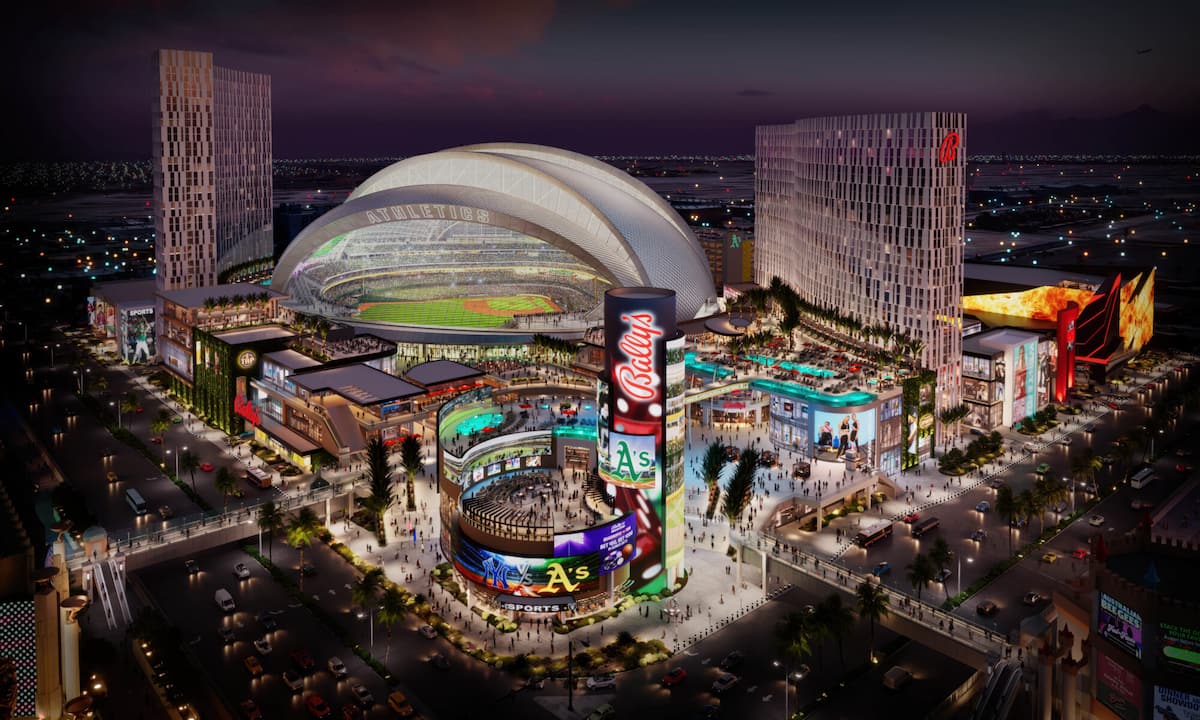
Read Full BioShortly after releasing details on its Las Vegas resort, Bally’s has outlined a three-year construction plan for the property, which will surround the Oakland A’s future $2 billion ballpark at the site of the former Tropicana.
The timeline illustrates how the 3.56 million-square-foot integrated resort and ballpark will transform into a new, unified entertainment district on the Strip.
Four Phases Through 2029
According to the filings, revealed in public documents and detailed by the Las Vegas Review-Journal, Bally’s development will span four distinct phases. It hopes to have permits approved by January and start construction by April 2026.
The company plans to complete the project in March 2029. Each phase is designed to complement progress on the A’s ballpark, which broke ground in June and remains on track for a 2028 debut.
In Phase 1, Bally’s will build shared infrastructure. That includes a central utility plant, a southeast parking garage, a public access road encircling the ballpark, and retail and dining space in the northwest corner of the site. Bally’s targets to complete the phase in unison with the A’s ballpark completion.
In Phase 2, the company will complete the central resort core. That includes a 1,800-room hotel tower, a casino floor, a sportsbook, and an expanded entertainment and retail district that integrates directly with the A’s nine-acre plaza.
Phase 3 will feature the completion of the 3,000-seat theater at the southwest corner.
Phase 4 will complete the project with a 1,200-room hotel tower on the northeast corner. This area will initially serve as a staging ground for stadium construction before being converted into the final resort component.
At full build-out, the site will feature:
- 1.7 million square feet of hotel space
- 822,000 square feet of parking
- 476,000 square feet of retail, dining, and entertainment space
- 216,000-square-foot theater
- 100,000 square feet of casino floor
- 50,000 square feet of pools
The hotel towers are planned at approximately 350 feet and 420 feet in height, pending final design review.
The A’s Partnership at the Core
In 2023, Bally’s partnered with the A’s and the landowner Gaming and Leisure Properties (GLPI). Bally’s controls 26 acres of the 35-acre site, with the A’s ballpark occupying nine acres. Under its lease agreement with GLPI, Bally’s will pay about $10.5 million in annual rent.
Together, Bally’s and the A’s will create a 500,000-square-foot entertainment district that combines retail, dining, and immersive attractions between the casino and the stadium. Bally’s Chairman Soo Kim has called the plan a “once-in-a-generation opportunity.”
The A’s have already filed roughly $901 million in construction permits, including $523 million submitted in late September. Bally’s timeline remains dependent on the stadium construction advancing on schedule. Any delays on the ballpark side could result in delays of the resort phases.
Bally’s Stays Alive in New York
While Bally’s is betting big on Las Vegas, it’s pursuing an even grander project in New York. The company’s bid to build a casino-resort in the Bronx is among the four remaining applicants in the highly coveted race.
Bally’s endurance in reaching the final stretch has been seen as surprising by many. That’s because it has faced questions surrounding its funding ability and the community divide.
The $4 billion Bronx proposal envisions a full-scale casino and a 500-room hotel at the company’s Ferry Point golf course, formerly known as Trump Golf Links.
The New York City Council’s June 2025 approval of a home-rule message allowed Bally’s to convert portions of the property for gaming use, keeping the bid alive for state consideration.
Despite fierce local opposition and a narrowly divided vote, Bally’s then advanced through the Community Advisory Committee step. With several rivals — including all Manhattan bids — now out of the running, Bally’s remains a dark-horse contender to secure a coveted downstate license.
Chicago Casino Faces New Challenge
Bally’s third front lies in Chicago, where it’s building the city’s first casino, a $1.7 billion River West casino resort. The project, which is the company’s most advanced major US development, has faced financing concerns. Bally’s recently closed a $250 million IPO to help with that.
Now, Bally’s Chicago faces a new, unexpected threat: a City Council proposal to legalize video gaming terminals (VGTs) across Chicago.
Elizabeth Suever, Bally’s vice president of government relations, warned the Council that expanding VGTs could result in Chicago losing $74 million in annual tax revenue. Additionally, VGTs threaten up to 1,050 jobs and could force renegotiation of the host-community agreement.
“We estimate that the legalization of VGTs in Chicago could result in a yearly total tax loss of $260 million from Bally’s Chicago Casino. Of that, the city of Chicago stands to lose roughly $70 million in tax revenue yearly — not including the $4 million [annual payment],” Suever said.
The proposal has since stalled amid opposition from Mayor Brandon Johnson and finance officials. They fear cannibalizing Bally’s tax stream — revenue earmarked to bolster Chicago’s pension funds.
A Balancing Act Across States
For Bally’s, 2026 through 2028 will test its ability to match its ambitious expansion plans.
Financing aside, success in Las Vegas depends on tight coordination with the A’s stadium schedule. In New York, Bally’s must navigate through politics and convince regulators it’s the best bidder. Meanwhile, in Chicago, the company must fend off policy shifts that could erode exclusivity.
The stakes are high. But if Bally’s manages to execute its strategy, it could become a more prominent player in the US casino industry in the next few years.