

The Netherlands’ gambling regulator Kansspelautoriteit (KSA) ordered Polymarket to stop allowing users in the country to access its platform. If the company fails to comply, the KSA says it will issue fines of almost $500,000 per week.
The regulator has taken special exception to Polymarket allowing users to trade on the outcome of elections in the Netherlands. In a statement issued on Tuesday, Ella Seijsener, director of licensing and supervision at the agency, said, “Prediction markets are on the rise, including in the Netherlands. These types of companies offer bets that are not permitted in our market under any circumstances, not even by license holders.”
“Besides the social risks of these kinds of predictions (for example, the potential influence on elections), we conclude that this constitutes illegal gambling. Anyone without a KSA license has no business in our market. This also applies to these new gambling platforms.”
While the KSA threatens Polymarket with weekly fines, it said it would cap any penalty at a two-week fine of €840,000 ($993,000). However, it added, “A turnover-related fine may also be imposed at a later date.”
Election Markets Attract Attention
The Dutch elections last year and subsequent market activity on who would become the country’s next Prime Minister have attracted high volumes of trading on Polymarket.
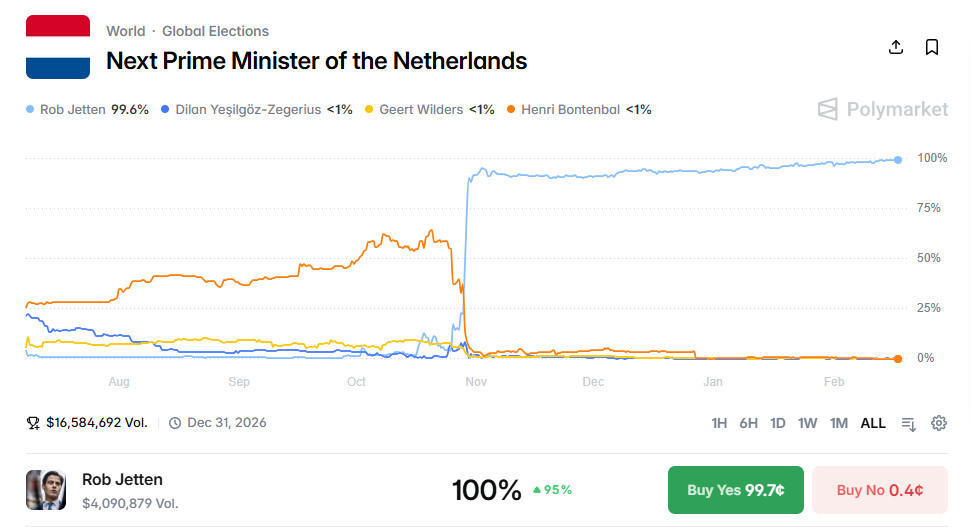
The next Prime Minister market saw over $16 million traded, with over $4 million of that on Rob Jetten, who will be formally installed next week.
The site also had markets on which party would win the most seats, and what coalition would form the government. The latter attracted $58.8 million in global trading volume. Only $1 million of that was spent on the eventual government formed by the VVD, CDA, and D66.
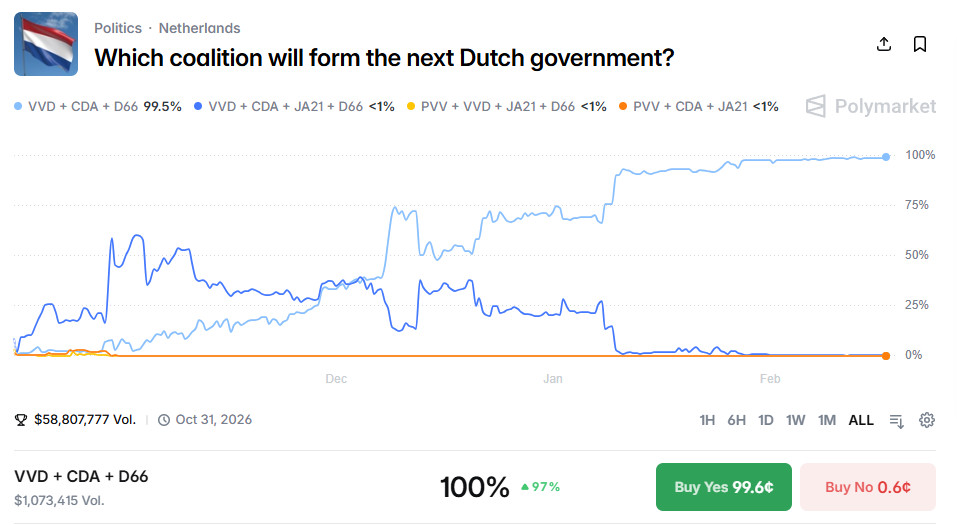
The NL Times reported that Dutch users were responsible for at least $32 million of that volume. Dutch laws, as the KSA noted, prohibit gambling on political events.
The new government has vowed to take a tougher stance against gambling, including a crackdown on illegal operators and restrictions on advertising. The KSA has questioned whether a ban on advertising is the right move, citing concerns it will push users to unregulated platforms, such as Polymarket.
KSA Chair Michel Groothuizen warned that the “consequence of the proposed advertising ban could be that players are pushed further away from the regulated market.”
Polymarket Comfortable Operating in Restricted Territories
The threats from the KSA could force Polymarket to add the Netherlands to its list of restricted countries. Nearby European nations, including Germany, Belgium, France, Italy, and the UK are already blocked.
Portugal took a similar exception to markets on the country’s elections last month, but it is not yet on the list of restricted countries.
Even if countries are officially blocked, VPNs and other workarounds often allow users to continue accessing the platform.
Polymarket has been accused of encouraging users in restricted zones to do this. In Australia, the country’s gambling regulator implemented its own block on the site, accusing Polymarket of targeting residents through social media, despite listing the country as restricted.
The company has also increased its efforts to target users in China, despite the country’s strict regulations prohibiting the platform.