


Blackjack is a card game where you compete against the dealer to get a hand value as close to 21 as possible without going over. Cards 2–10 are worth face value, face cards count as 10, and Aces count as 1 or 11. The player with the higher hand wins – as long as neither busts.
Key Beats
- Blackjack is straightforward to pick up. Your aim is simply to beat the dealer without going over 21. With a basic strategy, you can bring the house edge down to less than 1%.
- There are plenty of Blackjack variations, like European Blackjack and Spanish 21, each with its own twists that change how you should approach the game.
- Knowing when to hit, stand, double down, or split pairs makes a huge difference and helps you play smarter, whether you’re online or at a casino table.
What Is Blackjack?
Blackjack, also known as 21, is a game where you play against the dealer, not each other. It’s one of the most popular casino table games in the world because of its simple rules and low house edge when played correctly.
The objective of Blackjack is simple: beat the dealer’s hand without going over 21. You win by having a higher total than the dealer (without going over 21) or by the dealer busting. If your first two cards are 21 (an Ace and a 10 value card), you have a “blackjack,” which pays 3:2.
The game is an excellent balance of luck and strategy, so it’s suitable for casual players and serious gamblers.
How to Play Blackjack: A Step-by-Step Guide
To understand how a round of Blackjack works, it’s useful to look at the basic flow of the game. Each hand follows the same sequence of actions from placing a bet to determining the winner:
- Place your bet: Put your chips in the betting circle before cards are dealt.
- Receive your cards: You and the dealer each get two cards; one dealer card is face down.
- Make your decisions: Choose to hit, stand, double down, or split based on your hand and the dealer’s upcard.
- Dealer plays: The dealer reveals their hidden card and must hit until reaching 17 or higher.
- Determine the winner: Whoever is closest to 21 without busting wins; a natural blackjack (Ace + 10-value card) pays 3:2.
Now that you know the basic flow of a blackjack round, the next step is understanding how card values are counted.
Blackjack Card Values
Knowing what the cards represent is integral to playing Blackjack. Unlike many other card games, suits don’t matter – only the value of the cards determines how strong your hand is.
| Card | Value |
|---|---|
| 2-10 | Face value (2=2, 3=3, etc.) |
| Jack, Queen, King | 10 |
| Ace | 1 or 11 (whichever benefits the player) |
💡The flexibility of the Ace is what makes Blackjack interesting. A hand with an Ace is called a soft hand because it cannot bust on its next hit (the Ace can change from 11 to 1). If you have an Ace and a 6, for instance, you can add those cards as either 7 or 17, which makes it easier to determine whether you should hit or stand.
Basic Blackjack Strategy
Knowing your options is one thing – knowing when to use them is what separates a smart blackjack player from one who’s guessing. Here are the most common situations beginners face, and exactly what to do in each one.
When to Hit
Scenario 1: You have 16, dealer shows 7
Hit. This is one of the most uncomfortable spots in blackjack, but standing here is a mistake. The dealer is likely sitting on 17+ and your 16 loses unless you improve. Yes, you risk busting — but hitting gives you a better chance than doing nothing.
Scenario 2: You have 12, dealer shows 3
Hit. Most beginners stand here out of bust fear, but a dealer showing 3 is not weak enough to justify standing on 12. The mathematically correct play is to hit.
Scenario 3: You have a soft 17 (Ace + 6), dealer shows any card
Hit (or double, depending on the dealer’s upcard). A soft 17 feels strong but it isn’t — you can’t bust on the next card, so there’s no reason to stand. Most beginners make the mistake of treating soft 17 like hard 17.
When to Stand
Scenario 4: You have 17 or higher (hard), dealer shows anything
Stand. Hard 17 is the cutoff — the risk of busting outweighs any potential gain from hitting. This applies regardless of what the dealer is showing.
Scenario 5: You have 13, dealer shows 6
Stand. When the dealer shows a weak upcard (4, 5, or 6), they are more likely to bust. Let them. Don’t risk your own hand when the dealer is already in trouble.
When to Double Down
Scenario 6: You have 11, dealer shows 6
Double down. This is the most profitable double down situation in blackjack. You’re likely to land a 10-value card and finish on 21, while the dealer is already showing weakness.
Scenario 7: You have 10, dealer shows 9
Double down. You have a strong starting total and a good chance of reaching 20. Doubling here maximizes your return on a hand you’re already favored to win.
Scenario 8: You have 9, dealer shows 3
Double down. A dealer showing 3–6 is in the bust zone, and your 9 has good potential for improvement. This is a solid, if less obvious, double down opportunity.
When to Split
Scenario 9: You have two 8s, dealer shows anything
Always split. A hard 16 (two 8s together) is the worst hand in blackjack. Splitting gives you two chances to build a better hand from 8, which is a much stronger starting point.
Scenario 10: You have two Aces, dealer shows anything
Always split. Two Aces together give you either 2 or 12 — both weak. Split them and you have two chances at 21. This is the one split that should never be second-guessed.
Never split 10s. Ever. A hard 20 is one of the strongest hands you can have. Splitting it into two hands, starting at 10 each, is giving up a near-certain win for two uncertain ones.
| Your Hand | Dealer Shows | Correct Play |
|---|---|---|
| 16 | 7 | Hit |
| 12 | 3 | Hit |
| Soft 17 | Anything | Hit |
| Hard 17+ | Anything | Stand |
| 13 | 6 | Stand |
| 11 | 6 | Double Down |
| 10 | 9 | Double Down |
| 9 | 3 | Double Down |
| Two 8s | Anything | Split |
| Two Aces | Anything | Split |
| Two 10s | Anything | Never Split |
How to Play Blackjack Online
Playing Blackjack online is convenient and often has better odds than physical casinos. Here’s how to get started:
- Choose a reputable online casino. Look for a licensed platform with strong player reviews and a solid reputation for fair and secure play.
- Create an account and deposit. Sign up with your details and make a secure deposit. Many online casinos offer welcome bonuses that can be used on Blackjack games.
- Pick your Blackjack game. Most online casinos offer multiple Blackjack games. Choose one that suits your skill level and taste.
- Set your bet. Consider your bankroll management when determining your bet size. A common rule of thumb is to bet no more than 5% of your total bankroll on a hand.
- Play according to basic strategy. Use a basic strategy chart to make the right decisions. Many online casinos allow you to reference strategy charts while playing, but not physical casinos.
- Use free play mode. Practice in free play mode before playing for real money. This way, you can become familiar with the interface and test strategies without risk.
- Track your results. Keep a record of your wins and losses to monitor your progress and adjust your strategy as needed.
How to Play Blackjack in a Land-Based Casino
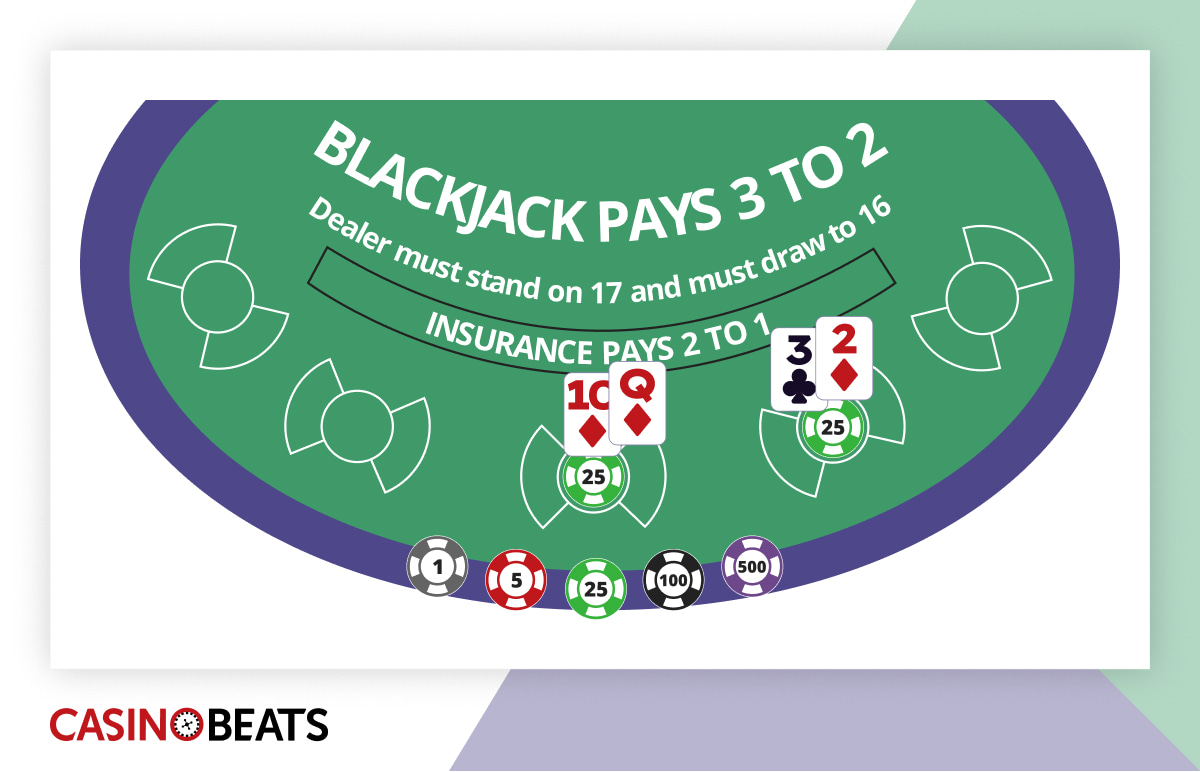
Playing Blackjack in a casino adds a social element and a whole new vibe to the game. Here’s how to do it:
- Watch before you play. Sit and watch a few hands at different tables to get a feel for the pace and minimum bet. Look for tables with 3:2 blackjack payouts.
- Buy chips from the dealer. Put your cash on the table (not in the dealer’s hand), and the dealer will exchange it for chips. Never hand some money to the dealer.
- Wait for the current hand to finish before you sit. It’s good etiquette to wait until the dealer has completed the current hand before taking a seat.
- Put your bet in the betting circle. Put your chips in the designated betting area in front of you before the dealer says “no more bets”.
- Use hand signals to the dealer. To hit, tap the table with your finger. To stand, wave your hand horizontally over your cards. To split or double down, put more chips next to your original bet.
- Never touch the cards in shoe games. In games dealt from a shoe (multiple decks), the cards are dealt face up and should not be touched. In hand-dealt games, you’ll get cards face down and can hold them with one hand.
- Tip the dealer occasionally. Not required, but tipping the dealer (especially during a winning streak) is appreciated and helps create a more positive atmosphere.
- Be aware of other players. While their decisions don’t affect you mathematically, being respectful is appreciated and helps maintain a pleasant game environment.
How to Play Blackjack at Home
Playing blackjack at home is simpler than most people think. You don’t need a casino table or professional equipment — just a standard deck of cards, some chips or coins, and at least one other person. Here’s everything you need to get a home game running properly.
What You Need
- Cards: One standard 52-card deck for 2–4 players; two decks shuffled together for 5–7 players.
- Chips: Poker chips work best, but coins or any countable tokens work fine. Assign values before you start (e.g. white = 1, red = 5, blue = 10).
- Players: Blackjack works with 2–7 players. With just 2 players, one person deals and the other plays — you can alternate the dealer role each round.
- A flat surface: Any table works. No felt required.
How to Set Up the Game
- Establish your house rules: Decide upfront whether you’re playing with doubling down, splitting, and insurance. Keeping it simple is fine for beginners.
- Designate the first dealer: Cut the deck, and whoever draws the highest card deals first.
- Set the minimum bet: Agree on a minimum and maximum bet before the first hand. A common home game range is 1–10 chips.
- Shuffle and cut: The dealer shuffles the deck and offers the cut to the player on their right.
How to Deal Blackjack at Home
-
The dealer gives every player one card face up, then deals themselves one card face down
-
A second card is dealt face up to every player, then the dealer takes a second card face up
-
Players now see one dealer card and make their decisions in turn, starting from the dealer’s left
-
Once all players have acted, the dealer flips their hidden card and plays their hand — they must hit on 16 or below and stand on 17 or above. This rule is not optional, even in a home game
How to Rotate the Dealer
In a home game, the dealer’s role should rotate after every hand (or every few hands). The standard approach:
- The deal passes clockwise after each hand.
- If a player doesn’t want to deal, they can pass the role to the next player.
- The dealer has a slight built-in advantage (players act first and can bust before the dealer plays), so rotating keeps the game fair over time.
How to Play Blackjack with 2 Players
Two-player blackjack works exactly like a full table game with one adjustment — you simply alternate who deals. A good rhythm is:
- Player A deals for 5 hands, then Player B deals for 5 hands.
- Keep a separate chip count so the dealer’s advantage evens out over the session.
- All standard rules apply — the dealer still must hit on 16 and stand on 17, regardless of the player’s hand.
Suggested Home Rules for Beginners
These are the simplest, most beginner-friendly rules to start with:
| Rule | Recommended Setting |
|---|---|
| Decks | 1 (easiest to manage) |
| Blackjack payout | 3:2 (Ace + 10-value card) |
| Dealer hits on | 16 or below |
| Dealer stands on | 17 or above |
| Doubling down | Allowed on 9, 10, 11 only |
| Splitting | Allowed (one split per hand) |
| Insurance | Skip it — adds complexity for no benefit |
| Surrender | Not needed for beginners |
Types of Blackjack
Blackjack comes in many variations, each with slightly different rules and strategies. Knowing the differences can help you adjust your approach and make better decisions at the table.
Standard Blackjack
Basic Blackjack, also known as American Blackjack, is the most common in US casinos. In this version, the dealer gets two cards at the beginning of the round: one face up and one face down (the “hole card”).
Players make decisions based on their cards and the dealer’s upcard. If the dealer’s upcard is an Ace, players can take “insurance”, a side bet that pays 2:1 if the dealer has a blackjack. Basic Blackjack uses 6-8 decks and allows doubling on any two cards and splitting pairs, with some restrictions on re-splitting. Single-deck and two-deck versions also exist and carry a slightly lower house edge, but watch out for tables that pay 6:5 instead of 3:2 for blackjack — that one rule change wipes out the advantage entirely.
Video Blackjack
Video Blackjack is the electronic version of the classic card game, where players can enjoy Blackjack without a live dealer. These machines are similar to slot machines, but with Blackjack rules.
The main difference in Video Blackjack is that most machines pay even money (1:1) for a natural blackjack instead of 3:2, as is usually done, really increasing the house edge. Video Blackjack utilizes a random number generator to determine card outcomes. It typically offers minimum bets that are significantly lower than those of the table games, making it an ideal choice for beginners or players with limited bankrolls.
European Blackjack
There are several significant differences between European and American Blackjack. The greatest distinction to note is that the dealer is initially dealt only one card at the beginning, and the second card is dealt once all participants have performed their actions.
This rule variation eliminates the dealer’s option to check for blackjack immediately, which slightly increases the house edge. European Blackjack generally uses fewer decks (usually 2), does not permit surrender, and is more restrictive regarding doubling down (usually only hard 9-11) and splitting. These differences necessitate adjustments in the basic strategy for American Blackjack.
Spanish 21
Spanish 21 is a fun variant of Blackjack played with Spanish decks, which are 52-card decks with all 10s removed. This provides a 48-card deck, altering the odds and gameplay.
To compensate for the 10s being removed (which increases the house edge), Spanish 21 has player-friendly rules including late surrender, double after split, re-split aces, and bonus payouts for specific Blackjack hand rankings. Player blackjacks always win, even if the dealer has a blackjack. Spanish 21 also has bonus payouts for 21s with five or more cards, making it a wild ride compared to regular Blackjack.
Our Top Blackjack Tips
Follow these tips from a pro, and you’ll enjoy Blackjack more; here’s how:
✅ Learn basic strategy perfectly: This one step reduces the house edge from 2% to under 1% – This is the highest ROI of your time.
✅ Check the rules before you play: Different rule variations can significantly impact the house edge. Look for 3:2 blackjack payouts and liberal doubling and splitting rules.
✅ Don’t take insurance: Unless you’re a card counter, insurance is a bad bet with a 7% house edge.
✅Set win and loss limits: Decide in advance how much you want to win or lose in a session and stick to those limits.
✅ Start at lower stakes tables: Begin at tables with lower minimum bets until you get the hang of the game and basic blackjack strategy.
✅ Ignore other players’ advice: Some players will give you strategy advice that contradicts mathematically correct play. Trust the basic strategy.
✅ Manage your bankroll: Never bet more than 5% of your total bankroll on a single hand, allowing you to weather variance.
✅ Play at less crowded tables: You’ll get more hands per hour, and if you’re playing with a perfect strategy, this minimizes your exposure to the house edge over time.
✅Check the legal age requirement: Minimum gambling ages vary by jurisdiction and casino. Always verify that you meet the legal requirements before playing.
Conclusion
Blackjack is one of the most strategic and player-friendly games in the casino. By learning basic strategy, understanding the different game types, and managing your bankroll through responsible gambling, you can have hours of fun with one of the lowest house edges in the casino.
Remember, strategy can reduce the house edge, but Blackjack is a game of chance, and the casino has an advantage in the long run. Approach it as entertainment first and winning as a bonus, not an expectation.
FAQs
-
What are the basic rules of playing blackjack?
Blackjack is played against the dealer. Get a hand value closer to 21 than the dealer without going over. Two cards are dealt to players, and they can “hit” for more cards or “stand” with their current total. The dealer must hit until 17 or higher. Natural blackjacks (an Ace with a 10-value card) pay 3:2.
-
Is 21 the same as Blackjack?
While both are used interchangeably, there’s a technical difference. “Blackjack” means an Ace and a 10-value card as your first two cards (a “natural”), which pays 3:2. “21” is any hand that totals 21 points, whether two cards or more, and pays 1:1 if you win.
-
How to win at Blackjack for beginners?
Learn basic strategy, which tells you the mathematically correct play for every hand. Start with small bets as you practice. Look for tables with player-friendly rules, such as 3:2 payouts for blackjack. Set strict loss limits and stick to them.
-
What is the golden rule in blackjack?
The golden rule in blackjack is to always follow basic strategy. This means making decisions based on mathematically proven probabilities rather than intuition or emotions.
-
Is it easy to play Blackjack?
Blackjack is easy to learn but hard to master. While the rules are straightforward, playing well requires understanding basic strategy and making optimal decisions in different situations. This balance of simplicity and strategy makes blackjack enjoyable for both beginners and experienced players.
-
How do I know when to hit or stand?
Follow basic strategy charts, which tell you the mathematically correct play for every possible hand. Generally, stand on a hard 17 or higher, always hit a hard eight or less, and for hands 9-16, your decision depends on the dealer’s upcard. For soft hands (with Aces), the strategy is different; you’ll often hit soft 17 or lower.
-
What is the best strategy for a beginner?
Learn basic strategy, which tells you the correct play for every situation. Start with more straightforward rules: always split Aces and 8s, never split 10s or 5s, double down on 11, and stand on 17 or higher. Play at tables with lower minimums while learning. Use strategy cards (allowed in most casinos) until you memorize the correct plays.
-
What does it mean to “double down” in Blackjack?
Doubling down is when you double your initial bet, after looking at your first two cards, in exchange for agreeing to stand once you are dealt one more card. It is best used when you have a hand that is likely to win with one more card, such as a hard 10 or 11, or certain soft hands, depending on the dealer’s upcard.