


Often called Tunk, Tonk is a game of speed, skill, and strategy. Unlike traditional Rummy, which can take longer to finish, a round of Tonk can be over in seconds, making it perfect for both casual fun and competitive play.
Whether you’re learning how to play Tonk with 2 players or planning a game night with friends, this guide will cover all the Tonk card game rules, from setup to winning hands.
Key Beats
- Tonk is a Rummy-style game for 2 to 4 players. Each player gets dealt 5 to 7 cards.
- The objective in Tonk is to be first who will lay down sets or same-suit runs till you run out of cards.
- You win if you lay down all your cards, or you believe you hold the lowest total at the table, or you have a natural tonk of 49 or 50 points.
How to Play Tonk: The Game Setup
Before your first hand, it’s essential to understand the Tonk game setup and flow.
Tonk Game Setup and Play
- Players: 2 to 4 players (though it’s a popular choice to play tonk with 3 players).
- The Deck: Standard 52-card deck (no jokers).
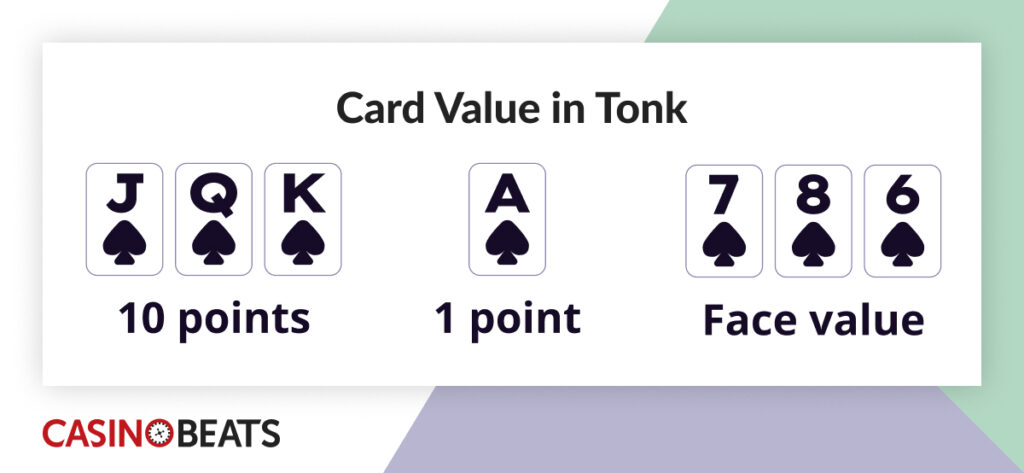
- Card Values:
- Aces: 1 point (Always low).
- Number cards (2–10): Face value.
- Face cards (J, Q, K): 10 points.
How Many Cards Do You Deal in Tonk?
The dealer shuffles the deck and passes out 5 cards to each player, one at a time, moving clockwise. For those wanting a longer, more strategic round, some house rules allow for 7 cards, but 5 is the standard for fast-paced play. The remaining cards form the draw pile (stock), and the top card is flipped face-up to start the discard pile.
The Golden Rule: Check for a “Natural Tonk”
The most important of all Tonk game rules happens before the first turn. Immediately after the cards are dealt, look at your hand total.
If your 5 cards total exactly 49 or 50 points, you have a Natural Tonk.
- Shout “Tonk!” and show your cards.
- You win the round instantly and collect a double stake from everyone. No play is required!
What Are the Rules of Tonk Card Game?
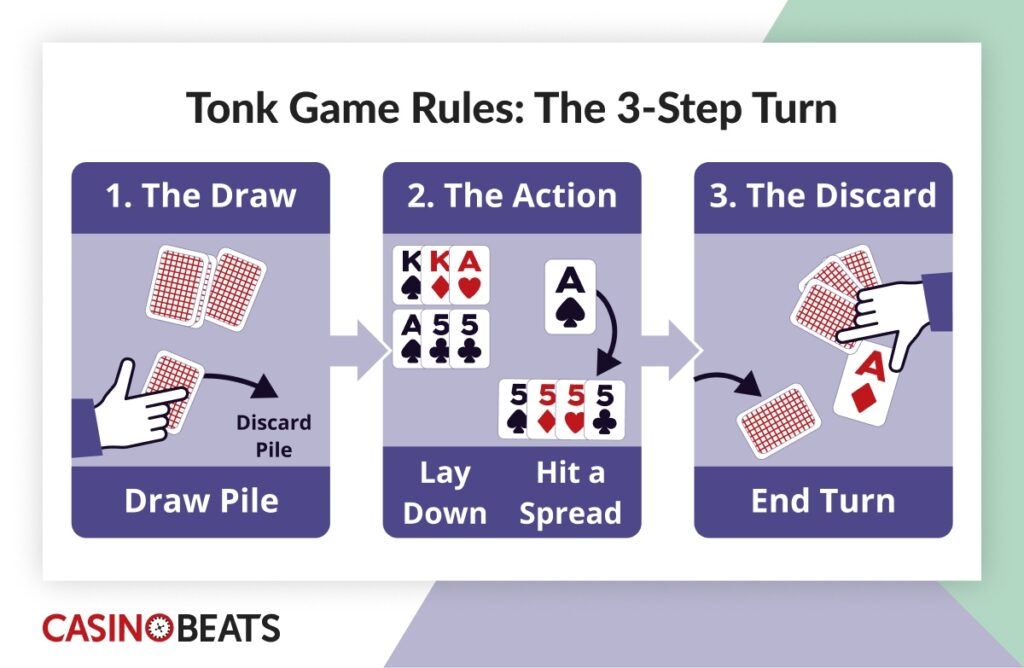
If nobody has a Natural, the player to the left of the dealer starts. Every turn in this Tonk cards game follows a simple, 3-step cycle:
The Draw
You must start by taking one card. You can either:
- Draw the top card from the face-down draw pile.
- Draw the top card from the face-up discard pile (only if it helps you form a combination).
The Action (Spreading & Hitting)
Now, try to lower the points in your hand. You have two options:
- Lay Down a Spread: Place a “set” (3 or 4 of a kind) or a “run” (3+ cards of the same suit in numerical order) on the table.
- Hit a Spread: You can add cards to any spread on the table, including your opponents’.
If there is a 5-6-7 of Clubs on the table and you have the 8 of Clubs, you can “hit” it to get those points out of your hand.
The Discard
To finish your turn, you must discard one card. You must always end your turn with the same number of cards you had before drawing (unless you went out).
How to Win Tonk: “Going Out” vs. “The Drop”
In Tonk, you have two options for winning – Going Out and The Drop.
- Option 1: Going Out
This is when you empty your hand by forming spreads or hitting existing ones. Your last card is discarded, and the round is over.
- Option 2: The Drop (Knocking)
If you believe you have the lowest points at the table, you can Drop. You can only Drop at the start of your turn, before you draw.
The Waiting Rule: If you just laid down a spread, you must wait 3 turns before you are allowed to Drop. This prevents players from dumping points and “snapping” the game shut immediately.
What Happens If You Tie in Tonk? (Scoring Explained)
When the round ends, players count the points remaining in their hands.
| Outcome | Result |
|---|---|
| Natural Tonk | Win double stake from all players. |
| Going Out | Win 1 stake from all players. |
| Drop & Win | If you have the lowest points, you win 1 stake. |
| Drop & Lose (Caught) | If an opponent has a lower or equal total to yours, you are “Caught.” You pay double stake to every player. |
2 Ways to Track the Score
Depending on your group’s preference, you will settle the score in one of two ways:
1. Playing for stakes (immediate payout)
In this version, every hand is a mini-game.
- The winner: Receives 1 stake (e.g., $1 or 1 chip) from every player. If they win with a Natural or a Tonk-Out, they receive a double stake from everyone.
- The losers: Each player simply pays the winner the agreed amount. Your hand total doesn’t matter here unless you were involved in a “Drop” comparison.
2. Playing for cumulative points (tournament style)
This is where losing hurts! If the game ends, the players who didn’t win must calculate their losses:
- The winner: Gets 0 points (this is the best possible score).
- The losers: You must sum up the value of all cards remaining in your hand (Aces = 1, Face cards = 10, etc.). These are recorded as penalty points.
- The goal: The game ends when a player reaches a pre-agreed target (like 100 or 250 points). The player with the lowest cumulative score at that moment is declared the overall winner.
What Happens When the Deck Runs Out?
If the draw pile (stock) runs out before any player goes out or drops, one of the following outcomes occurs:
- The hand ends in a draw, with no points awarded.
- The hand is scored. The player with the lowest point total wins.
- The discard pile is reshuffled (excluding the top card) and reused as the new draw pile.
Different groups adopt different house rules. Always decide beforehand which rules you want to use prior to the game to keep things flowing smoothly.
While Tonk is mostly played for fun among friends, you can still enjoy similar real-money games by learning how to play blackjack or rummy at online casinos of your choice.
How to Play Tonk for Beginners: 3 Winning Strategies
Mastering the rules of tonk card game is just the start. To win, we suggest you use these tips:
- The “Early Drop” strategy: If you are dealt a hand with 15 points or less, Drop immediately on your first turn. It is very unlikely your opponents have anything lower that early.
- Minimize hand value: If an opponent has only one card left, they are about to go out. Lay down any spreads you’ve been holding to reduce your points.
- Watch the discards: If you are learning how to play tonk with 2 players, this is vital. If your opponent picks up a 6, don’t discard any 5s or 7s that might help them.
Laying down your spreads as soon as you get them is often a rookie mistake. Because the moment you put your cards on the table, you’re vulnerable. You’re telling the whole room exactly what you’re doing, and more importantly, you’re triggering that ‘3-turn lock’ where you can’t drop. Only lay your cards down early if you’re absolutely sure you can ‘Go Out’ on that same turn or the next. Otherwise, keep your weapons hidden; in Tonk, information is just as dangerous as a high point count, and once you show your cards, you’ve lost your element of surprise.
Conclusion
Tonk is a game of quick thinking and even quicker turns. Whether you are playing for fun at a kitchen table or testing your skills in a more competitive environment, remember that the best players aren’t just lucky — they are disciplined.
If you decide to take your skills to the next level and play for stakes, it is essential to practice responsible gambling to keep the game enjoyable for everyone. Grab a deck, keep your hand total low, and see if you have what it takes to master the fast-paced world of Tonk!
FAQs
-
How do you win in Tonk?
There are three ways to win a round of Tonk: Natural Tonk (Being dealt exactly 49 or 50 points), Going Out (Playing all cards in your hand into spreads or by “hitting” other players’ sets), and The Drop (Declaring the end of the game because you believe you hold the lowest point total at the table).
-
Is Tonk a game of skill or luck?
Tonk is a blend of both, but it is primarily a game of skill over the long term. While the initial deal (luck) can grant a “Natural” win, successful players use skills like card counting, probability, and psychological bluffing to decide when to “drop” or when to withhold spreads to avoid being “hit.”
-
What is the 49 50 rule in Tonk?
The 49 50 rule, known as a Natural Tonk, is an automatic win condition. If the 5 cards dealt to you at the very start of the game total exactly 49 or 50 points, you must declare it immediately. The round stops, and you collect a double stake from all opponents before a single turn is played.
-
Do you flip the first card in Tonk?
Yes. After the dealer has dealt 5 cards to each player, the next card in the deck is flipped face-up to start the discard pile. The remaining cards stay face-down to form the “stock” or draw pile.
-
How to win at Tonk with 2 players?
To win Tonk with 2 players, you must play defensively. Focus on “defensive discarding”—keeping cards that might help your opponent finish a spread. Since there are fewer spreads on the table to “hit,” winning usually comes down to a well-timed early Drop when your hand total is 15 points or fewer.
-
How many cards do you deal in Tonk?
In a standard game of Tonk, each player is dealt 5 cards. In some regional variations or for a longer, more strategic match, players may agree to deal 7 cards per person.
-
What happens if you tie in Tonk?
If you “Drop” (Knock) and an opponent has the same point total as you, the dropper loses. In Tonk, the dropper must have the strictly lowest hand to win. In the event of a tie, the dropper is considered “Caught” and must pay the penalty (usually a double stake) to the player who tied them and all other opponents.