

Zohran Mamdani cruised to victory in the New York City mayoral race on Tuesday, making history as the city’s first Muslim and South Asian to lead City Hall. With more than 90% of the ballots counted, the democratic socialist has secured just over half of the vote, giving him what many consider a broad mandate to advance his vision for the city.
His win comes as New York state prepares to finalize its long-running downstate casino licensing process, with the decision expected before Mamdani takes office on January 1, 2026.
During the campaign, the mayor-elect made his stance on the proposed casinos clear, expressing doubts about the large-scale expansion of gambling in the city while acknowledging that, as a state-run process, it’s outside City Hall’s control.
In June, Mamdani lightheartedly joked that “Gambling is haram,” as he passed a Times Square billboard featuring an ad for prediction platform Kalshi that put his odds of winning the mayoral race at just 23% at the time. A little over a week out from the election, those odds had increased to 93% and Mamdani gave a public nod to Kalshi on social media.
Also in June, he expressed that he was “generally in opposition” to the downstate casino plan and said he would have voted against legislation for the Citi Field proposal had he been present for the Assembly vote.
When asked about his views on the topic in August, Mamdani told reporters: “I’ve been open about my personal skepticism, and yet I also know this is the law.” His response highlights the measured approach he’s taken to the casino debate: wary of gambling’s expansion, but unwilling to challenge a state mandate.
New York City’s Mayor has Limited Power Over Casino Approvals
The Gaming Facility Location Board (GFLB) and the New York State Gaming Commission oversee New York’s downstate casino licensing process, with a mandatory local checkpoint: a six-member Community Advisory Committee (CAC) for each bid.
Within New York City, one member of each CAC is appointed by the governor, the mayor, the local state senator and assembly member, the borough president, and the district’s city council member.
A project must receive two-thirds of a CAC vote to move forward. Only CAC-approved bids are forwarded to the state board for evaluation and final selection.
At the same time, applicants must undergo a separate process to clear local entitlements for land use and zoning, as well as complete the State Environmental Quality Review Act, before they’re evaluated by the GFLB.
Even though the mayor participates in the process by appointing one CAC member and having influence over zoning decisions, such as when Mayor Eric Adams used his limited authority earlier this year to veto a Council measure that would have blocked the Bronx casino proposal, the overall structure, which consists of multiple layers of independent review including the CAC, GFLB, Gaming Commission, and environmental regulators, means the final decision rests with the state, not City Hall.
Since New York state is expected to issue final approvals by the end of 2025, Mamdani will likely have no direct role in the outcome despite his skepticism toward the casino expansion.
Where the Field Stands Now
After a summer full of ups and downs leading up to the CAC votes, Manhattan’s marquee bids in Times Square, Hudson Yards, and Freedom Plaza were voted down by their respective CACs, while the Coney Island proposal in Brooklyn also failed to advance.
Even with the defeat of the Caesars Palace Times Square proposal, SL Green Realty’s CEO Marc Holliday is optimistic that at some point there could be a casino in Manhattan, saying, “I don’t think by any means it’s…completely dead.” Still, for now, Manhattan is out of the running. As a result, all eyes are now on the remaining bids in other parts of the city.
With MGM Empire City in Yonkers withdrawing its application, the field narrowed to three: Resorts World (Queens expansion), Metropolitan Park (Citi Field, Queens), and Bally’s Bronx (Trump Links redevelopment).
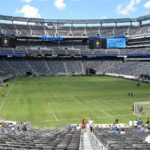
Resorts World New York City at Aqueduct Racetrack in Queens received unanimous CAC approval on September 25, and the Metropolitan Park project, which includes the Citi Field plan backed by Steve Cohen and Hard Rock, cleared its CAC with a 6-0 vote on September 30.
Bally’s Bronx, which will be built on the former Trump Links golf course at Ferry Point, also secured CAC approval with a 5-1 vote on September 29. All three bids now await the state board’s final selections.
In late October, Maybank Investment Bank analyst Samuel Yin Shao Yang said that the three remaining downstate casino projects are “virtually assured” of approval.
What Mamdani’s Stance Means
As far as industry stakeholders are concerned, Mamdani’s position is basically a hands-off posture when it comes to casinos in New York City. While the mayor-elect seems less than enthusiastic about the proposals, he hasn’t made any statements suggesting he’d use the limited powers of his office to stall the process.
In fact, in August, he said: “The siting and the choices of which casinos will open, that pertains to the state,” in response to a question posed by a reporter at a rally organized by the Hotel and Gaming Trades Council.
With the Queens and Bronx projects through their CACs, the decision now rests with the state’s Gaming Facility Location Board and Gaming Commission, exactly where Mamdani has said it belongs.