


South Korean casino stocks are in freefall after the government unveiled plans to force operators to increase the size of their contributions to the state tourism fund.
The Paradise City operator Paradise saw its share price fall by over 23% over the past five days. Paradise rival Lotte Tour Development’s share price fell by almost 5% day-on-day when the market opened on July 20.
The Ministry of Culture, Sports, and Tourism last week said it was considering raising the percentage of its revenues operators must pay into the Tourism Promotion and Development Fund from the current 10% to 15%.
“[The rate hike] could not only worsen the performance of individual companies, but also affect the overall competitiveness of the domestic […] casino industry,” Choi Yong-hyun, an analyst at KB Securities, told the South Korean media outlet MTN.
The slump will come as jarring news for South Korean casino operators and their financial backers. Just days ago, domestic analysts predicted a tourism-powered surge for gambling-related stocks.
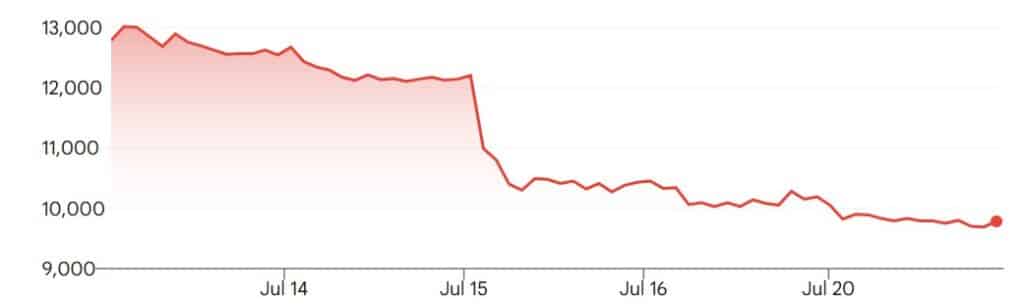
South Korean Casino Stocks: Fee Hike Fears Spook Markets
The ministry’s plan, as things stand, applies to foreign-passport-holder-only casinos. However, only one South Korean casino, High1 in Gangwon Province, is currently allowed to admit domestic passport holders.
And its operator, too, appears to have been caught up in the casino stock funk. Kangwon Land’s shares are down over 3% in the past five days. They also fell 1% after the market opened on Monday morning KST.
However, the firms posting the biggest declines were all casino operators with foreign-passport-only employees. Grand Korea Leisure, the Korea Tourism Organization-owned operator of the Seven Luck casino chain, has seen its share price drop by over 11% since July 15.
Securities industry experts said if the ministry signs off on the contribution rate hike, a decline in profits would be “inevitable.”
The same media outlet quoted Eugene Investment & Securities analysts as forecasting Paradise would need to pay over $64 million to the fund per year, based on last year’s earnings.
Using the same calculations, the financial services firm said Lotte Tourism Development would need to pay $40.5 million. Grand Korea Leisure, meanwhile, would need to pay over $31 million a year.

“There is a possibility that casino firms’ operating profits could decrease by 20–30% compared to existing forecasts,” said Eugene researcher Lee Hyun-ji.
Mid-Term Competition Heating Up
Securities industry experts said some operators are also concerned about long-term competition with Japan.
Developers plan to open Japan’s first integrated resort in Osaka by 2030. While construction is still underway, domestic observers are concerned that the scale of the project could result in a casino complex that dwarfs existing South Korean venues.
MGM Osaka is set to cost around $10 billion. Experts expect it to generate $2 billion a year in Earnings Before Interest, Taxes, Depreciation, and Amortization.
The analysts noted that existing South Korean casinos could find facility improvement challenging due to construction regulations.
“From a mid-to-long-term perspective, South Korean foreigner-only casinos must prepare to compete with Japanese IRs in four years,” Choi told the South Korean newspaper Maeil Kyungjae. “And securing competitiveness is impossible without capital expenditure spending.”
However, the analysts added that the overall outlook for South Korean casino stocks remains positive. They said that the price drop was a “psychological adjustment reflecting policy uncertainty, rather than a result of actual earnings deterioration.”
The experts said VIP and ordinary customer spending remains high at most domestic casinos. They also explained that a recovery in domestic casino sector stock prices was likely “once policy uncertainties are resolved.”