


Derek Stevens, owner of three Las Vegas casinos including Circa Sports, has been described as the last casino mogul in town, taking a big gamble on remaking Downtown Vegas. He is also betting against prediction markets, which he describes as “thieves.”
CasinoBeats spoke to Stevens over the phone on the eve of Circa’s opening of two new floors in its impressive hotel and casino resort on Fremont Street.
The 60-story complex features the Circa Sportsbook, the world’s largest sportsbook, spanning three floors with enormous screens that can display 19 games at a time, along with live odds.

Forbes estimates that the resort makes more in gambling revenue than Boyd’s three properties on Fremont combined. Amid dwindling visitor numbers in Vegas, it is a venue that is bucking the trend.
“I think we’ve got a very nice product,” Stevens says. “I think we’ve got a great property and I think people like the fact that there’s great hospitality here.”
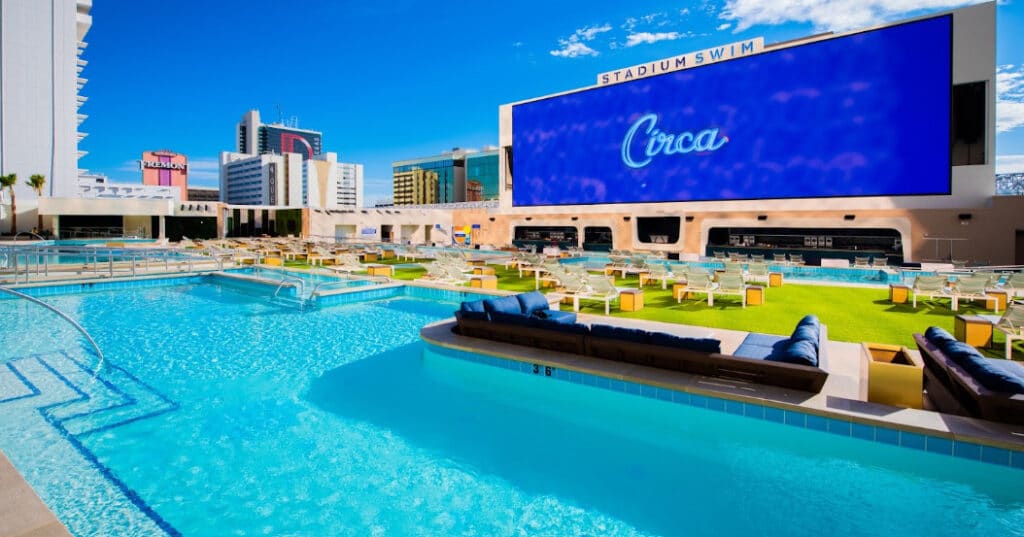
Outside the building, you will find Stadium Swim, the largest pool in Las Vegas, complete with a 143-foot-tall TV screen.
Stevens Fighting Against Prediction Markets
The product offered on Fremont Street is very different from the increasingly popular way to wager on sports: prediction markets.
Nowhere have prediction markets been opposed more strongly than in Nevada. The state was the first to block Kalshi and quickly drove out Polymarket, Underdog, and Crypto.com, even forcing FanDuel and DraftKings to give up sports betting licenses.
Operating casinos and sportsbooks usually comes at a premium, but prediction market platforms have found a way to avoid the expenses that go with the territory. Stevens repeats his claims from a recent interview that they are “pirates and thieves.”
“They are not paying federal excise tax, they’re not paying associated gaming operator taxes, they are not paying into any problem gambling funds, they are not paying for any league data, they are not paying any state-mandated gaming taxes,” Stevens says in our call.
He is disgruntled that prediction markets are trying to spin their product as something good for the world, something innovative.
“If I was someone that hijacked a truck full of televisions and then I went into the parking lot of an electronic store, like a Best Buy, and I sold all these televisions at 50% off, does that make me a good guy?”
“The answer is no. I’d still be a thief. And just because Kalshi and Polymarket and Novig have been shrewd, the fact that they are avoiding all the taxes does not make them heroes.”
Too Much Money Lost to Allow Sports Event Contracts
In Stevens’ view, sports event contracts are sports betting by any other name.
“I think when it comes down to it, a bet is a bet. And I think it’s very clear that 85% to 90% of the handle on Kalshi and Polymarket prediction markets comes from sports betting. So, what they’re doing is sports betting,” he says.
State judges have tended to agree. In 37 rulings, judges have ruled against prediction markets 31 times, rejecting arguments that the Commodity Exchange Act (CEA) should allow their sports markets. Michigan and Washington state have joined Nevada in blocking Kalshi, while others are lining up to follow suit. Connecticut is the latest to ramp up its legal action against the operator.
Amid the legal challenges, Kalshi’s volume has exploded. It traded over $33 billion on the World Cup. The issue of whether sports event contracts are fair and legal looks set for the Supreme Court. In 2024, SCOTUS sided with Kalshi and allowed its election markets; if it did the same for sports, it would have huge consequences, says Stevens.
“I think if that were to happen, that would change the whole sports betting industry. That also changes the budgets for a number of states. The state of New York will lose over $1.5 billion in tax revenue. The state of Illinois will lose a tremendous amount of tax revenue. So, if this is what the Supreme Court rules, you’re going to have a lot of states that are going to have massive holes in their budget,” he says.
However, he does not see that as a likely scenario.
“I’m of the position that there’s 44 of the 50 states’ Attorneys General in lawsuits with the prediction markets. I think there’s too much money that would be lost. I still believe that a more reasonable outcome will be developed.”
On the final day of a public comment period on prediction market rules, 44 state attorneys general submitted a 66-page letter telling the CFTC to withdraw its proposal, which would explicitly allow sports markets.
Prediction Markets No-Go Territory For Circa
Stevens added that if SCOTUS approves sports prediction markets, “You’ll also have a number of sportsbooks that clearly will make decisions to become prediction markets.”
DraftKings, for example, has fully embraced the opportunity presented by prediction markets. For Stevens and Circa, it’s no-go territory.
“DraftKings is not licensed in Nevada, and DraftKings may not be able to become licensed in Nevada because of their actions,” Stevens says.
Both FanDuel and DraftKings gave up potential sports betting licenses as they moved into prediction markets last year. Stevens is fully invested in the state and would not risk his $1 billion gaming empire on a prediction market gamble.
Other casino operators have also steered well clear of getting involved in the emerging industry. Caesars, MGM, and PENN have all said they view prediction markets as unlicensed sports betting and will not consider launching their own products.
CFTC Not Capable of Regulating Sports Betting, Says Stevens
Casino owners must speak out against prediction markets, says Stevens. “Just because Kalshi and Polymarket have an unlimited budget for lawyers doesn’t mean they get to break the law and create their own outcomes.”
“I think we have to communicate, and we’ve got to let people know that what they’re doing is not acceptable under the current scenario. We have to let other legal gaming operators know that their model is unsustainable. I realize that there are scenarios where it’s looked upon as if they’re doing something good, but the reality is that there’s a tremendous amount of harm being created here.”
Kalshi and casino lobby groups are going toe-to-toe in campaigns, with both sides claiming the other is doing harm. The difference, according to Stevens, lies in the regulator’s capability.
While Circa is held to standards by the Nevada Gaming Control Board and other state regulators, Kalshi answers to the CFTC, which is led by Michael Selig, the agency’s sole commissioner.
“The CFTC does not have the ability to regulate sports betting,” Stevens says. “If you look at the gaming commissions in all 50 states, you’re looking at tens of thousands of workers.”
Prediction Markets Will End Up Like Sweepstakes Casinos
Ultimately, whether through a Supreme Court ruling or other means, Stevens believes the future of prediction markets is the same as that of sweepstakes casinos.
“I think it’s pretty apparent that sweepstakes casinos have lost. I think you’ll probably see criminal charges against them, and I think that’s the way it’s going to go for prediction markets.”
Last year saw a wave of states explicitly ban sweepstakes casinos, including Nevada. This has led several operators to shut up shop, while others, such as Novig, are pivoting to prediction markets.
The difference is that sweepstakes casinos did not have a federal agency backing them up in counter-lawsuits. Stevens is aware that it is not a foregone conclusion that prediction markets go the same way.
Circa’s online operations will go live in a seventh state next year as it launches in Arizona. Asked whether there are plans to expand further, Stevens took a cautious approach.
“It’ll be dependent upon the regulatory environment of the tax rates. And it’ll depend on what happens with prediction markets. If prediction markets become more prevalent, we would invest less in some other states.”
While he was hesitant to say that Vegas has bounced back, as Circa opens two new floors in its hotel, he remained optimistic about the future of the city.
“We’re very bullish on Las Vegas in the long term,” Stevens said.
For now, it is one of the few places in the country where prediction markets do not exist.