









Paul started his career in newspaper journalism before exploring the emerging world of online gaming in 1998, joining Intertops in Antigua - the pioneering force behind the first online sportsbook. Since then, Cullen has enjoyed...
Read Full Bio
Jacob Potter Gambling Editor
Jacob is a betting and casino enthusiast with over five years of experience in the iGaming industry. Whether it's how-to-play guides, operator reviews, or casino bonuses, you can rest assured that the information provided is...
Read Full BioThe Spanish 21 game is often called the “ultimate” blackjack alternative. It offers a faster pace and more excitement than the classic game, primarily because it removes the “push” (tie) on 21 and replaces it with a guaranteed win for the player.
If you are looking for a guide on how to play Spanish 21 to maximize your fun and payouts, this comprehensive breakdown covers everything from basic rules of Spanish 21 to advanced betting options.
Key Beats
- Unlike regular blackjack, if you hit 21, you win instantly, even if the dealer also has 21.
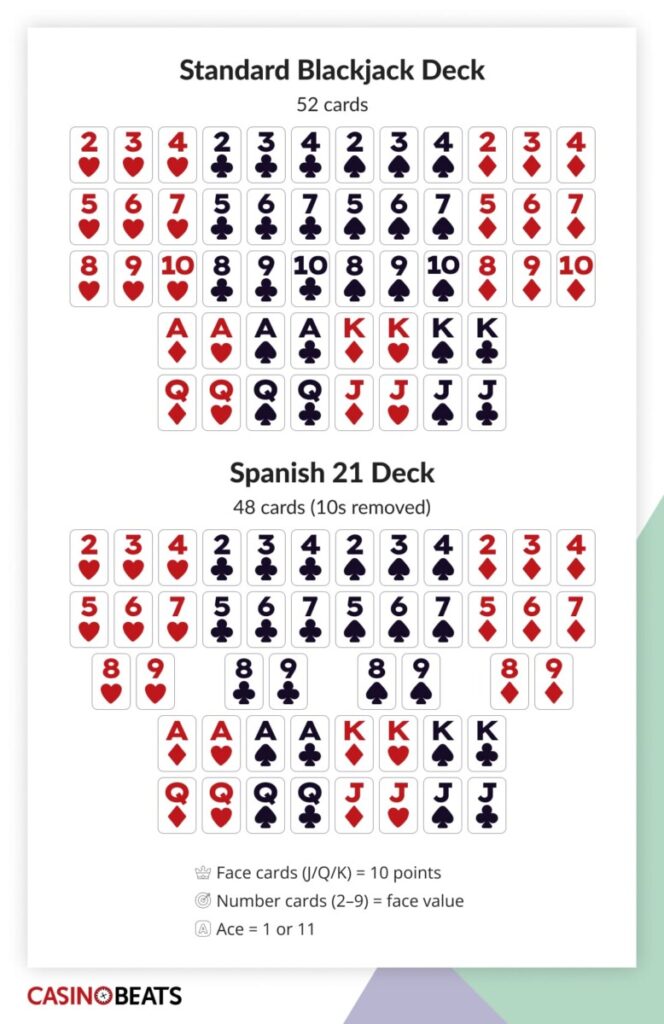
- The Spanish 21 game is played with a 48-card “Spanish Deck.” All 10-spot cards are removed, which changes the mathematical strategy.
- You can earn bonus payouts up to 3:1 for specific card combinations (like a 5-card 21 or 6-7-8) without placing a side bet.
What Is Spanish 21?
Spanish 21 is a blackjack variant first introduced to Nevada casinos in the mid-90s. While its rules look like those of a learning blackjack game, the primary difference lies in the deck.
The Spanish 21 game is played with 6 to 8 Spanish decks. A Spanish deck is a standard 52-card deck with the four 10-spot cards removed. This leaves 48 cards per deck. While the 10s are gone, the Jacks, Queens, and Kings remain and still count as 10-value cards.
The Objective of the Game
The objective of Spanish 21 is to beat the dealer’s hand by reaching a total as close to 21 as possible without “busting” (going over 21). You win if:
- Your hand total is higher than the dealer’s.
- The dealer’s hand exceeds 21.
- You hit a total of 21 (you win automatically).
The Basic Spanish 21 Rules
To play effectively in online casinos, you must understand the “player-friendly” Spanish 21 rules that compensate for the missing 10s.
- Player 21 wins: A player’s 21 always beats the dealer’s 21.
- Player blackjack beats dealer blackjack: If you are dealt an Ace and a face card, you win 3:2 immediately, even if the dealer has the same.
- Double down on any number of cards: Unlike doubling down in blackjack, where you usually only double on your first two cards, here you can double down at any time (even on 3 or 4 cards).
- Late surrender: If you don’t like your hand, you can forfeit half your bet to exit. This is even allowed after you have doubled down (Double Down Rescue).
- Splitting aces: Players can hit and re-split Aces, giving you multiple chances to hit a 21.
Dealer Rules & Table Mechanics
Understanding how the dealer operates is vital for strategy:
- The peek: The dealer will peek for blackjack if their upcard is an Ace or a face card. This happens before any player actions.
- Soft 17: In almost all Spanish 21 games, the dealer must hit on Soft 17 (an Ace and a 6).
- Insurance: If the dealer shows an Ace, insurance is offered at 2:1 odds. However, because there are fewer 10-value cards in a Spanish deck, the odds of the dealer having blackjack are lower, making insurance an even worse bet than in standard blackjack.
How to Play Spanish 21: Step-by-Step Process
- Place your bet
Put your chips in the betting circle. You can also place the “Match the Dealer” side bet.
- The deal
You get two cards face-up. The dealer gets one face-up and one face-down (the hole card).
- Player decisions
Choose your move:
a. Hit: Take another card.
b. Stand: Keep your current total.
c. Double: Double your bet for one more card.
d. Split: Turn a pair into two separate hands.
e. Surrender: Give up half your bet to end the hand. - Dealer move
If you haven’t busted or hit 21, the dealer reveals their hole card and plays according to the Soft 17 rule.
- Settlement
Payouts are made, and the next round begins.
Most players lose because they’re terrified of busting, so they stand on a 13 or 14. In Spanish 21, that is a massive mistake. Since there are no 10s in the deck, your mathematical risk of breaking is significantly lower. So, be aggressive. If you have a three-card 11, don’t just hit—Double Down regardless of how many cards you’re holding. If that extra card leaves you with a weak total, you always have the Double Down Rescue to pull back half your bet. It’s the safety net that regular blackjack doesn’t have, and it’s the ‘ace up the sleeve’ that separates the amateurs from the pros.
Spanish 21 Payouts & Bonus Hands
Bonus payouts are paid automatically on any 21-hand that has not been doubled.
| Hand Combination | Payout |
|---|---|
| Standard Win | 1:1 |
| Natural Blackjack | 3:2 |
| 5-Card 21 | 3:2 |
| 6-Card 21 | 2:1 |
| 7+ Card 21 | 3:1 |
| 6-7-8 or 7-7-7 (Mixed Suits) | 3:2 |
| 6-7-8 or 7-7-7 (Same Suit) | 2:1 |
| 6-7-8 or 7-7-7 (All Spades) | 3:1 |
| Super Bonus (Suited 7-7-7 vs Dealer 7) | $1,000+ Jackpot |
The Spanish 21 Super Bonus Explained
One of the most exciting aspects of the Spanish 21 game is the Super Bonus. Unlike standard side bets, this is a built-in feature of the rules of Spanish 21 that can trigger massive payouts during regular play.
How it’s triggered
The Super Bonus is hit when a player holds a suited 7-7-7 and the dealer’s upcard is any 7.
The payouts
If you bet between $5 and $24, the jackpot is typically $500. For bets of $25 or more, the payout jumps to $1,000.
The envy bonus
In a true “everyone wins” fashion, when one player hits the Super Bonus, all other active players at the table receive a $50 Envy Bonus.
Spanish 21 Side Bets: Match the Dealer
The most popular side bet in this Spanish 21 game is Match the Dealer. This is considered the signature side bet for the game and is available at almost every physical and online table.
To play, you place a separate wager alongside your main bet. You win if either (or both) of your first two cards match the dealer’s upcard in rank.
| Match Type | Typical Payout |
|---|---|
| 1 Non-Suited Match | 4:1 |
| 2 Non-Suited Matches | 8:1 |
| 1 Suited Match | 9:1 |
| 2 Suited Matches | 18:1+ |
Spanish 21 House Edge
The house edge in Spanish 21 is approximately 0.4% to 0.8%. Because the 10s are missing, you are less likely to bust, and the dealer is as well.
Beginner Spanish 21 Strategy Chart
| Your Hand | Dealer’s Upcard | Correct Action |
|---|---|---|
| Hard 11 | Any Card | Always Double Down |
| Hard 12 | 2,3, or 7 – Ace | Hit |
| Hard 12 | 4, 5, or 6 | Stand |
| Hard 13 | 2-6 | Stand (Hit vs 7–Ace) |
| Hard 16 | Ace | Surrender |
| Hard 17 | 8, 9, 10, or Ace | Surrender |
| Pair of Aces | Any card | Always Split |
Spanish 21 vs Blackjack: Key Differences
When comparing Spanish 21 vs blackjack, players often wonder which is better. Here is a direct comparison:
| Feature | Spanish 21 | Blackjack |
|---|---|---|
| Deck composition | Uses 48-card decks (no 10s) | Uses 52-card decks |
| “Push” rule at 21 | Player wins automatically if both have 21 | Player and dealer both have 21 = push (tie) |
| Doubling flexibility | Can double after any number of cards | Usually can double only on your first two cards |
| Payouts / bonuses | Offers many bonus payouts for 21-hands (e.g., 6-7-8) | Extra payout is typically only for a Natural 21 |
6 Expert Tips for Playing Spanish 21
Understanding the rules is just the beginning. Here are some Spanish 21 strategy tips to improve your chances:
- Don’t take insurance, as it’s rarely worth it unless you’re counting cards.
- Always hit soft 17 or less, especially against a dealer’s seven or higher.
- Use a basic strategy. There are many strategy charts explicitly for Spanish 21.
- Card counting in Spanish 21 is made more complex due to the absence of 10s.
- Take advantage of bonus payouts by playing conservatively to build large hands.
- Avoid the Match the Dealer bet unless you’re playing for entertainment. It has a high house edge.
Conclusion
Spanish 21 is an exciting version of blackjack that gives players more freedom and bigger bonus payouts. Even though there are no 10-spot cards in the deck, the Spanish 21 rules make up for it. You win automatically if you hit 21, and you can use special moves like late surrender or doubling down on any number of cards.
If you are a beginner, the best way to play is to learn how the Spanish 21 deck works and how the bonuses pay out. By using a Spanish 21 basic strategy and avoiding risky bets like insurance, you can improve your Spanish 21 odds and have a better chance to win.
Whether you play online or at a casino, the key to the Spanish 21 game is making smart choices. Learn the rules of Spanish 21, follow your plan, play responsibly, and enjoy the faster pace of this classic card game.
FAQs
Spanish 21 is a popular blackjack variant played with a 48-card deck where all 10-spot cards are removed. To play Spanish 21, players place a bet and receive two cards, aiming to beat the dealer’s total without exceeding 21. The game follows standard blackjack flow but includes “player-friendly” Spanish 21 rules, such as a player’s 21 always winning and the ability to surrender late or double down on any number of cards.
The main difference in Spanish 21 vs blackjack is the deck composition and the payout structure. While traditional blackjack uses a 52-card deck, Spanish 21 uses a 48-card “Spanish Deck” (no 10s). To compensate for the missing 10s, Spanish 21 game rules are more liberal: players win all ties at 21, can surrender after doubling down (Double Down Rescue), and receive bonus payouts for hands like a 5-card 21 or a 6-7-8 combination.
The card values in Spanish 21 are almost the same as in regular blackjack, but there is one big difference: all the 10-spot cards have been taken out of the deck. Cards 2 – 9 are worth their face value, Jacks, Queens, and Kings are worth 10 points. Aces are special and can count as either 1 or 11, depending on what helps your hand more. Even though there are no actual 10s in the deck, the face cards (J, Q, K) mean that 10-value cards are still a key part of the game and your Spanish 21 basic strategy.
The decks used in Spanish 21 are specialized 48-card “Spanish Decks.” These are standard 52-card decks with the four 10-spot cards physically removed. In a casino setting, a “shoe” typically contains 6 or 8 Spanish decks mixed together. Removing the 10s shifts the Spanish 21 odds slightly in favor of the house, which is why the game includes so many extra bonus payouts and player-friendly rules.