


Online gambling tentatively began in 1994 with a simple but functional gambling software program created in the Isle of Man. Since then, the industry’s growth has been explosive. The intervening years have seen online gambling become a significant source of revenue for many European countries, and have culminated recently with the introduction of crypto casinos.
Key Beats
- iGaming is a term used to describe multiple global gambling industries, like online casinos, gambling tech, and even finance.
- As an industry, it impacts lives around the world (both positively and negatively) to such an extent that you are unlikely not to know it exists.
- The iGaming industry is valued at over $107 billion and is projected to reach up to $153 billion by 2030.
What Is iGaming?
iGaming means participating in online gambling on the internet. This includes playing online casino games (like slots), online poker, sports betting, esports wagering, and lottery-style games, all played on web platforms or mobile apps using real money.
The “i” in iGaming simply stands for internet, highlighting that these games are played online rather than in physical casinos or betting shops. Beyond the games and betting, iGaming also involves the technology behind everything, including software, mobile apps, payment systems, and more.
It’s worth noting that iGaming differs from traditional gaming. Traditional video games are usually played for entertainment, progression, or competition, with no real money at stake. iGaming, on the other hand, always involves real-money wagering, regulated platforms, and an element of chance.
What Is the Difference Between Gambling and iGaming?
The primary difference between gambling and iGaming lies in the environment where the betting takes place. Gambling is the umbrella term that encompasses iGaming.
Gambling refers to wagering money on an uncertain outcome (chance) at any location, be it at a physical casino, a betting shop, or even at a racetrack. iGaming, on the other hand, is a subcategory of gambling that happens online.
So, when you stake on a sports event on your phone, spin an online slot, or play poker at an online casino, you’re specifically participating in iGaming, even though it’s still classified as gambling. In essence, all iGaming is gambling, but not all gambling is iGaming.
Evolution of the iGaming Industry
When Antigua and Barbuda passed the Free Trade & Processing Act of 1994, it opened the door to iGaming for the first time. It was the first country ever to issue online gambling licenses.
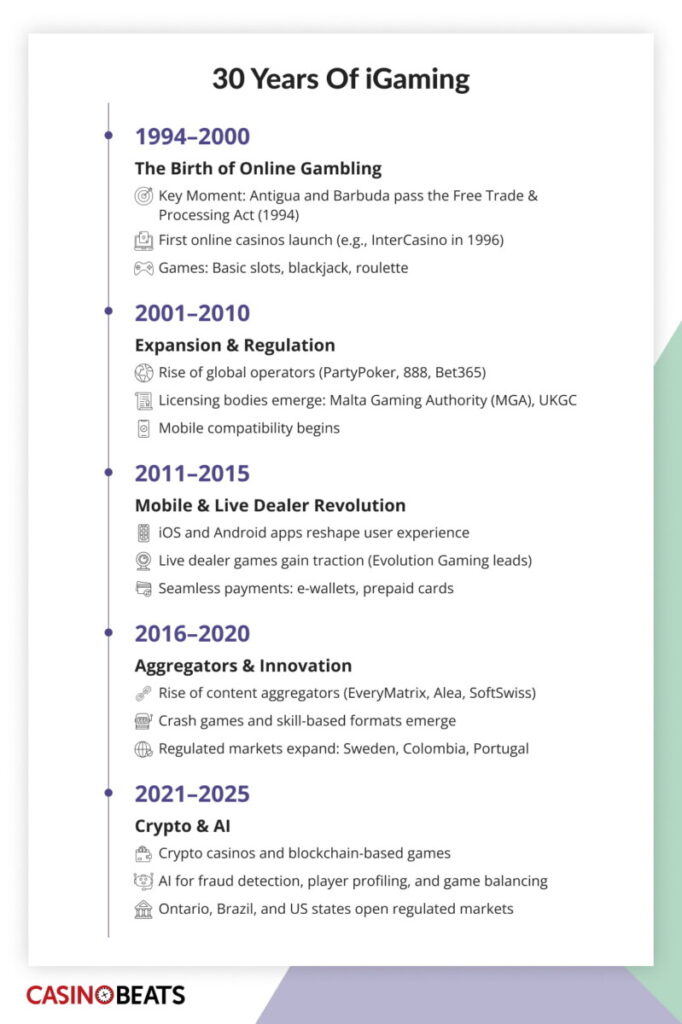
Microgaming was founded in the same year and developed the first fully operational iGaming software platform, which served as the basis for the first real-money online casino, InterCasino, in 1996.
There were hundreds of online casinos after that in the late 1990s, each attracting players from around the world with classic table games and slots.
By 1998, the industry hit another milestone with the launch of Planet Poker’s online poker rooms. The same period also marked the launch of online sports betting, which, unsurprisingly, became even more popular than computer-based casino gaming.
The history of iGaming wouldn’t be complete without the early 2000s poker boom popularized by televised WSOP tournaments and late-night games. This funneled millions of new players online and expanded the industry’s user base.
Around 2010, phones became smarter, and the mobile revolution ushered in live dealer casinos. With the introduction of HTML5, game providers could create games that ran smoothly on smartphones, and operators could adjust their sites to fit all screen sizes and work in mobile browsers.
Recent years have seen crypto and fintech dramatically changing the way people bet online. Blockchain offers the speed and anonymity that traditional banking methods often lack. Now there’s tighter security and provably fair games that threaten the reliance on RNGs.
Types of iGaming Activities
iGaming is an umbrella term that encompasses many verticals. Here’s a breakdown:
Online casinos
iGaming casinos are digital versions of brick-and-mortar casinos, offering a wide variety of games. You’ve got the classics like slots, ranging from simple three-reel games to complex video slots with daring themes and multiple bonus rounds.
Then there are table games, the online equivalent of what you’d find in Las Vegas, like blackjack, roulette, and baccarat. The most immersive part is live dealer games, which use a live video stream to let you play with a real dealer and other players from around the world.
Sports betting
iGaming sports betting is the most prominent vertical. It lets you place bets on everything from global soccer matches and the NBA to obscure horse races.
You can do pre-match betting, where you place your wager before the game even starts, or get into the real action with in-play betting, where the odds change in real time as the game unfolds. A considerable part of this market is also esports betting, where fans bet on professional video game tournaments.
Poker
Online poker rooms became famous in the early 2000s and are still going strong. They let you play against other people in formats like Texas Hold’em and Omaha. The fun part is the tournaments, where you can compete against a massive number of players for a shot at a big prize pool.
Sweepstakes casinos
Sweepstakes casinos are a special category of iGaming platforms that offer casino-style games. The difference is that they operate with virtual currencies such as Gold coins or Sweeps coins instead of betting real money directly. Sweepstakes resemble and function like regular online casinos, but function under a different legal framework, and therefore are not classified as traditional gambling sites.
At sweepstakes casinos, bettors can play slot-style games, table game variants, crash, and instant-win games. Sweepstakes are popular among casual players who want casino-style entertainment without depositing real money upfront, making them a unique faction of the iGaming industry.
Beyond these, there are other cool verticals, including online bingo halls, where you can play for prizes with people from all over the world, and digital lotteries that let you buy tickets for major international jackpots. There’s also the fast-growing fantasy sports vertical, which enables you to build a virtual team and win cash prizes based on how well your players do in real life.
How iGaming Platforms Work
Essentially, iGaming platforms are websites or apps that enable players to access casino games, sports betting, or poker online. Every activity, including sign-up, deposits, betting, and withdrawals, happens digitally.
Nowadays, players look for easy-to-use interfaces where they understand every process. They also want to ensure that online casinos are not rigged and that they can get help when needed.
Behind the scenes, iGaming platforms also involve managing:
- Player accounts (balances, bonuses, and limits)
- Payments (deposits and withdrawals)
- Game providers (third-party iGaming companies that supply games, e.g., Evolution, NetEnt, etc.).
- Security systems (encryption to protect personal and financial data)
Every regulated platform has a customer support service that attends to issues faced by users. If their response or service is not satisfactory, players can escalate the problem to regulatory bodies for assistance.
In simple terms, the iGaming sector combines technology, security, and regulated systems to deliver safe and fair online gaming from anywhere.
What Is RNG in iGaming?
In terms of fairness, casino-style games rely on Random Number Generators (RNGs). These algorithms continuously generate random and unpredictable sequences of symbols or numbers.
When you spin a slot, draw a blackjack card, or play crash-style games, an RNG decides the result instantly (like a dice roll), thus ensuring games are fair and not controlled by the casino. Regulated casinos ensure their RNGs are regularly tested by independent auditors, such as eCOGRA and GLI, to confirm they’re in perfect condition.
Key iGaming Industry Players
The iGaming industry operates as a big ecosystem, with many moving parts working together to deliver games, bets, and payments smoothly. Adequate knowledge of the function each faction provides helps bettors understand what’s happening behind the screen when they place a bet or play baccarat. Here’s an iGaming industry overview of the major stakeholders that you should know about.
Operators
Operators are the brands (casinos and sportsbooks) that players sign up with and play. They manage websites and apps, handle accounts, offer bonuses, process deposits and withdrawals, and provide customer support. Some of the most successful examples include bet365 and Flutter Entertainment, which own and operate multiple betting platforms worldwide.
Game Providers
iGaming providers design and build the games themselves. They are responsible for the slots, table games, live dealer games, and game shows that bettors play.
Operators license these games instead of making them in-house. Well-known providers include Evolution for live casino games, as well as Playtech and NetEnt, for slots and table games. The igaming services they provide are essential to the overall existence of the iGaming business.
Platform & Technology Providers
These companies supply the iGaming software technology that connects everything. They handle player management systems, backend management tools, game integration, mobile compatibility, and security. Without them, casinos couldn’t operate smoothly across devices.
Data & Odds Providers
In sports betting, data and odds providers play a crucial role. They supply live scores, statistics, and odds feeds to sportsbooks. Companies like OddsMatrix and Sportradar are top-class in this field, and their iGaming technology services help ensure betting markets stay accurate and up to date.
Payment & Security Partners
Payment processors facilitate payment services, including deposits and withdrawals, using various methods such as cards, e-wallets, cryptocurrencies, and bank transfers. They work hand-in-hand with security partners to ensure adequate data protection, effective fraud prevention, and secure transactions between players and their betting platforms.
Regulators
Regulators are the most important link in the iGaming chain. They license, oversee, and lay down iGaming regulations that operators follow to protect players. Some of the biggest and most trusted authorities include UK Gambling Commission (UKGC) and Malta Gambling Authority (MGA).
The regulators are the backbone of modern iGaming. Their work enables every other process to be fast, secure, and accessible worldwide.
In 2025, iGaming has grown into a $107.6 billion industry, and is projected to reach $153.57 billion by 2030. The value and expansion work because operators, providers, and regulators each play their part efficiently.
iGaming Regulations: Is it Legal?
iGaming is legal in many parts of the world and is spreading rapidly into regions where it was previously banned or unregulated. However, there’s no single law that governs iGaming globally.
Instead, laws are set country by country and sometimes state by state, which is why iGaming legislation can feel confusing for beginners. In essence, the region where you live determines what you can legally play.
Here is an overview of how iGaming works around the world:
United States
In the U.S., iGaming is regulated at the state level. Some states permit online sports betting and casinos (such as New Jersey and Pennsylvania), while others allow sports betting only. Some states ban online gambling entirely. This state-by-state approach creates a very mixed landscape.
Europe
Europe is the most mature regulated market in the world. Countries license operators individually, but regulators such as the UKGC and MGA set very high standards for fairness, player protection, and responsible gambling. Many international casinos operate under MGA licenses.
Africa
Africa is one of the fastest-growing iGaming regions. Regulation varies widely by country, with some markets, such as those in South Africa and Ghana, being well-regulated. Others are still developing formal frameworks or scaling them up.
South America
iGaming regulation in South America is advancing quickly, with more countries moving toward licensed online betting and casinos to protect players and collect tax revenue. Some countries regulate iGaming on a federal level, while others, such as Argentina, leave it to the states/provinces.
Asia
The iGaming laws in Asia are somewhat complex and inconsistent. Some countries ban iGaming outright, while others operate in areas of legal uncertainty. Other countries, like India, ban real-money games, focusing on promoting educational games instead.
Australia
This region operates on a dual-edged knife, with some factions of online gaming, e.g., sports betting, being legal and regulated. On the other hand, other services and products, such as online casino games, are heavily restricted.
Across all regulated markets, player safety is the priority. Licensed operators must offer tools like deposit limits, self-exclusion, and access to help resources. Without strong responsible gambling measures, casinos can’t get licensed.
Long story short, the golden rule is to check local laws and play only on licensed platforms.
Technology & Payments in iGaming
Modern iGaming platforms are built around fast payments and strong security. If you plan to place a small bet or cash out a big win, the technology working behind the scenes is designed to keep things smooth, safe, and reliable. Here’s an overview of the most common payment methods that you can use in iGaming.
| Payment Method | Deposit Speed | Withdrawal Speed | Primary Benefit | Main Drawback |
|---|---|---|---|---|
| Debit & Credit Cards | Instant | 1–5 business days | Familiar & easy to use | Slower withdrawals; extra verification |
| E-wallets | Instant | Instant to 24 Hours | Very fast & secure | Requires setting up a third-party account |
| Bank Transfers | Instant | 1–3 business days | High security; no card details needed | Withdrawals can still be slow |
| Cryptocurrency | Instant | Near-instant | Privacy & provably fair gaming | Price volatility & technical learning curve |
| Prepaid Cards | Instant | N/A (Rarely supported) | Excellent for budget control | Cannot be used for withdrawals |
Safety, KYC, and Fraud Prevention
For the modern player, peace of mind is just as important as the payouts, making safety and identity verification the most critical components of the iGaming experience. Here are some terms you may run into:
- SSL encryption: Encryption certificates protect your personal and financial data by scrambling it so cybercriminals can’t get access to your sensitive information. Most casinos use this method at the source of their web code, so every page is protected.
- KYC (Know Your Customer) checks: Casinos usually require IDs, proof of address, and payment verification for withdrawals. The KYC process helps prevent fraud, underage gambling, and account misuse.
- Anti-Money Laundering (AML) systems: These systems are implemented to monitor transactions and detect suspicious activity related to money laundering. They help to keep platforms compliant with regulations.
- Blockchain & Provably Fair technology
Some platforms allow players to verify game outcomes themselves. These elements add more transparency and trust.
iGaming Risks: Is Online Gambling Ethical?
iGaming can be fun and engaging. However, like in every other sector that involves money, it’s essential to understand the risks and ethical questions that come with it.
iGaming affects people differently. For some, it’s harmless entertainment, while for others, it can lead to financial stress or unhealthy habits if not managed carefully. Even though the ethical discussion can get complex, iGaming is generally seen as “ethically neutral”, as it stands at the crossroads of individual liberty and social responsibility.
These are the most common risks and dangers associated with iGaming:
- Compulsive gambling: Easy access, fast payments, and gameplay can encourage excessive play and chasing losses.
- Financial loss: Betting real money always carries the risk of losing more than planned.
- Unlicensed operators: Some sites operate without proper regulation or player protection. These platforms pose significant problems, including the theft of player information and funds.
- Data and payment risks: Poor security practices (employed by casinos or players) can expose personal or financial information.
- False expectations: Marketing formats can sometimes blur the line between chasing losses and trying to profit.
Responsible Gambling: Staying in Control While Playing Online
Responsible gambling exists to keep iGaming fun, safe, and within your limits. As online gambling grows, the protection of players has moved from a “nice-to-have” to an “absolute necessity.” Player protection is now a core legal requirement in most regulated markets, and licensed betting platforms must offer tools that help players stay in control.
Here are the most important responsible gambling tools you’ll see on trusted iGaming platforms:
| Tool Type | How It Works | Best Used For |
|---|---|---|
| Self-exclusion | Blocks access to your account for a fixed period (weeks, months, or years) | Taking a total break or stopping permanently |
| Deposit limits | Sets a hard cap on how much money can be uploaded (daily, weekly, or monthly) | Financial budgeting and preventing “chasing losses” |
| Reality checks | Pop-up notifications showing time elapsed and net wins/losses | Breaking “immersion” and regaining perspective |
| Time limits/Session reminders | Automatically tracks session length and alerts you when time is up | Managing time and preventing marathon sessions |
| Self-assessment | Confidential quizzes to evaluate your current gambling behavior | Early detection of potentially harmful gambling habits and changes |
| Support resources | Direct links to helplines (e.g., GamCare) or in-house counseling | Accessing professional help or crisis intervention |
How to Stay Safe and Gamble Responsibly
If you’re a beginner in iGaming, pay attention to these tips to ensure that your gambling experience stays safe and responsible:
- Watch for warning signs: Signs of compulsive gambling include chasing losses, hiding play, betting with money meant for essentials, etc.
- Verify legitimate operators: Check for licenses, clear terms, and online reviews.
- Use responsible gambling tools: Tools such as deposit limits, time-outs, and self-exclusion features exist to promote healthy gambling.
- Practice financial safety: Set a bankroll and budget it accordingly. Always use secure payment methods that you trust and track your spending.
- Know when to step away: Once gambling stops being fun or feels essential to your well-being, it is no longer appropriate. Step away!
The Future of iGaming
The industry’s history so far already tells us what to expect from the future of iGaming. Mobile gaming has changed how people play games remotely, but wearable devices are set to change it even more.
VR headsets and glasses will likely take live dealer gaming from basic live streams to a more “near physical” experience. Of course, VR casinos will require more work, but the iGaming industry has been trialing them since 2015.
Esports betting is another area of growth in the iGaming industry that will likely attract a fan base as large as sports betting. It is already generating substantial revenue and offering some of the biggest tournament payouts in any vertical. Fintech and open banking iGaming trends also solve the issue of transaction speed.
Yet crypto casinos will likely outshine these in terms of transparency and anonymity. There is great potential for global regulation and standardization, but that may be many decades away, as individual countries still struggle over whether to welcome this industry fully.
Conclusion
So, what is iGaming? At its core, it’s the digital evolution of traditional gambling. What started as a simple platform on the Isle of Man in 1994 has exploded into a multi-billion-dollar iGaming industry that influences entertainment, finance, and technology worldwide. We’ve seen it all: from the rise of mobile casinos to the adoption of cryptocurrencies and the introduction of new verticals like esports betting. And it will only get bigger.
Now that you have iGaming explained in simple terms, you should feel more comfortable and make better-informed decisions. In any case, don’t forget to play responsibly.
FAQs
-
Is iGaming legal?
The legality of iGaming depends on where you are playing from. Some countries allow online gambling nationwide, while others regulate it by state or region, and a few ban it entirely.
-
What types of games are included in iGaming?
iGaming includes online casino games (slots, blackjack, roulette), poker, sports betting, esports betting, bingo, and sweepstakes-style games.
-
What is the meaning of iGaming?
iGaming simply means “internet gaming.” This includes gambling and betting activities conducted online.
-
How does iGaming work?
Players create an account at an online casino or sportsbook, deposit money, choose a game to bet on, and play online.
-
Is iGaming the same as online gambling?
Yes, the terms are often used interchangeably. However, iGaming is the broader industry term.
References
- The iGaming Certification Specialists (eCOGRA)
- Gaming Laboratories International – Leading Testing & Certification Services (Gaming Labs)
- SPORTS BETTING DATA ODDS FEEDS & APIS (Odds Matrix)
- THE SPORTSTECHNOLOGY COMPANY (Sportradar)
- Helping you get information about gambling in Great Britain and find support when you need it (Gambling Commission)
- Competence. Excellence. Innovation. (Malta Gaming Authority)
- Online Gambling Market (2025 – 2030) Size, Share & Trends Analysis Report By Type (Sports Betting, Casinos, Poker, Bingo), By Device (Desktop, Mobile), By Region (North America, Europe, Asia Pacific, Latin America, Middle East & Africa), And Segment Forecasts (Grand View Research)