


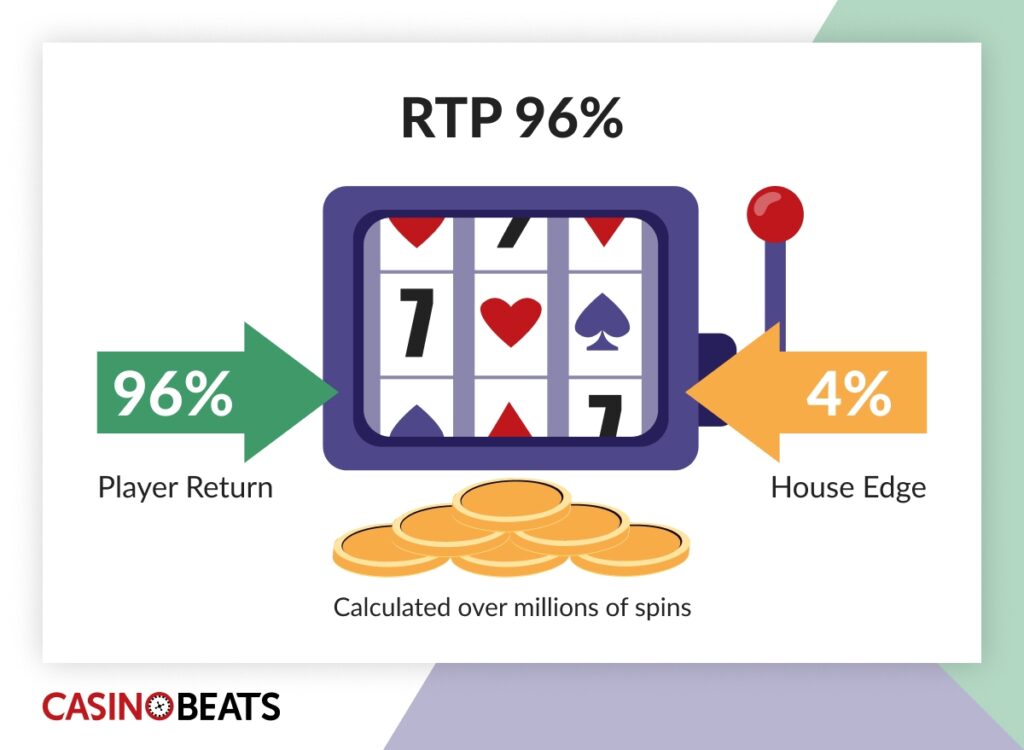
RTP in slots stands for Return to Player, a percentage that shows how much of all wagered money a slot machine is designed to pay back to players over time. For example, a slot with a 96% RTP is theoretically expected to return $96 for every $100 wagered. However, these figures are calculated over millions of spins by an RNG (Random Number Generator), meaning individual sessions will vary.
In this guide, you’ll learn how to spot high RTP games, understand the difference between RTP, RNG, and volatility, and use this data to make better choices at the casino.
Key Beats
- RTP of slot machines is a theoretical percentage calculated over millions of spins using RNG (Random Number Generator) software. While it guides long-term payouts, it does not guarantee specific results in a single session.
- An RTP slot of 96% is the industry average for online slots. Anything below 95% is considered a low payout game, while 97% or higher is a high RTP slot and offers better value over time.
- The RTP and House Edge always equal 100%. If a slot has a 96% return, the casino’s mathematical advantage is 4%.
How Does RTP Work in Slots?
While we know that RTP in slots stands for “Return to Player,” understanding its mechanics is key to your strategy. The RTP of slot machines is not a simple guess; it is a mathematical certainty programmed into the game’s software to ensure fairness over the long run.
To fully grasp how RTP slot online games function, you should consider these four pillars:
- Long-term statistical averages: The slot machine RTP is calculated over millions of spins. This explains what slot RTP is in a macro sense — it is a community average, meaning individual sessions can vary widely from the theoretical percentage.
- The power of RNG: Every RTP slot is governed by a Random Number Generator. This ensures each spin is independent, making it impossible to predict the RTP of slot machine outcomes based on previous wins or losses.
- The house edge connection: To understand the RTP slots’ meaning, you must look at the casino’s share. The difference between 100% and the game’s RTP is the “house edge.” For example, if the slot RTP is 96%, the casino has a built-in 4% advantage.
- Compliance and transparency: Licensed developers must prove their RTP in slots is accurate through rigorous third-party testing. This ensures that the RTP slot you play online is transparent and fair.
What Is the Difference Between RTP and House Edge?
Essentially, there is no mathematical difference between the two; it’s just a different way to describe the same odds. While the RTP slot tells you what players can expect back, the house edge is how the casino determines its long-term profit.
To understand the RTP slots meaning, you simply have to look at the same figure from two opposite perspectives:
- RTP: If a slot machine RTP is 96%, it is a player-focused way of saying you theoretically keep 96% of wagers over time.
- House Edge: If the RTP in slots is 96%, the house edge is 4%. This is the percentage of total wagers the house will retain.
If a game has a house edge of 5%, then the RTP of slot machines in that category is 95%. Casinos usually advertise the slot RTP because it sounds more player-friendly. It is much more encouraging to know you are playing an RTP slot online with a 97% return than to focus on the 3% the casino keeps.
How Many Levels of Slot RTP Exist?
When researching what is a good RTP for slots is, it helps to categorize games into three main tiers. This allows you to choose an RTP slot that matches your budget and playing style.
| RTP Level | Percentage Range | RTP Slots Meaning |
|---|---|---|
| High RTP | 97% – 99% | Maximum theoretical return; ideal for long sessions |
| Medium RTP | 95% – 96.9% | The industry standard; balanced risk and rewards |
| Low RTP | Below 95% | Usually paired with massive progressive jackpots |
High RTP Slots (97%+)
If you are focused on what slot RTP is for the sake of efficiency and longevity, high RTP slot online games are your best bet.
Pros
-

Best long-term value for players
-
Bankroll lasts longer (lower risk)
-
Ideal for clearing casino bonus wagering requirements

Cons
-
Often have smaller maximum win potential
-
May have simpler gameplay/fewer bonus features
-
Rarely include massive progressive jackpots

Medium RTP Slots (95% – 96.9%)
This is the “sweet spot” for most developers. When people ask what does RTP mean in slots in a real-world setting, they are usually looking at this category.
Pros
-
Perfect balance between risk and entertainment
-
Feature-rich with high-quality graphics and bonuses.
-
Most popular and widely available titles
Cons
-
Not as mathematically efficient as “High” games
-
Can still have “dry spells” depending on volatility
-
Average returns compared to dedicated “grinding” slots
Low RTP Slots (Below 95%)
A lower slot machine RTP is often a trade-off for the chance to win a life-changing sum of money. Knowing what RTP on slot machine titles in this bracket is helps manage your expectations.
Pros
-
Access to multi-million dollar progressive jackpots
-
Most advanced mechanics and licensed themes
-
Potential for huge multipliers in a single spin
Cons
-
Highest risk of losing your bankroll quickly
-
Longest losing streaks are common
-
Lower rtp in slots means less money back over time
What Does Volatility Mean in Slots And How Does It Differ From RTP?
While the slot RTP tells you the theoretical return, online slot volatility (also called variance) refers to the frequency and size of the payouts you experience during a session. There are three levels of slot volatility:
- Low Volatility: These games provide frequent payouts, but usually in smaller amounts. They are the best RTP slot online options for players with a smaller bankroll who want a longer session.
- Medium Volatility: A “sweet spot” that offers a mix of small wins and occasional larger payouts. This is the most common setting for an average RTP slot.
- High Volatility: These slots pay out infrequently, but when they do, the wins are often much larger. Highly volatile games often feature big jackpots and complex bonus rounds.
RTP vs. Volatility: The Key Difference
The main difference lies in what each figure measures:
- RTP (The “What”): This is the potential percentage returned to players over millions of spins (e.g., a 96% RTP slot). It is a long-term mathematical average.
- Volatility (The “How”): This is the “personality” of the game. It determines the size and regularity of the payouts you see in real-time.
For example, two games can both have a 96% slot machine RTP, but one could be low volatility (giving you many small wins) while the other is high volatility (giving you many losing spins followed by a huge win). Understanding what RTP means in slots alongside volatility, is the only way to truly master your casino strategy.
Factors Influencing RTP in Slots
The RTP of slot machines isn’t just a random number; it is a meticulously calculated figure based on millions of spins. Everything from the base game to the most complex bonus rounds is considered to determine the final slot machine RTP.
Behind the scenes, developers fine-tune various elements that dictate how the money is returned to the player community. If you want to understand what RTP in slots is beyond the basic percentage, you need to look at these key components:
Bonus rounds & features
The more complex a game is, the more its RTP slot percentage is spread out. High-paying bonus rounds often mean the base game pays out less frequently.
Slot volatility
As we discussed, volatility determines the “swing” of the payouts. It is a major factor in how the RTP slot online experience feels to the player.
Progressive jackpots
In many cases, a portion of the slot RTP is diverted to fund the jackpot. This is why famous jackpot slots often have a lower base RTP.
Gamble functions
Some games allow you to “double or nothing” your wins. While exciting, these functions can influence your personal return compared to the theoretical RTP in slots.
Symbol distribution
The frequency of high-paying symbols versus low-paying symbols on the virtual reels is what ultimately creates the RTP of slot machines.
Don’t let a high RTP percentage blind you. A slot can have a great return on paper, but if that value is all “hidden” in a jackpot or a bonus round that only hits once every 500 spins, your balance will disappear fast. If you want a steady session with more “play time” for your money, skip the complex jackpot hunters and stick to simpler games where the payouts happen right there in the base game.
Most Popular Online Slots and Their RTPs
Choosing the right game depends on your goals. Below, we have categorized some of the most famous titles to help you understand what a good RTP for slots is and how they compare in the real world.
Top High RTP Slots
If you are looking for an RTP slot online with the best possible theoretical return, these high RTP slot games are the industry leaders. They are perfect for longer sessions and stretching your bankroll.
| Slot Game | Slot RTP | Volatility | What To Know |
|---|---|---|---|
| Ugga Bugga | 99.07% | Low | Playtech’s hidden gem; the king of high RTP slots |
| Mega Joker | Up to 99% | High | Old-school fruit slot with an incredible rtp slot rate |
| Blood Suckers | 98% | Low | Vampires and value; one of NetEnt’s highest returns |
| 1429 Uncharted Seas | 98.5% | Low | Beautifully designed with very frequent, smaller wins |
RTP can vary slightly depending on where you play. Check the game info panel or paytable before you spin. Check out trusted online casinos to find those with clearly listed RTPs.
Popular Medium & Low RTP Slots
Many players choose a slightly lower slot machine RTP in exchange for more exciting bonus features or massive payout multipliers. Understanding what RTP on slot machine games in this category is key to managing your risk.
| Slot Game | Slot RTP | Volatility | What To Know |
|---|---|---|---|
| Book of Dead | 96.21% | High | A high-volatility classic with enormous win potential |
| Starburst | 96.09% | Low | Super simple and iconic; an excellent slot for beginners |
| Mega Moolah | 88.12% | High | Lower rtp in slots but offers world-record jackpots |
| Gonzo’s Quest | 95.97% | Medium | The industry standard for balanced, feature-rich gameplay |
3 Tips On How to Pick the Right RTP and Volatility Slots Online
- Balance your risk with slot volatility: A good starting point is using 96% as your benchmark for what is a good RTP for slots.
- For frequent wins: Look for a high RTP slot (97%+) paired with low volatility. This is perfect if you want to extend your session and see your bankroll tick over frequently.
- For big hits: If you are chasing a substantial win, you might choose a lower slot machine RTP (under 95%) with high volatility.
- Consider your bankroll: Your budget should dictate what RTP on slot machine titles you choose is
- Small bankroll: Stick to high RTP and low/medium volatility. Your goal is to maximize playing time and stay in the game.
- Flexible budget: You can afford the “swings” of lower RTP games that offer massive progressive jackpots.
- Test the math with slot demos: Before wagering real money, use free demos to get a feel for the RTP slots in action. Demos allow you to experience the frequency of bonuses and the “dry spells” of a game without any financial risk.
Start by getting a real feel for the game yourself rather than just looking at the numbers on the screen. While a high RTP looks great on paper, taking a slot for a 50-spin “test drive” in demo mode lets you see if the vibe actually fits your personal playing style. It is much smarter to use free play to see if the payouts feel as frequent as the stats suggest, giving you the chance to spot a “hungry” game before you ever risk your own money.
Conclusion
At the end of the day, understanding what RTP stands for in slots is about transparency. The slot RTP is a tool to help you make smarter choices, manage your expectations, and guide you on how to win on slot machines. Whether you are looking for an RTP slot online for a long session or a high-volatility game for a quick thrill, always prioritize entertainment value.
Remember that all slots have a built-in house advantage, and the best approach is to play within your financial comfort level and practice responsible gambling at all times.
FAQs
-
What is a good RTP for slots?
A good RTP for slots usually starts at 96% or higher. This is considered the industry average for an RTP slot online. Anything above 97% is excellent, while games below 95% are generally considered to have a low return unless they offer a massive progressive jackpot.
-
What does 96% RTP mean?
A 96% RTP means that, in theory, the game will return $96 for every $100 wagered over millions of spins. The remaining $4 is the “house edge” or the casino’s profit margin.
-
What slot has 99% RTP?
Ugga Bugga by Playtech (99.07%), Mega Joker by NetEnt (up to 99%), and Book of 99 by Relax Gaming.
-
What is the best strategy for playing RTP slots?
The best strategy is to match the slot machine RTP and volatility to your budget. If you want to play for a long time, choose a high RTP (97%+) with low volatility. If you are hunting for a big win, you can choose a lower slot RTP game that features high volatility and large multipliers.
-
How to find RTP on a slot machine?
For online slots, open the game’s “info” or “help” (usually marked with an ‘i’ or ‘?’) and scroll through the paytable or rules. Most licensed providers are required to display slot machine RTP clearly in this section.
-
How do you calculate RTP on a slot machine?
To calculate the RTP in slots, developers divide the total amount returned to players by the total amount wagered over a vast number of spins. For a player, the formula is: (Total Win / Total Bet) x 100 = RTP%. However, this only reflects your personal session, not the game’s theoretical slot machine RTP.
-
Is RTP the same as payout percentage?
Yes. Both terms describe the same thing: the theoretical percentage of wagers that a game will pay back to players over time.
-
How does RTP differ from volatility?
The difference is simple: slot RTP is the “what” (how much you get back on average), while volatility is the “how” (the frequency and size of those wins). Knowing what is slot RTP tells you about the game’s fairness, while volatility tells you about the risk level.
-
Can casinos change the RTP of online slots?
Generally, no. Online casinos do not own the games; they “rent” them from developers like NetEnt or Microgaming. While some developers offer “variable RTP” versions of their games, the casino must still display the RTP value clearly, and it cannot be changed during a session.