


Card counting is one of the most controversial strategies in casino gambling, often misunderstood and frequently portrayed inaccurately in movies and pop culture.
This page breaks down what card counting in casino really is, why casinos ban players who use it, and explains the legal reality behind why a strategy that isn’t illegal can still get you removed from the table.
Key Beats
- Card counting in a casino itself is not illegal – using your brain to track cards is allowed, but casinos can still take action against you.
- Casinos can refuse service – as private businesses, casinos can ban players who are using card counting in blackjack for advantage play even if it’s not against the law.
- Ignoring bans or trespass warnings has consequences – continued play after being asked to leave can lead to arrest or legal action.
What Is Card Counting in a Casino?
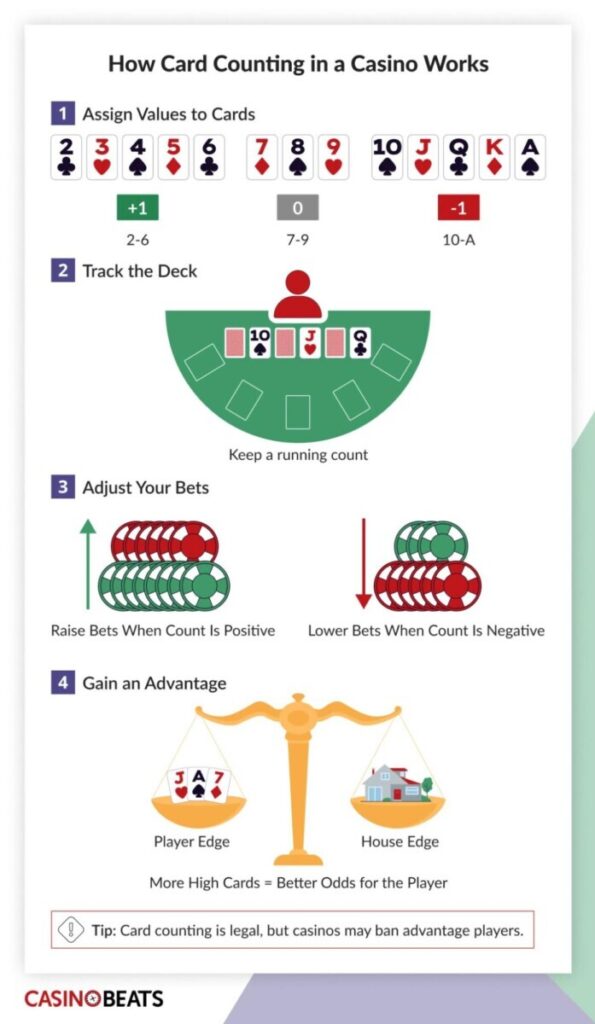
Card counting is a strategy used in blackjack to track the ratio of high to low cards remaining in the deck. Players assign point values to cards as they’re dealt, adjusting their bets when the odds favour them.
Contrary to Hollywood myth, it doesn’t require genius-level math or hidden earpieces. All you need is a sharp memory and some serious focus.
The idea of card counting in casino is simple – when more high cards remain (10s, face cards, Aces), the player has a better chance of hitting blackjack or beating the dealer. It tilts the house edge in the player’s favor and threatens the casino’s profit margin.
Why Casinos Can Ban Players for Counting Cards
Casinos can legally ban players for card counting because it threatens their profits, even though it’s not illegal.
The casino problem is that blackjack already has a low house edge – around 0.5% when played optimally. Skilled card counters can flip that edge, in their favour, by up to 2%. That’s quite a swing!
So, to better understand why can casinos ban you for card counting, we single out seven reasons:
- Flipping the house edge – Skilled card counters can gain a small advantage over the house, which accumulates over time and reduces casino profits.
- Unusual betting patterns – Sudden increases in bet size when the deck is favorable are a red flag for staff.
- Suspicious behavior – Dealers, pit bosses, and floor managers monitor players who pay excessive attention to cards, the discard tray, or betting sequences.
- Potential for advantage play teams – Casinos are wary of players collaborating or using signals to exploit the deck.
- Protecting game integrity – Casinos aim to keep games fair for all players; advantage play disrupts expected outcomes.
- Internal blacklists – Players identified as advantage players may be tracked across multiple locations and banned proactively.
- Preventing profit loss – Even a small consistent edge by a counter can translate into large long-term losses for the casino.
Casinos don’t require proof – they can ban anyone for any reason. They also share intel, so if you’re blacklisted at one major casino, you will likely be forbidden at them all. Your only option might be to play blackjack online – and card counting doesn’t transfer well to the Internet.
How Casinos Detect Card Counters in Blackjack
Casinos have a host of anti-card-counting tactics – and they’re not afraid to use them. Surveillance teams monitor tables for unusual betting patterns. The eye in the sky (casino surveillance) is always on alert for low wagers on bad counts, followed by big jumps when the deck gets hot.
Every employee knows to look for card counters. Dealers are trained to spot players who seem too interested in the discard tray. Pit bosses and floor staff observe player behavior, not just results. If they suspect you’re card counting, here’s what they might do:
- Shuffle early, killing your count before you can use it.
- Restrict mid-shoe entry to prevent new players from joining a favorable deck.
- They may insist on your flat-betting to keep bets consistent.
- Using automatic shufflers so it’s impossible to track the deck(s).
- Ask you to leave – politely or not!
Some casinos will even escort suspected card counting players off the premises and mark their player profiles with internal notes like ‘advantage player’ or ‘heat’. Get caught enough times, and you’ll be on a nationwide watchlist and banned for life.
Is Counting Cards Illegal in Casinos?
Card counting is not illegal in most jurisdictions, including the United States and the UK. The reality is that you’re using your brain, not a device. The law can’t punish you for thinking strategically.
However, the line gets blurry fast. If you use technology, or are part of a team with elaborate signals, or hidden devices, then you’ve crossed it. This type of advantage play is illegal and considered cheating.
Casinos are private businesses, which means they can legally refuse service to anyone, even if you haven’t broken any laws. If you push your luck after being asked to leave, you could be charged with trespassing.
Also, if you’re caught card counting in certain tribal casinos or overseas jurisdictions, you could face more substantial legal consequences. In rare cases, civil suits or fines have been issued for players seen as ‘cheating by advantage’.
Points to take away:
- Is card counting cheating? No, but casinos treat it as if it were.
- Is it illegal? No, unless you use tools or collaborate in ways that cross legal boundaries.
- Can you get arrested for it? Only if you ignore a ban or a trespass warning.
Is Card Counting Worth Getting Banned From Casinos?
Card counting can give you a small edge over the house, but the potential rewards are limited compared to the risk of being banned. Casinos track advantage players closely through surveillance, shared lists, and anti-counting measures like early shuffles or flat betting. If caught, you may be asked to leave, banned permanently, or blacklisted across multiple casinos.
For most players, the potential profit doesn’t outweigh the consequences. Safer alternatives to reduce the house edge include using basic blackjack strategy charts or focusing on legal advantage play techniques. These methods allow you to improve your game without risking a ban.
Summary
To be honest, if you’re cool enough and clever enough at card counting, you already know the score. All you fear is a new dealer, a shuffled shoe, and a pit boss with years of experience.
That cozy house edge is what keeps the betting business ticking over. Disrupt that with card counting in casinos and your comped tickets to the big show are getting re-allocated – as are you (probably).
But hey! If you’re bossing it at the blackjack table, with a crafty count, we say crack on – play responsibly, crunch the numbers and cash the chips. Whether you’re wondering what is card counting, how do casinos catch card counters, or asking is counting cards illegal in blackjack, remember: it’s not truly illegal unless you use devices or team strategies. And if you’ve ever asked yourself why is counting cards cheating, now you know it’s not cheating in the legal sense, but casinos treat it as a serious advantage play.
FAQs
-
Do casinos ban you for counting cards?
Yes, casinos can ban you for counting cards because it shifts the odds in the player’s favor, even though it’s not illegal.
-
Can casinos take your winnings for counting cards?
No, casinos generally cannot seize your winnings, but they can refuse service, ask you to leave, or ban you from playing.
-
Why do casinos ban you from winning?
Casinos ban players who gain an advantage, like card counters, to protect their profit margins and maintain a fair game for other customers.
-
Is card counting illegal in blackjack?
No, card counting is not illegal if done using your memory and mental calculation; using devices or collusion is illegal.
-
Do professional poker players count cards?
Not usually, poker is a very different game. In blackjack, you’re playing against the house with a fixed deck, which makes card counting viable. In poker, you’re playing against other players, and the deck is shuffled every hand.
-
Does card counting work in online casinos?
In most cases, no. Online blackjack games use Random Number Generators (RNGs) and shuffle the virtual deck after every hand, making counting pointless. However, live dealer blackjack sometimes uses real decks and slower shuffling, which makes counting theoretically possible.
-
Are there legal alternatives to card counting?
Some players use basic strategy charts to reduce the house edge. Others join advantage play teams that look for promos, comps, or errors to profit legally without counting cards.