



A top US gambling industry chief has called on the Commodity Futures Trading Commission to stop defending prediction markets platforms and stick to regulating the financial markets.
The comments came from Bill Miller, the CEO of the Washington DC-based American Gaming Association, reported the Washington Times.
“[Prediction markets] are deceptively calling sports betting financial contracts and investing, despite messaging designed to beguile policymakers and the public,” Miller said. “They are increasingly being exposed as backdoor sports betting operations.”
Miller was addressing the Senate’s Commerce, Science, & Transportation Subcommittee on Consumer Protection, Technology, and Data Privacy in a session on May 20.
The hearing comes as states continue to fight back against the CFTC. The regulator asserts that it alone has the power to regulate prediction markets.
New Jersey has stated it wants to take its own legal battle against Kalshi to the Supreme Court. Prosecutors hope the court will help force the operator to adhere to its sports betting rules in the Garden State.
US Gambling Chief: CFTC Regulations Claims Are ‘Laughable’
CFTC Chairman Michael Selig has recently stated that prediction market platforms like Polymarket and Kalshi are “financial markets.” Conventional casinos and sports betting providers, meanwhile, are classified as “entertainment” providers, Selig said.
Sports leagues like the NFL have pushed back, calling for the CTFC to ban a large range of sports-related contracts. The CTFC says it is speaking to “all the professional leagues” about ways to stop insider trading on prediction markets. But Selig remains bitterly opposed to the idea of letting states have ultimate control over the matter.
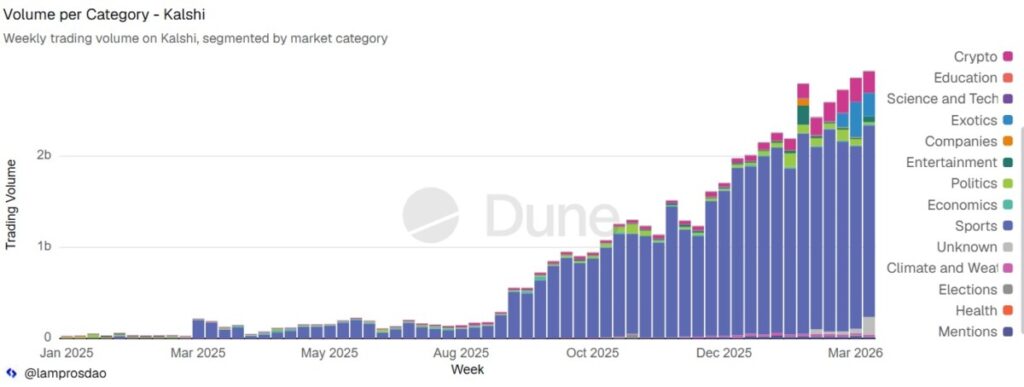
The CTFC exists to “regulate markets critical to the functioning of the nation’s economy, not to regulate Monday Night Football,” Miller told the subcommittee.
The CFTC has a workforce of 500 employees, he said. The idea that “somehow or another they could manage and facilitate a nationwide sports betting network is laughable,” Miller added.
But prediction markets representatives refuted the claims, stating that major operators self-regulate activity on their platforms.
The former Congress Financial Services Committee Chairman Patrick McHenry, now a senior adviser for the Coalition for Prediction Markets, said platforms use higher surveillance standards than casinos.
Prediction market operators proactively ban users, he said. And the CFTC requires operators to use know-your-customer and anti-money laundering protocols.
McHenry also argued that a dozen states that allow gambling have thus far failed to ban advertising that could reach the eyes of children.
Prediction markets, by contrast, have enacted “a complete ban of anyone under 18 from touching these products,” the former lawmaker said.
Coalition members have adopted “higher standards” than those used by most “average” states, McHenry added.
No ‘Federal Department of Gambling’
The AGA chief said financial regulators should stay away from sports betting supervision.
Miller said that Congress never planned to create a “Federal Department of Gambling” when it launched the CFTC in 1974.
He noted that 41 state attorneys-general have told the CFTC to “knock it off.” These attorneys-general say states retain the right to regulate prediction markets, Miller added.
The regulator is exerting “control and dominance in a world that they, quite frankly, have no business being in,” Miller said.
Senator John Hickenlooper appeared to agree with Miller’s argument. He took issue with McHenry’s assertion that the CFTC has the capacity to supervise the market.
Hickenlooper retorted: “You’re the first person who’s told me you think that they think the CFTC is up to the standards.”