

Is it legal to gamble at online casinos in the U.S.? The answer is more complicated than you might think. This casino bill tracker and guide breaks down where online gaming is legal or otherwise, and where bills are still in progress. While this guide provides state gambling updates, players should always double-check their respective state’s iGaming laws before playing online.
Key Beats
- Online casino gaming legality in the U.S. is decided on a state-by-state basis. There’s no single federal law, as each state decides whether to allow or prohibit online sites, poker, and sports betting.
- Eight states already allow iGaming: New Jersey, Delaware, Pennsylvania, Michigan, Connecticut, West Virginia, Rhode Island, and Maine.
- Other states, such as Illinois, Massachusetts, and New York, are weighing new online casino laws in 2026.
Is Online Casino Gambling Legal in the U.S.?
A single federal law does not govern online casino gambling in the US. Its legality is determined on a state-by-state basis. Every state has its own regulatory and compliance codes and can decide what forms of gambling are permitted.
In Utah, all forms of gambling are banned. In neighboring Nevada, Las Vegas never sleeps, a reflection of diverse state-by-state gambling laws across the country.
Are Offshore Sites Legal?
The legality of offshore sites is a bit of a gray area. Federal law doesn’t explicitly prohibit individuals from playing on offshore platforms; however, state legislatures in many states restrict or ban casino sites from operating.
Offshore platforms are often located in jurisdictions like Curaçao, Malta, or Panama. These sites offer access to games and betting options, along with welcome bonuses and loyalty programs.
U.S. States Where Online Casinos Are Legal
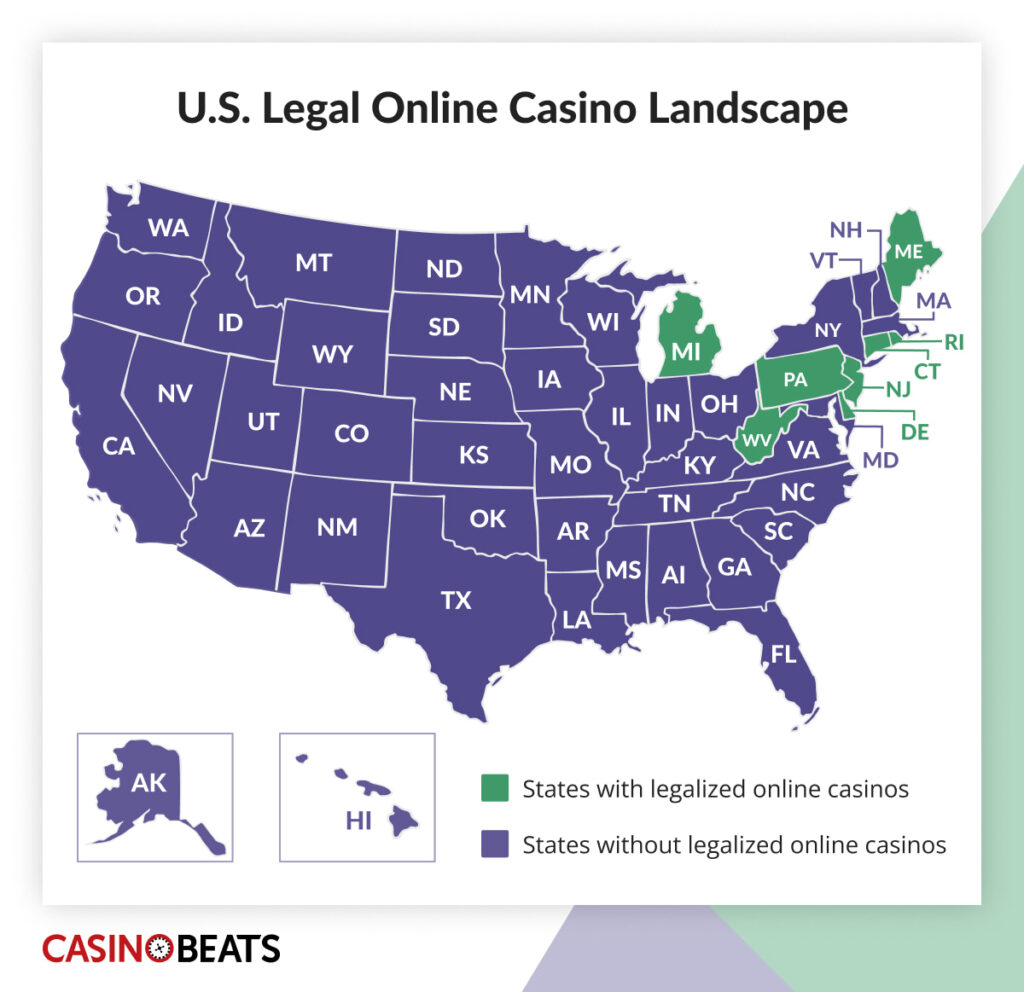
As of 2026, eight states have legalized online casinos. These are the states of New Jersey, Delaware, Michigan, Pennsylvania, Connecticut, Rhode Island, West Virginia, and Maine. The sites are fully regulated and operational, except in Maine, where iGaming has been legalized but the market has yet to launch. Each jurisdiction has its own licensing and taxation framework, including programs for responsible gambling.
For the rest of the country, iGaming legislation varies from state to state. Many other states permit sports betting, lotteries, land-based casinos, and sweepstakes-style gaming, but draw the line at online casino legalization.
U.S. State-by-State iGaming Legal Tracker
Discover where you can and where you can’t officially gamble in our online casino gambling legal tracker in the U.S.
| Legal Online Casinos by State | New Jersey (NJ), Delaware (DE), Pennsylvania (PA), Michigan (MI), Connecticut (CT), West Virginia (WV), Rhode Island (RI), Maine (ME) |
| States With Active Online Casino Bills | Illinois (IL), Massachusetts (MA), New York (NY), New Hampshire (NH), Texas (TX) |
| States With No Online Casino Bills | Alabama (AL), Alaska (AK), Arizona (AZ), Arkansas (AR), California (CA), Colorado (CO), Florida (FL), Georgia (GA), Hawaii (HI), Idaho (ID), Indiana (IN), Iowa (IA), Kansas (KS), Kentucky (KY), Louisiana (LA), Maryland (MD), Minnesota (MN), Mississippi (MS), Missouri (MO), Montana (MT), Nebraska (NE), Nevada (NV), New Mexico (NM), North Carolina (NC), North Dakota (ND), Ohio (OH), Oklahoma (OK), Oregon (OR), South Carolina (SC), South Dakota (SD), Tennessee (TN), Utah (UT), Vermont (VT), Virginia (VA), Washington (WA), Washington, D.C. (DC), Wisconsin (WI), Wyoming (WY) |
Alabama (AL)
Alabama has repeatedly rejected efforts to introduce a state lottery or commercial casinos, leaving only three tribal casinos operated by the Poarch Band of Creek Indians as legal gambling options. The state does not permit commercial casinos, sports betting, or a lottery, and online casino legalization remains off the table in 2026.
Despite Alabama’s strict gambling laws, sweepstakes casinos continue to operate in a legal gray area, even as they face an unprecedented number of lawsuits from residents seeking to recover gambling losses. While no immediate legislative changes are expected in 2026, the growing legal pressure and potential involvement of the state attorney general could significantly impact the future of sweepstakes-style gambling in Alabama.
Current legislation
- ⛔ No active online casino bills. Efforts to establish a state lottery have repeatedly failed, with no progress expected in 2026.
Alaska (AK)
Alaska has some of the strictest gambling laws in the country. The state has no casinos, though charitable gaming and pull-tabs are allowed. Legal online gaming options are still not available to residents.
Current legislation
- ⛔ There are no active bills seeking to open any form of gambling. Proposal HB145 to legalize sports betting is currently stalled.
Arizona (AZ)
Arizona has more than two dozen tribal casinos and launched online sports betting in 2021. While legislation has yet to take off, players can access offshore Arizona online casinos to play their favorite games.
Current legislation
- ⛔ No current proposals to launch legal online casinos.
Arkansas (AR)
Arkansas permits only four commercial land-based casinos, runs a state lottery, and offers legal online sports betting. iGaming has yet to be legalized.
Current legislation
- ⛔ No active online casino bills.
California (CA)
California is home to hundreds of tribal casinos and licensed cardrooms. Multiple attempts to regulate online poker and casinos have failed, including ballot initiatives in 2016 and 2022, and California online casino operators continue to face strong opposition from tribal and commercial stakeholders.
California’s sweepstakes casino market contracted ahead of the statutory ban on dual-currency sweepstakes casinos, which took effect January 1, 2026, with many platforms exiting the state or limiting access, though some continue offering free-to-play Gold Coin modes for entertainment.
Current legislation
- ⛔ No active iGaming bills.
Colorado (CO)
Colorado offers commercial and tribal casinos in mountain towns, as well as legalized sports betting, since 2020. However, the state continues to resist the legalization of online gaming.
Current legislation
- ⛔ No active bills.
Connecticut (CT)
Connecticut launched online gaming in 2021 through the Mohegan and Mashantucket Pequot tribes. Both tribes offer regulated online slots, table games, and sports betting. Currently, there haven’t been any significant state gambling proposals for expansion.
Current legislation
- ✅ Online casino gaming is legal and regulated.
Delaware (DE)
Delaware was one of the first states to launch iGaming in 2013. The market operates through the state lottery in partnership with licensed casino operators.
Current legislation
- ✅ Online gaming sites remain legal under state lottery oversight.
District of Columbia (Washington D.C.)
Washington, D.C., permits lottery and sports betting but has no casinos. Playing online remains prohibited in the nation’s capital.
Current legislation
- ⛔ No active online casino bills.
Florida (FL)
Florida allows tribal casinos through the Seminole Tribe and recently launched expanded sports betting under a tribal compact. For fans of jackpot slots and American roulette, online casinos in Florida continue to offer real money.
In 2025, the Florida Gaming Control Commission (FGCC) has intensified enforcement against illegal gambling in Florida, seizing nearly $15 million and over 6,700 illegal slot machines, more than double the previous year. New bills and regulatory measures aim to tighten penalties and crack down on unregulated operators, highlighting the state’s ongoing efforts to control online gray-market gambling.
Current legislation
- ⛔ No active proposals to legalize iGaming. Recent enforcement and new bills focus on cracking down on illegal gambling rather than legalizing online casinos.
Georgia (GA)
Georgia allows a state lottery but does not have any casinos. Lawmakers frequently discuss expanding gambling, but bills rarely advance.
Current legislation
- ⛔ No active bills. Proposals for casinos and sports betting have stalled in the past.
Hawaii (HI)
Hawaii has no casinos and does not permit a lottery. Occasional efforts to introduce gambling have failed. Cultural opposition to casinos remains strong.
Current legislation
- ⛔ No active casino bills. SB1507 would permit limited forms of online gambling; this bill stalled in committee in 2025.
Idaho (ID)
Idaho permits tribal casinos with limited offerings but lacks a framework for commercial casinos or online gaming. Efforts to expand gambling beyond tribal operations have consistently failed. The state constitution bans most forms of gambling, including online casinos.
Current legislation
- ⛔ No active iGaming bills.
Illinois (IL)
Illinois does not yet offer legal iGaming. Residents can access land-based casinos and a state lottery, but online slots and table games remain off the table.
Indiana (IN)
Indiana legalized commercial land-based casinos which are overseen by the Indiana Gaming Commission. The state has also allowed sports betting in 2019. Legalizing iGaming is the missing piece to the puzzle. In the meantime, residents have the option to play at offshore Indiana casino sites offering popular games and secure payments.
Current legislation
- ⛔ No active bills. A 2025 proposal to legalize iGaming was shelved.
Iowa (IA)
Iowa has commercial and tribal casinos, legalized sports betting, and a state lottery, but online casino gaming remains illegal in 2026. While no online casino legislation has advanced, lawmakers are considering a bill that would expand the authority of the Iowa Racing and Gaming Commission to crack down on unlicensed gambling platforms, including sweepstakes casinos in Iowa, signaling increased regulatory scrutiny rather than market expansion.
Current legislation
- ⛔ No online casino bills. Proposed legislation focuses on enforcement against unlicensed gambling rather than legalization.
Kansas (KS)
Kansas legalized sports betting in 2022 and operates land-based casinos. But internet-based gaming remains prohibited.
Current legislation
- ⛔ No active bills.
Kentucky (KY)
Kentucky offers horse racing, a lottery, and charitable gaming. The state recently legalized sports betting in 2023. Online gaming is not permitted.
Current legislation
- ⛔ No active iGaming bills.
Louisiana (LA)
Louisiana has a thriving gambling scene that puts riverboat, tribal, and commercial casinos, as well as sports betting under regulation by the Louisiana Gaming Control Board. However, playing games on digital devices remains out ot reach. For on-the-go gaming, players can choose from several offshore Louisiana online casinos to access real-money slots and jackpots.
Current legislation
- ⛔ No active bills to legalize online gaming.
Maine (ME)
Maine permits retail casinos and a state lottery, but online sites remained prohibited until 2026. Following the approval of LD1164, Maine legalized online casinos with exclusivity for the Wabanaki Nations, making it the eighth US state to allow iGaming. Under the law, the tribes will pay 18% of revenue in taxes to the state, generating an estimated $1.8 million in the first year, rising to over $3 million annually.
The Maine Gambling Control Board expressed concerns about the exclusion of commercial casinos and potential impacts on problem gambling, and public opinion remains mixed, though tribal exclusivity increases support. The National Association Against iGaming (NAAiG) has voiced opposition, but the legislation now enables regulated online casino gaming in the state.
Maryland (MD)
Maryland has commercial casinos, sports betting, and a state lottery. Gaming online remains prohibited. A bill aimed to legalize iGaming failed to advance during the 2025 session. Lawmakers indicated the issue may be revisited in future years.
Current legislation
- ⛔ No active bills. The latest proposal, HB0017, to legalize online gaming was shelved in 2025.
Massachusetts (MA)
Massachusetts allows commercial casinos and sports betting, but online gaming remains illegal. Lawmakers are currently debating multiple proposals.
Current legislation
- ⏲️ H4431: Introduced in 2025 to regulate online casinos and ban unlicensed sweepstakes sites.
- ⏲️ Additional proposals remain under committee review.
Michigan (MI)
Michigan launched online casinos in January 2021, with both commercial casinos and tribal operators offering a wide range of games. The market quickly grew into one of the largest in the country.
Current legislation
- ✅ iGaming remain legal under the 2019 law. No new bills were introduced in 2025.
Minnesota (MN)
Minnesota has tribal casinos across the state. Playing online is still not legalized, although discussions about online sports betting continue.
Current legislation
- ⛔ No active online casino bills.
Mississippi (MS)
Mississippi hosts Gulf Coast and river casinos, as well as tribal gaming. While internet gambling has not been legalized, residents continue to access online casinos from the Magnolia State.
In 2026, lawmakers are exploring online sports betting as a way to generate additional revenue for pensions and healthcare, though no legislation has been passed yet. Current laws still prohibit online wagering, but existing retail sportsbooks and prediction markets indicate strong resident demand.
Current legislation
- ⏲️ No active online casino bills. Efforts in 2026 focus on the potential legalization of online sports betting, with discussions emphasizing regulation and state revenue generation.
Missouri (MO)
Missouri has riverboat casinos and a state lottery. iGaming has yet to be legalized but players can still access Missouri online casino sites that accept residents for real-money gaming. Legal sports betting launched in December 2025, with over 250,000 active accounts on opening day and early estimates projecting around $28 million in annual tax revenue. The state’s regulated sportsbook market aims to retain residents’ bets that previously crossed state lines to Kansas and Illinois.
Current legislation
- ⛔ No active bills.
Montana (MT)
Montana permits small “casinos” that operate video lottery terminals and tribal gaming. However, the state prohibits playing casino games online. In 2025, lawmakers passed restrictions banning unregulated sweepstakes-style operators.
Current legislation
- ⛔ No active online casino bills. Recent laws restrict sweepstakes-style gaming.
Nebraska (NE)
Nebraska voters approved commercial casinos at racetracks in 2020, though development is still ongoing. The state stopped short of legalizing online play.
Current legislation
- ⛔ No active iGaming bills.
Nevada (NV)
Nevada considered the gambling capital of the United States, Nevada is home to extensive land-based and tribal casinos. It may come as a surprise to many that the state only permits online poker; for players seeking online slots and table games, they can turn to offshore Nevada casino sites while waiting for formal legislation to pass.
Current legislation
- ⛔ No active online casino bills.
New Hampshire (NH)
New Hampshire permits online lottery sales and sports betting, but not online gaming. A proposal to link online sites with charitable games is under review.
Current legislation
- ⏲️ SB168: Would legalize online casinos tied to charitable gaming revenue, still active in the 2025 session.
New Jersey (NJ)
New Jersey has offered regulated online gaming since 2013, making it the largest and most established iGaming market in the United States. Players can access online slots, table games, and poker through multiple licensed operators.
Current legislation
- ✅ Online casinos remain legal under the existing framework. No significant new casino bills are pending in 2025.
New Mexico (NM)
New Mexico hosts tribal casinos and racetrack casinos. Sports betting is limited to partnerships with tribal organizations, but online gaming is prohibited.
Current legislation
- ⛔ No active bills.
New York (NY)
New York has a thriving online sports betting market, but it has yet to legalize iGaming. In 2026, Senator Joseph Addabbo has introduced a new bill for the legalization of online casinos, which would allow commercial and tribal casinos, as well as licensed sportsbooks, to expand into online slots, poker, table games, and live dealer games.
The legislation would not issue new gambling licenses but would permit existing operators to launch online platforms, with fees and a 30.5% tax rate earmarked for education, worker training, and responsible gaming programs. If passed, New York would join the ranks of neighboring states New Jersey, Connecticut, and Pennsylvania. In the meantime, players have the option to access NY online casinos to play their favorite games.
Current legislation
- ⏲️ S2614 (sponsored by NY state senator Joseph P. Addabbo Jr.) and its House companion A5922 remain under review, focusing on legalizing online casinos for existing operators and ensuring strong consumer protections.
North Carolina (NC)
North Carolina permits tribal casinos and legalized sports betting in 2024. Online casinos remain prohibited.
Current legislation
- ⛔ No active proposals.
North Dakota (ND)
North Dakota has several tribal casinos. Past efforts to legalize iGaming have not advanced.
Current legislation
- ⛔ No active online casino bills.
Ohio (OH)
Ohio operates four commercial land-based casinos located in the state’s major cities of Cleveland, Cincinnati, Toledo, and Columbus that brought in over $3 billion in revenue in 2024. The following year, sports betting was legalized. While internet gaming has yet to be licensed and launched, residents in the Buckeye State can pick from a number of Ohio online casinos.
Current legislation
- ⛔ No active bills.
Oklahoma (OK)
Oklahoma is home to more than 100 tribal casinos. Online casinos are not authorized.
Current legislation
- ⛔ No active iGaming bills.
Oregon (OR)
Oregon offers tribal casinos and a state lottery. While online sports betting is available, its casino equivalent remains out of reach.
Current legislation
- ⛔ No active bills.
Pennsylvania (PA)
Pennsylvania legalized online casinos in 2017, with sites launching in 2019. The market includes slots, table games, and online poker, with both land-based and online operators participating.
Current legislation
- ✅ Online casinos remain legal and regulated. No active bills seeking significant changes or expansion.
Rhode Island (RI)
Rhode Island became the newest iGaming state in 2024, with Bally’s as the sole licensed operator. The state’s small size makes it one of the more limited markets.
Current legislation
- ✅ Online casinos remain legal under the 2023 law. No new bills in 2025.
South Carolina (SC)
South Carolina prohibits casinos, except for casino cruises. The state runs a lottery, but online gaming remains illegal.
Current legislation
- ⛔ No active bills.
South Dakota (SD)
South Dakota permits casinos in Deadwood and tribal facilities. Online casinos are prohibited.
Current legislation
- ⛔ No active bills.
Tennessee (TN)
Tennessee has no land-based casinos, but legalized online sports betting in 2020. The state lawmakers have yet to legalize iGaming.
Current legislation
- ⛔ No active online casino bills.
Texas (TX)
Texas prohibits all commercial casinos, although tribal gaming is permitted in a limited form. The Lone Star State is now debating constitutional amendments that could significantly reshape the gambling industry. Meanwhile, players can access Texas online casinos to play blackjack, roulette and baccarat, among other popular games.
Utah (UT)
Utah bans all forms of gambling, including casinos, lotteries, and sweepstakes. The state constitution prohibits expansion. There is no indication that the status will change as legislators continue to crack down on any workarounds.
Current legislation
- ⛔ No active casino bills.
Vermont (VT)
Vermont has no casinos. The state runs a lottery and legalized online sports betting in 2024. Online casinos remain prohibited.
Current legislation
- ⛔ No active bills.
Virginia (VA)
Virginia approved commercial casinos in 2020, with new venues opening in Bristol, Norfolk, and Portsmouth. Online sites are not authorized.
Current legislation
- ⛔ No active bills. A 2025 proposal for iGaming was shelved.
Washington (WA)
Washington legalized tribal casinos and legalized sports betting in 2020. Online gaming is off the table for now.
Current legislation
- ⛔ No active online casino bills.
West Virginia (WV)
West Virginia legalized online casinos in 2019 and launched its first sites in 2020. The state permits operators affiliated with land-based casinos to offer online slots and table games.
Current legislation
- ✅ Online casinos remain legal and regulated. No new proposals for expansion in 2025.
Wisconsin (WI)
Wisconsin has tribal casinos and a state lottery, but iGaming legalization has yet to occur. In 2026, the state is considering a bipartisan bill to legalize online sports betting, primarily through tribal gaming groups, with a full Assembly vote expected. Prediction markets and offshore platforms are already used by residents, highlighting growing demand and the need for regulated offerings.
Current legislation
- ⏲️ No active online casino bills. Assembly Bill 601 and SB 592 aim to establish a tribal-exclusive framework for online sports betting, mirroring the approach taken in Florida with the Seminole Tribe. Lawmakers anticipate debate and a floor vote in 2026.
Wyoming (WY)
Wyoming permitted tribal casinos and legalized online sports betting in 2021. Online casinos remain prohibited.
Current legislation
- ⛔ No active iGaming bills.
Key U.S. Gambling Laws 2005-2026
The state of today’s gambling market may be explained by examining the history of U.S. gambling laws that have shaped the industry over the past two decades.
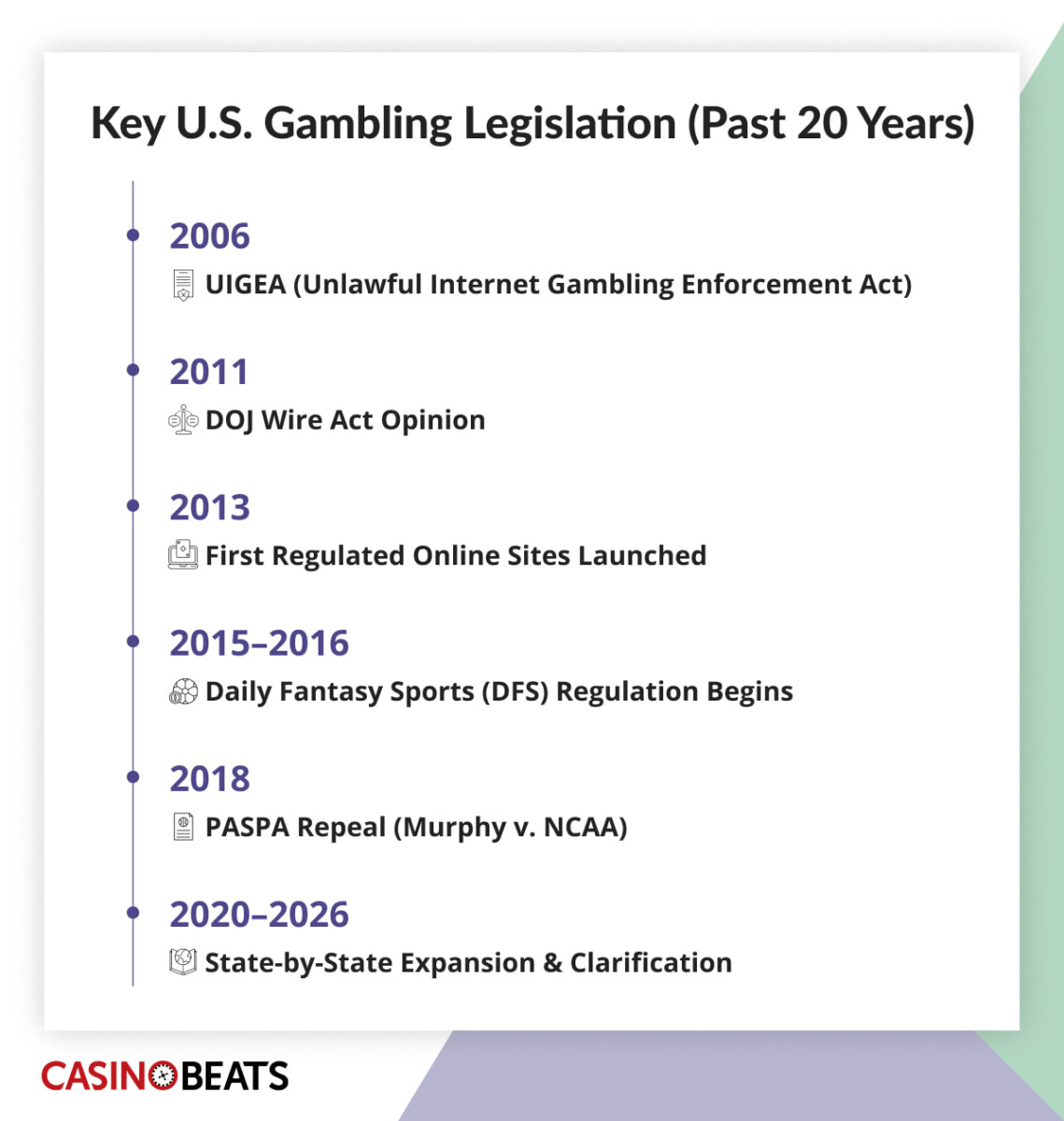
2006: UIGEA (Unlawful Internet Gambling Enforcement Act)
It prohibited U.S. banks and financial institutions from processing transactions tied to unlawful online gambling. It did not itself make the act of gambling online illegal, but the UIGEA effectively cut off payment channels for unregulated sites.
2011: DOJ Wire Act Opinion
The Department of Justice enforced a reinterpretation of the 1961 Wire Act, ruling that it applied only to sports betting. This opened the door for states to regulate online poker, lottery, and casino games. This opinion was subsequently reversed in 2018 (only 6 months after PASPA was overturned), with the DOJ now declaring interstate lotteries, gaming companies, and other gambling-related businesses illegal.
2013: First Regulated Online Sites Launched
Delaware and New Jersey launched the first state-regulated online casino sites, while Nevada legalized only online poker. This set the precedent for state-level licensing and regulation.
2015–2016: Daily Fantasy Sports (DFS) Regulation Begins
After legal challenges in states like New York, legislatures began passing specific laws to regulate DFS as a game of skill. By 2019, more than 20 states had adopted DFS legislation, laying the groundwork for broader online betting.
2018: PASPA Repeal (Murphy v. NCAA)
The U.S. Supreme Court struck down the Professional and Amateur Sports Protection Act (PASPA), allowing states to legalize and regulate sports betting. This decision triggered the rapid expansion of both sports betting and broader iGaming discussions.
2020–2026: State-by-State Expansion & Clarification
There is a growing acceptance of iGaming, daily fantasy sports (DFS), and sweepstakes-style casinos. Several states have increased gambling taxes, expanded responsible gaming measures, or restricted sweepstakes casinos that simulate online slot machines.
The Bottom Line
Online casino legislation in the U.S. is still a patchwork of progress, politics, and patience. While seven states have fully embraced iGaming, most continue to move cautiously — testing the waters with sports betting or tribal exclusivity before expanding further.
However, the conversation surrounding the legality of online casinos continues as part of the national dialogue on tax revenue, player protection, and digital innovation.
FAQs
-
Which U.S. states currently allow online casinos?
As of 2026, eight states in the USA with legal gambling are New Jersey, Delaware, Pennsylvania, Michigan, Connecticut, West Virginia, Rhode Island, and Maine.
-
How do gambling laws differ by state?
Each state sets its own rules. Some allow full-scale land-based and online casinos, while others restrict gambling to tribal facilities, lotteries, or charitable gaming.
-
What states still ban all forms of gambling?
The states of Utah and Hawaii ban casinos, lotteries, and online gambling. Utah prohibits gambling under its constitution, while Hawaii has rejected repeated legalization attempts.
-
How often do state gambling laws change?
Legislation can change every year, depending on the prevailing political climate. While most bills stall in committee, several states actively consider online casino proposals during each session.
-
Where is sports betting legal in the USA?
More than 35 states and Washington, D.C., have legalized sports betting in some form. Availability varies by state; not all jurisdictions allow online or mobile betting.
References
- Opinion | Alabama determined to stay in the past when it comes to gambling (Alabama Political Reporter)
- Bill introduced to legalize sports betting in Alaska (CBS Sports)
- Hawaii Senate Bill 1507 (Legiscan)
- Bill Status of SB19634 (Illinois State Legislature)
- 104TH GENERAL ASSEMBLY State of Illinois 2025 and 2026 HB3080 (Illinois State Legislature)
- Home (Indiana Gaming Commission)
- Louisiana Gaming Control Board (Louisiana Gaming Control Board)
- Bill Text: MD HB17 | 2025 | Regular Session | Introduced Maryland House Bill 17 (Legiscan)
- Bill H.4431 (Massachusetts State Legislature)
- Michigan Gaming Control Board authorizes online gaming, sports betting to begin Jan. 22 (Michigan State Government)
- SB 168 (FastDemocracy)
- Market Overview (American Gaming)
- https://capitol.texas.gov/tlodocs/89R/billtext/pdf/HJ00137I.pdf
- A JOINT RESOLUTION No.134 (Texas State Government)
- hA JOINT RESOLUTION No.137 (Texas State Government)
- Public Law 87-216 (GovInfo)
- WHETHER PROPOSALS BY ILLINOIS AND NEW YORK TO USE THE INTERNET AND OUT-OF-STATE TRANSACTION PROCESSORS TO SELL LOTTERY TICKETS TO IN-STATE ADULTS VIOLATE THE WIRE ACT (United States Department of Justice)
- New Jersey Allows Online Gambling Tied to Its Casinos (New York Times)
- Daily Fantasy Sports: Industry Trends, Legal and Regulatory Issues, and Policy Options (United State Congress)
- OCTOBER TERM, 2017 (United States Supreme Court)
- Legal Developments in the Gaming Industry: First Half of 2025 (Wilmer Hale)