


Google quietly amended its advertising policies on October 28 and no longer classifies sweepstakes casinos under the “social casino games” category. The move brings the already scrutinized model under stricter online gambling regulation
The change, published on the company’s official Gambling and Games Advertising Policy page, was short, but significant:
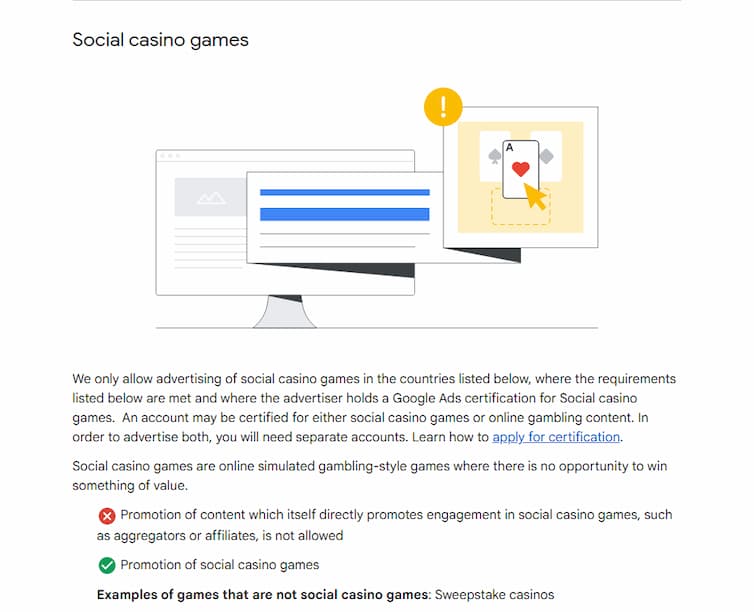
“Examples of games that are not social casino games: Sweepstake casinos.”
The single line effectively closes a loophole. Sweepstakes casinos will no longer be able to advertise as social casino platforms on Google, as ads are permitted only for games that resemble casino play but do not involve monetary prizes.
How Google Defines the Difference
Google describes social-casino titles as: “Online simulated gambling games (e.g., poker, slots, roulette, or blackjack) where there is no opportunity to win real money or prizes based on the outcome of the game.”
The company adds that it supports “responsible gambling advertising and require[s] that advertisers abide by local gambling laws and industry standards.”
By excluding sweepstakes casinos from the social casino game category, Google is formally aligning them with its online gambling category.
Its gambling definition includes another short but significant update. Under online gambling examples, Google lists:
“Online casinos or bookmakers, online bingo or slots sites or apps, online lottery ticket or online scratch card purchase, online sports betting, online gambling games played with virtual currencies or items that have real-world value.”
Google also states that advertisers “must comply with the local laws for any area that their ads target.”
These lines clearly state that any operator offering prizes of real-world value, including offering games with virtual currencies, falls under the same advertising restrictions as licensed gambling companies, such as FanDuel and DraftKings.
Certification Requirements: Who Qualifies
Google’s social casino games certification rules outline what advertisers must do to be eligible—and why sweepstakes operators may no longer qualify. The policy states:
“In order to receive and retain Google Ads certification, you must comply with the requirements below:
- Games must include a disclaimer that they are only intended for users over [the] legal gambling age and must not target minors.
- The advertiser must hold a valid local license for [the] distribution of their games in the targeted country, where applicable.
- Games must include statements that they aren’t offering or promoting real money gambling and are not providing prizes of real-world value.
- The advertiser must disclose on the landing page or ad if a game includes in-app purchases.
- Ads, sites, or apps must not use logos, names, or marks associated with real-money gambling brands.”
Those conditions effectively disqualify sweepstakes casinos. Their model contradicts Google’s requirement that social-casino games “are not providing prizes of real-world value.”
The policy could have a significant effect on suppliers and developers. Content providers offering software for regulated gambling platforms will no longer be able to market themselves under the “social casino” umbrella without violating Google’s certification standards.
That means more companies could follow Pragmatic Play, which recently withdrew its content from US sweepstakes casinos. One could be global giant Evolution. During its Q3 earnings call, CEO Martin Carlesund said the company will continue offering sweepstakes casino products only where there are “no regulatory problems or any legal problems.”
How Sweepstakes Casinos Operate
Sweepstakes casinos operate under federal sweepstakes laws using a dual-currency system. One currency, often referred to as “Gold Coins,” has no intrinsic value and is used solely for entertainment purposes. The other, usually labeled as “Sweeps Coins,” is redeemable for cash prizes, but players cannot purchase it.
The platforms typically offer a small amount of Sweeps Coins for free through various promotions (e.g., daily login bonuses). However, users can buy Gold Coin packages, with most awarding them Sweeps Coins as a “bonus”.
The industry has long argued that the platforms are not a form of gambling because purchases are optional. It also argues that no “bet” is technically placed. However, as users can redeem prizes for cash prizes, many regulators and lawmakers view the format as equivalent to gambling. Now, Google thinks the same.
By redefining the boundaries of its advertising categories, Google has clarified the placement of these operators. They will no longer be able to promote themselves through the social casino ad certification.
What the Change Means for Users & Operators
For users, the update will reduce the visibility of sweepstakes casino advertisements across the company’s networks, such as Google Search and YouTube. Promotions once framed as “free social games” could disappear or require age-gating and clear gambling disclosures.
For operators, the implications are more significant. To continue advertising, sweepstakes casinos would need to meet the eligibility standards for online gambling certification. That includes holding the appropriate licenses and ensuring compliance in each targeted jurisdiction.
Furthermore, Google’s Online gambling and games section states that online gambling operators must “have a landing page that displays information about responsible gambling and never target minors.”
For many sweepstakes-casino operators—most of which lack gambling licenses—meeting those conditions will be impossible. That effectively bars them from Google’s ad inventory.
Growing Regulatory Pressure
The change comes as the sweepstakes casino industry faces a growing regulatory scrutiny, along with a wave of legal challenges.
Recently, California banned dual-currency sweepstakes casinos, becoming the sixth state to do so this year. Meanwhile, several other states, such as Delaware, Louisiana, and West Virginia, have chased dozens of operators out through regulatory enforcement notices.
At the same time, over 80 class-action lawsuits have been filed against sweepstakes-casino operators nationwide. Two recent lawsuits also name rapper Drake, who promotes Stake.us.
These developments highlight a growing alignment between public policymakers and private-sector platforms, such as Google.
Both are moving to categorize sweepstakes casinos not as “free-play” entertainment but as unlicensed gambling.
A Defining Moment for the Sector
A key phrase in Google’s policy – “where there is no opportunity to win something of value” – draws a line between sweepstakes casinos and social gaming. By explicitly adding the controversial model as an excluded example, Google has significantly reduced the ambiguity in its classification, aligning with the growing regulatory sentiment.
The update also reflects a shift in the perception of digital value. Google now views virtual currencies as having real-world value rather than a harmless game mechanic.
Beyond losing access to Google ads, sweepstakes casinos now face uncertainty with suppliers, some of whom may sever ties to avoid advertising risk.
In plain terms, Google’s latest policy formally distinguishes entertainment from gambling. In doing so, it helps close a significant gray area for sweepstakes casinos in the digital marketplace.